

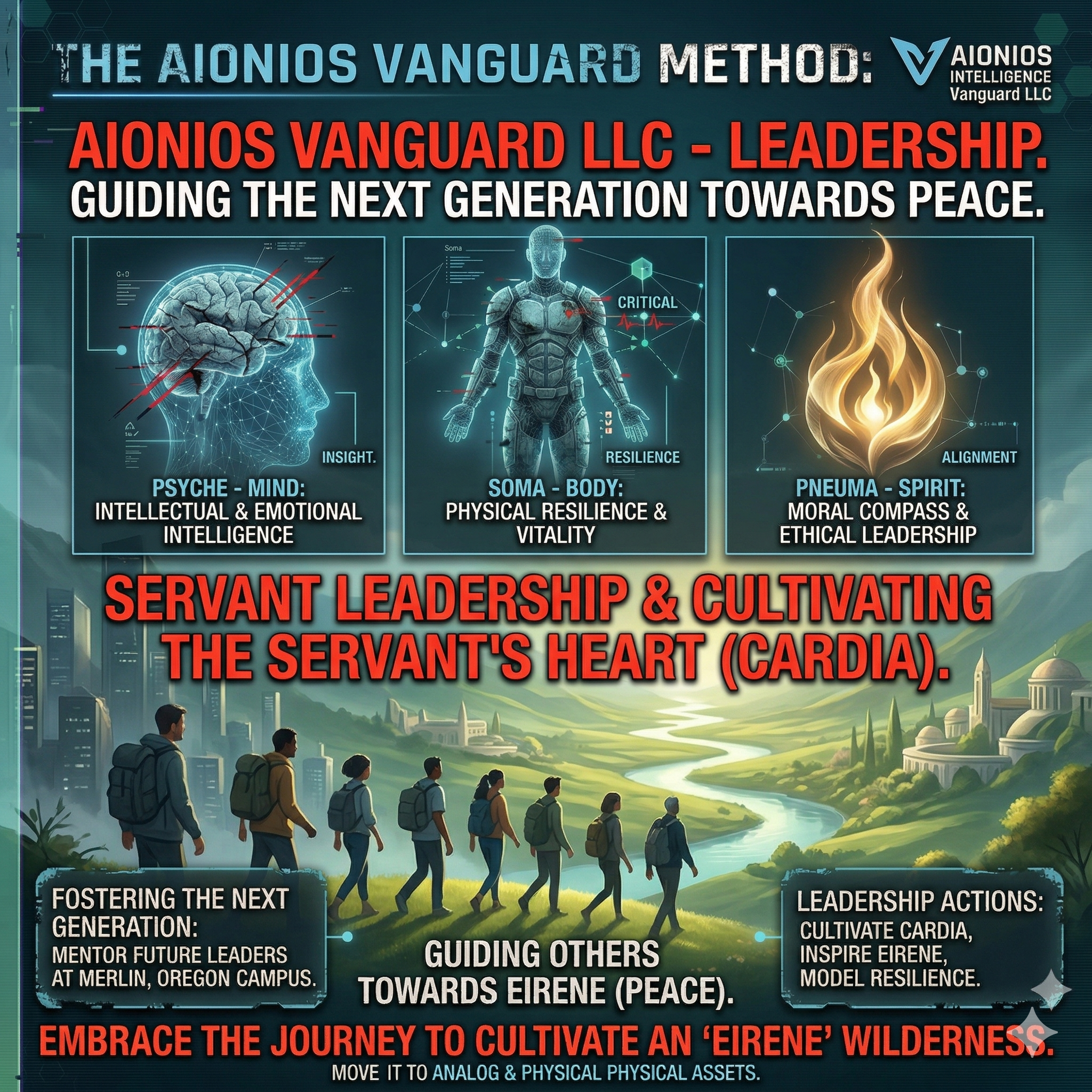
The Aionios Vanguard method offers a powerful visual guide into the world of leadership. This approach involves a deep dive into the psyche (mind), soma (body), and pneuma (spirit) to help you achieve your absolute best. It emphasizes cultivating a servant's heart (cardia) to guide the next generation toward a wilderness of peace (Eirene).
The Architecture of Unbreakable Leadership: Synthesizing Ancient Koine Wisdom and Modern Neuroscience for Executive Resilience
In the contemporary C-suite, the executive is frequently besieged by a volatility that mimics primordial chaos—an entropy born of information saturation and relentless high-stakes decision-making. To lead in this climate requires more than mere psychological "grit"; it demands a structural ordering of the mind. This architecture begins with the Logos—the Divine Reason or blueprint that provides a structural logic to internal disorder—and is grounded in Aletheia, the "unveiled truth." By anchoring leadership in reality rather than curated perception, an executive transforms a chaotic environment into a coherent field of strategic action.
1. The Foundation: The Primacy of Logos and Aletheia
Resilience is frequently undermined by intellectual fragility, which typically stems from the self-deception of "filter bubbles." By practicing Aletheia as "Radical Honesty," a leader strips away the veil of cognitive bias. From a neuroscientific perspective, Aletheia is a strategy of biological efficiency. Maintaining a facade or "hiding" specific failures requires significant metabolic energy; the brain must actively suppress contradictory information. Radical Honesty reduces this cognitive load, freeing up glucose and oxygen for high-level problem solving. When you identify the limits of your understanding, you eliminate the underlying stress of "being found out."
This structural foundation allows the leader to move beyond mere survival toward Arete (excellence). The Logos acts as the command center, taking the raw data of the "unveiled truth" and organizing it into a stable, reasoned conviction.
The Logic of Resilience
Feature Chaos-Driven Reactivity Logos-Centered Response
Cognitive State Fragmented; reacting to high-entropy "noise" Ordered by a structural blueprint/Reason
Biological Cost High metabolic drain due to self-deception High efficiency via Aletheia (Honesty)
Stability Fleeting, reactive, and emotionally volatile Stable, reasoned, and ontologically grounded
Outcome Fragility, burnout, and systemic collapse Arete (Excellence and sustained strength)
--------------------------------------------------------------------------------
2. The Transformative Mindset: Metanoia and the Growth Architecture
The capacity for resilience depends on neuroplasticity—the neurological substrate of Metanoia. This is not a superficial shift in strategy but a fundamental transformation of the "heart and mind" (kardia and nous). Through Metanoia, a leader reframes obstacles not as threats to their status, but as Paideia—the rigorous "gymnastics" or discipline required for growth.
By adopting a "Growth Mindset," leaders re-evaluate the nature of effort through the lens of Hypomone. Translated as "heroic endurance," Hypomone is the ability to remain under a heavy load without breaking. Neuroscience suggests that valuing persistence over raw talent reinforces the neural pathways associated with resilience. This shift ensures that effort is viewed as character-building "staying power" rather than a sign of innate deficiency.
Key Metanoia Shifts for Leaders:
1. Reframe Challenges: Transition from seeing a task as a threat to viewing it as a "Puzzle" or an opportunity for Paideia.
2. Value Persistence: Applaud Hypomone—the capacity to endure the weight of the role—recognizing that the pressure itself produces the required character.
3. Constructive Criticism: Treat feedback as Aletheia (informative data) rather than a personal attack, shifting from a defensive posture to an analytical one.
The shift in Metanoia is the spark, but Sophrosyne is the furnace that sustains the flame of leadership.
--------------------------------------------------------------------------------
3. The Emotional Engine: Sophrosyne and the Neuroscience of EQ
In the Koine tradition, Emotional Intelligence is expressed as Sophrosyne—a state of healthy-mindedness and self-control. It is the strategic counterbalance to "Amygdala Hijack," where the limbic system’s stress response overrides the prefrontal cortex.
Neuroscience demonstrates that when Pathos (intense suffering or emotion) threatens to overwhelm the leader, the "Uttered Word" (the small Logos) restores equilibrium. Naming an emotion—the act of symbolic processing—activates the ventrolateral prefrontal cortex, which inhibits the amygdala and calms the brain's stress center. This is the virtue of Praotes, or "Power Under Control." It allows a leader to remain focused and precise even when internal or external environments are in a state of "uproar."
To re-engage the logical "Sage" brain and silence internal "Saboteurs," perform PQ Reps. Engage in a 10-second burst of intense focus on a physical sensation—the texture of a pen or the rise of the breath. This sensory grounding quiets the limbic noise and facilitates a return to Sophrosyne.
Emotional balance provides the cognitive clarity necessary for tactical, high-stakes decision-making.
--------------------------------------------------------------------------------
4. Tactical Application: Phronesis and the Mastery of Kairos
Executive intelligence must be refined into Phronesis, or "Practical Wisdom." While Chronos refers to the linear, ticking clock, the resilient leader masters Kairos—the "opportune moment." Identifying the Kairos is a matter of energy conservation. By discarding Kenos (empty or vain) thoughts—such as catastrophizing or "striving after wind" (Hebel)—the leader prevents the dissipation of mental energy. This conservation is vital; the brain requires that "battery" to execute decisive action when the window of opportunity opens.
Koine-Infused SMART Goal Checklist:
* [ ] Specific (Segments): Break overwhelming chaos into tiny, manageable segments.
* [ ] Measurable (Trackable): Ensure progress is visible to ground the mind in Aletheia.
* [ ] Achievable (Dopamine): Focus on "Small Wins" to trigger dopamine release, reinforcing the Gnosis of your own capability.
* [ ] Relevant (Logos-Aligned): Ensure every action aligns with the structural blueprint (the Logos).
* [ ] Time-bound (Kairos): Set the window for action to maximize impact and minimize energy waste.
Achieving these goals builds Gnosis—experiential knowledge of resilience—yet even the sharpest mind requires a sustainable physical vessel.
--------------------------------------------------------------------------------
5. The Biological Vessel: Soma as the Naos (Temple)
The Soma (Body) is the physical incarnation of resilience; it is the "hardware" upon which the "software" of the mind runs. It functions as a Naos (Sanctuary) that must be meticulously maintained. A neglected vessel leads to cortisol dysregulation, which dims the "Light of the Mind."
Resilience requires Askesis—the athletic training of the executive. To maintain the Naos, three pillars are non-negotiable:
* Prioritize Sleep: Sleep is the primary mechanism for emotional regulation and glymphatic clearance of metabolic waste.
* Physical Movement: Exercise trains the Soma to handle Kinesis (purposeful movement) under stress, essentially "stress-testing" the nervous system.
* Anapausis: This is not idleness, but "Restorative Unplugging." It is a tactical retreat that allows the system to recharge for the next engagement.
Somatic Check-in Exercise Close your eyes and scan your Soma. Identify where you are "holding" intellectual stress—the jaw, the shoulders, the solar plexus. Acknowledge this tension as a signal that the Naos requires maintenance. The Soma incarnates the resilience of the Logos; treat it with the Askesis it deserves.
Maintaining the vessel prepares the leader for the final layer of resilience: the vital force that powers the entire system.
--------------------------------------------------------------------------------
6. The Vital Force: Pneuma and the Energy of Agape
The Pneuma (Spirit/Breath) is the "Vital Force" of the resilience architecture. It provides the Dunamis (Inherent Power)—a "second wind" or cognitive inspiration that sustains the leader when the biological "Flesh" is spent.
The "Glue" of this intelligence is Agape (Selfless Love). When leadership is fueled by Agape, the intelligence shifts from "Ego-Threat" to "Service." This transition is a psychological shield; a setback is no longer a blow to your pride, but a temporary obstacle in your mission to serve others. This fosters "Compassionate Inquiry," removing the fear of failure. Furthermore, the leader must exercise the "Discernment of Spirit"—distinguishing between life-giving strategic ideas and Hebel (the Hebrew concept of "vanity" or "breath" surfacing in the Greek context as "striving after wind").
--------------------------------------------------------------------------------
7. Conclusion: The Integrated Fortress of the Mind
The resilient leader does not merely react to volatility; they respond from an integrated fortress where the mind, spirit, and body operate in harmony. The Logos is the "Great Integrator"—it is the governing force that channels the Pneuma, governs the Soma, and ensures Sophia is applied with precision.
The Completed Bedrock of Resilience:
1. Logos (The Blueprint): Directive: Establish the structural logic of your organization and your mind.
2. Aletheia (The Foundation): Directive: Use radical honesty to reduce metabolic waste and ground yourself in truth.
3. Sophia (The Structure): Directive: Maintain a transcendent, "big picture" view to prevent cognitive shattering.
4. Gnosis (The Proven Strength): Directive: Trust the experiential knowledge gained from past survival.
5. Agape (The Intentionality): Directive: Fuel your intelligence with service to remove the paralyzing fear of ego-failure.
6. Pneuma (The Energy): Directive: Access your "second wind" by aligning with your core vital purpose.
7. Soma (The Manifestation): Directive: Train your physical vessel to incarnate the strength of your convictions.
Final Logos-Statement Exercise: Formulate a personal "Creed"—a two-sentence summary of your structural logic. Recite this "Small Logos" during times of crisis to command your biology and spirit to align with the Truth of your resilience.
Aspasmos!
