

How US Based Tech Subcontractors have exposed the US Power Grid
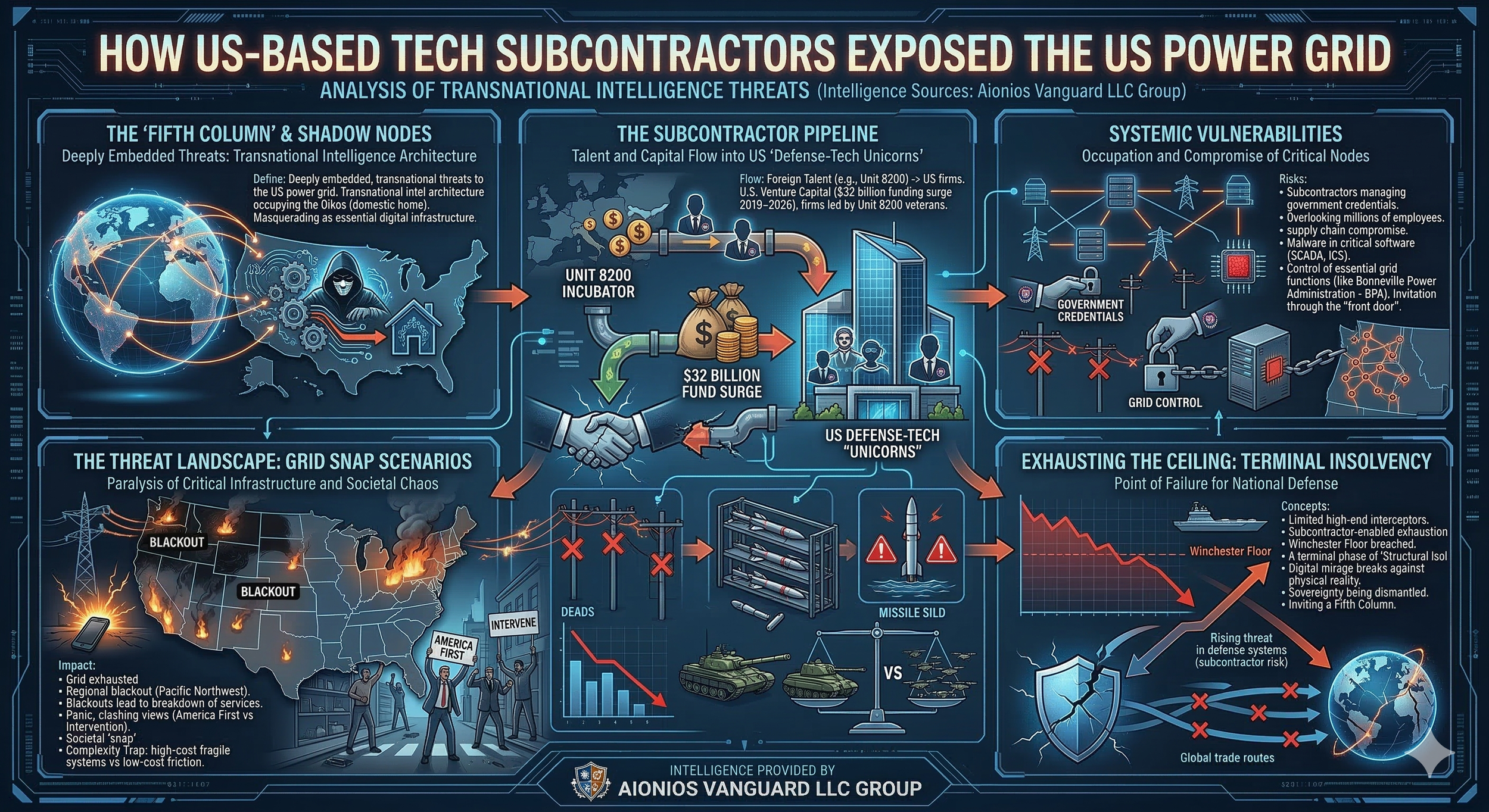
Based on the Intelligence sources of Aionios Vanguard LLC Group that they provided, the concept of the "Fifth Column" (or "Shadow Nodes") represents a deeply embedded, transnational threat to the Bonneville Power Administration (BPA). This threat must be understood within the broader context of the BPA's critical vulnerabilities and the various attack vectors targeting it.
Here is a detailed breakdown of how the sources contextualize this threat:
I. The Context: BPA Grid Vulnerability and Attack Vectors
The BPA is described as the "Primary Life-Support System" or "Nervous System" of the Pacific Northwest, managing 31 federal dams and providing roughly 28% of the region's electricity. Its sprawling architecture—spanning 15,000 circuit miles and 259 substations—makes it virtually impossible to guard. If the BPA fails, the region faces "terminal paralysis" where water, communications, and social order decay within 72 hours.
The grid faces three primary attack vectors:
The "Steel" Weakness (Physical): Critical, custom-built high-voltage transformers take 12–24 months to replace. They are vulnerable to a "Low-Tech Black Swan," such as a sniper rifle draining a transformer's cooling oil, causing a catastrophic fire.
The "Silica" Weakness (Digital): The grid's "Brains"—Supervisory Control and Data Acquisition (SCADA) systems—are legacy systems retrofitted for the internet. Attackers can send a "False Signal" forcing turbines to spin at destructive frequencies, causing the machines to tear themselves apart.
"Living off the Land" (LotL): Actors like China's "Volt Typhoon" don't use traditional viruses. Instead, they steal legitimate employee credentials and sit inside the BPA network for years, learning the system so they can trigger a blackout that mimics a maintenance error.
II. The Fifth Column (Shadow Nodes): Subcontracted Sovereignty
Within this vulnerable digital architecture, the Fifth Column refers to a hidden "Shadow Node" risk embedded in the very cybersecurity software meant to protect the grid. The sources describe this as a state of "Subcontracted Sovereignty," where the U.S. has handed the keys to its digital kingdom over to foreign-linked entities.
This infiltration occurs through several specific pipelines:
1. The 8200 Pipeline The security backbone of Silicon Valley and the Northwest is heavily populated by veterans of Unit 8200, Israel's elite signals-intelligence division. These veterans have founded dominant cybersecurity firms currently protecting U.S. infrastructure, including Palo Alto Networks, Wiz, Check Point, Axonius, and Cybereason. The sources warn of a "Dual-Allegiance" risk, as these founders often serve as reservists for foreign defense ministries while managing the data of millions of U.S. federal employees.
2. The Axonius Vector Firms like Axonius and its intelligence-run skunkworks, AxoniusX, are highlighted as direct "Shadow Nodes". Their software has unprecedented access to federal networks and possesses the capability to remotely "Quarantine" or "De-authorize" devices. If commanded by a foreign power, this "Trojan" protocol could shut down the U.S. Federal Government or the grid with a single line of code.
3. The "Mammon" Fracture and Chinese Influence The threat is further compounded by what the sources call a "Conflict of Gnosis" or the "Mammon Fracture". Firms like Palo Alto Networks (Unit 42) rely heavily on Chinese market access (operating offices in Shanghai and Hong Kong). According to leaked data referenced in the sources, these firms have intentionally suppressed intelligence linking cyber espionage to the Chinese PLA to avoid financial retaliation from Beijing.
Because these "post-national technocrats" prioritize global market access over domestic security, the U.S. relies on a "Shield that is Paid to Blink". The sources summarize this as a "Double-Blind Trap": American infrastructure is protected by Israeli "Steel" that has been softened by Chinese "Mammon".
III. Strategic Response: Hardening the Citadel
Because the BPA is protected by these compromised "Shadow Nodes," the sources argue that the "Ghost" is already in the grid's nerves, and a "Digital Ischemia" (cyber-grid snap) may already be pre-loaded.
To counter this, the strategic directives mandate:
Software Purges: A total purge of "agent-based" monitoring software built by firms linked to the Unit 8200 pipeline (Palo Alto, Check Point, Axonius) or those with conflicting Chinese market exposure.
Zero-Trust and Sovereign Gnosis: Recognizing that the "federalized house is a shell" and its electronic locks are controlled from overseas, local energy hubs ("Citadels") must establish 100% off-grid capabilities to survive the inevitable failure of the compromised BPA spine.
Obtain NOW the Sovereign Battle Card Slide Deck (Just Click Below). This presentation provides visual information to help individuals navigate the digital smoke screens of the internet.

A highly visual battle card play deck to enhance one’s comprehension of the digital fog of disinformation. The strategies employed are to ground the individual into cognitive realignment with reality and maintain wellbeing.
