

The AV Podcast dives deep into the complex dynamics of the Cuban threat. While the Cuban regime desperately pleads with its puppet masters, urging them not to "turn us into a glass parking lot," those same masters hold the true ace up their sleeve, focusing their strategy on the harsh realities of economic attrition. You might be wondering, what can the average American actually do to help? There is plenty! Hit that play button and discover the actionable steps you can take today!
For those who enjoy reading. (Does anyone do this anymore?) AV gives the intelligence summary below.
Executive Summary
This briefing synthesizes intelligence regarding the emerging drone threat from Cuba and recent kinetic strikes in the Middle East. As of May 2026, the global security environment is characterized by "total global balkanization," where the "Architects"—a coalition comprising Russia, China, and Iran—are utilizing asymmetric warfare to overextend United States hegemony.
Key takeaways include:
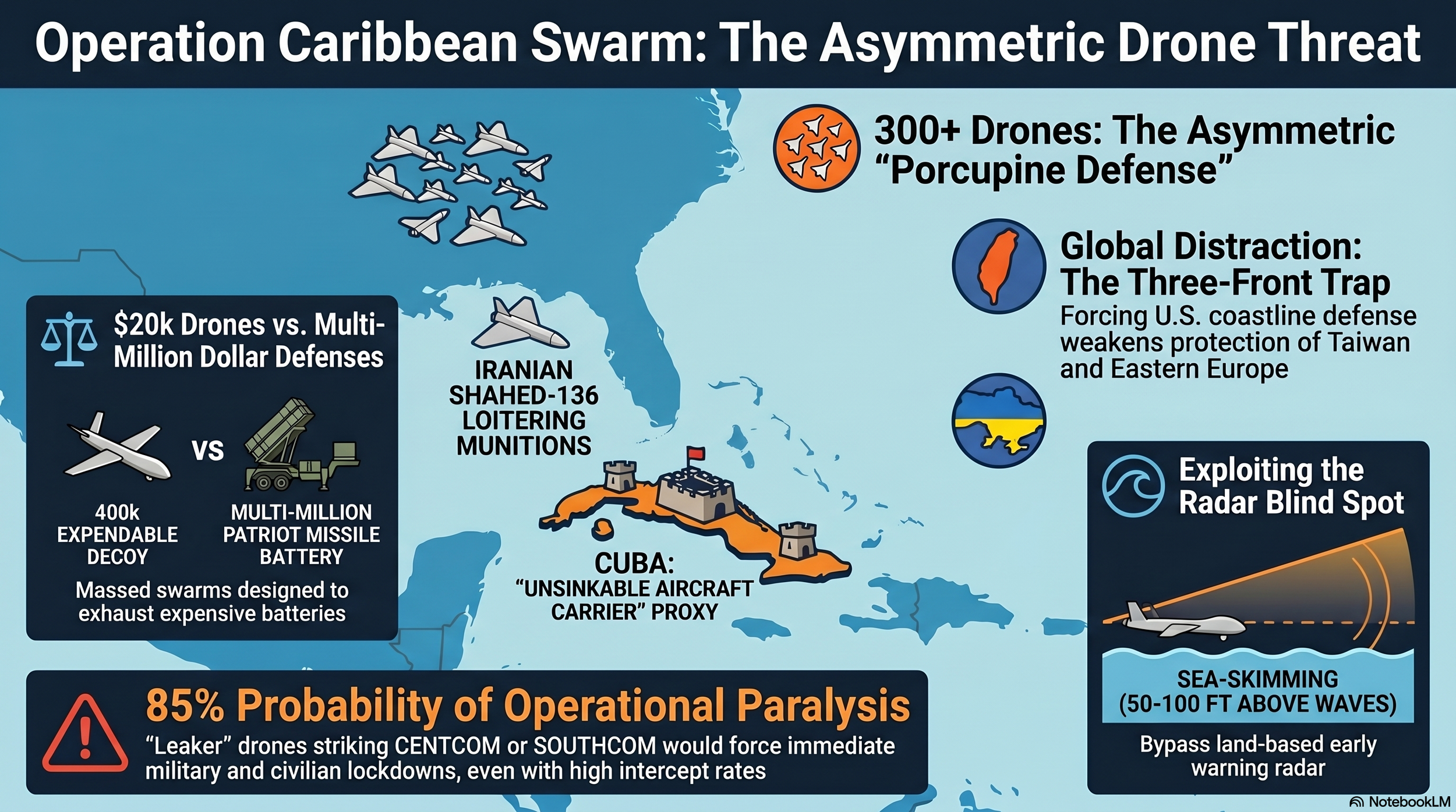
The Cuban Threat Matrix: While an unprovoked strike from Havana is strategically unlikely due to regime survival instincts, Cuba now possesses the hardware (300+ Russian/Iranian drones) and geographic proximity to serve as an "unsinkable aircraft carrier" for proxy attacks.
Tactical Modeling: A drone swarm targeting CENTCOM or SOUTHCOM assets in Florida is mathematically feasible. Success is measured not by total destruction but by achieving 100% geopolitical shockwave and operational paralysis.
Macro-Geopolitical Synthesis: The Caribbean tension is a direct retaliatory response to U.S.-supported telemetry strikes on Moscow and the U.S. ultimatum regarding Taiwan.
Middle East Escalation: The recent strike on the Barakah Nuclear Power Plant in the UAE represents a shift to "Asymmetric Economic Retaliation," targeting critical infrastructure to bypass traditional financial sanctions.
--------------------------------------------------------------------------------
I. Operation "Caribbean Swarm": The Cuban Threat Matrix
Hardware and Capability
Since 2023, Cuba has significantly modernized its asymmetric capabilities despite a failing conventional air force.
The Drone Arsenal: Cuba has acquired over 300 military drones from Russia and Iran.
Key Munitions: The arsenal primarily features the Shahed-136 loitering munition (range: 1,500+ miles) and the Shahed-238 (jet-powered variant).
Asymmetric Parity: Low-cost drones ($20,000 per unit) now function as the equivalent of multi-million-dollar cruise missiles, providing a "porcupine defense" for the island.
Geographic Proximity
The physical logistics of the threat create a narrow window for defense:
Key West, FL: 90 miles from Cuban shores.
SOUTHCOM (Doral, FL): ~230 miles.
CENTCOM (MacDill AFB, Tampa, FL): ~330 miles.
Guantanamo Bay (GTMO): Situated directly on the island, it is the most immediate target for a localized swarm.
Plausibility vs. Viability
Intelligence suggests a distinction between capability and intent:
Plausibility (High): Military wargaming and contingency planning for strikes on U.S. assets are actively occurring among Cuban brass.
Viability (Low/Imminent): An unprovoked strike is currently non-viable because the Cuban Communist Party prioritizes regime survival. A first strike would trigger fatal U.S. retaliation.
The Leak Context: The intelligence leak (via Axios, May 17, 2026) is viewed as a "justification matrix" by Washington to build public consent for increased pressure on Havana following a secret ultimatum delivered by CIA Director John Ratcliffe.
--------------------------------------------------------------------------------
II. Tactical Modeling: Operation "Florida Straits"
A kinetic strike originating from Cuba would likely utilize a multi-phase "sea-skimming" profile to exploit radar blind spots.
Phased Execution Model
Phase
Action
Objective
1: Cyber/EW
Russian SIGINT from Lourdes facility initiates GPS spoofing.
Blind South Florida air traffic control and military radar.
2: Saturation
Launch of 100–150 unarmed decoy drones.
Exhaust Patriot PAC-3 and NASAMS interceptor magazines.
3: Kinetic Kill
Armed Shaheds strike critical nodes (Comms, Data Centers).
Achieve operational paralysis of CENTCOM and SOUTHCOM.
Projected Success Percentages
Detection & Intercept Failure (20%–30%): Even an 80% intercept rate allows 60 drones to impact targets.
Operational Paralysis (85%): Forcing military leadership into bunkers and grounding all civilian air traffic in the Southeastern U.S.
Geopolitical Shockwave (100%): Triggering algorithmic panic in bond and equity markets and accelerating domestic "timeline infarction."
--------------------------------------------------------------------------------
III. Macro-Geopolitical Synthesis: The "Architect's" Motives
The Cuban threat is not an isolated event but a retaliatory countermeasure coordinated by Russia, China, and Iran.
1. The Moscow Trigger (Proportional Asymmetry)
Following a strike on Moscow that forced Russian leadership into bunkers, the Kremlin identifies U.S./NATO telemetry as the enabling force for Ukrainian precision. In response, Russia uses Cuba to position telemetry-guided threats 90 miles from the U.S. coastline.
2. The Taiwan Ultimatum (Active Defense)
China aims to divide the U.S. Pacific Fleet. By facilitating a drone threat in the Caribbean, Beijing forces the U.S. to choose between defending its own coastline and maintaining a posture in the Taiwan Strait.
3. The Proxy Sacrifice
For the BRICS coalition, Cuba is a "geopolitical suicide vest." The Architects anticipate that a U.S. retaliation would:
Exhaust U.S. munitions and financial capital.
Isolate Washington diplomatically as it bombs an impoverished neighbor.
Create a window for Russia and China to move decisively in Eastern Europe and the Indo-Pacific.
--------------------------------------------------------------------------------
IV. Operation "Meltdown Mirage": Middle East Kinetic Retaliation
A strike on the Barakah Nuclear Power Plant in the UAE (May 17, 2026) serves as the physical manifestation of the Architect’s strategy of "Asymmetric Economic Retaliation."
Battle Damage Assessment (BDA)
Target: External cooling infrastructure, administrative annexes, and high-voltage electrical switchyards.
Containment Status: Reactor cores remained unbreached to avoid a regional radioactive plume and direct nuclear escalation.
Immediate Impact: A massive transformer oil fire forced an emergency shutdown (SCRAM) of all reactors, instantly deleting 25% of the UAE’s electrical generation capacity.
Strategic Calculus
This strike is a direct response to financial warfare (SWIFT exclusion, oil seizures) and the UAE's kinetic strike on Lavan Island. It demonstrates that $20,000 drones can physically "turn off" the electricity powering a centralized financial empire, bypassing the need for a conventional naval engagement.
--------------------------------------------------------------------------------
V. Strategic Implications for National Security
The convergence of these threats signals a transition from shadow wars to a single, kinetic flashpoint.
Domestic Impacts
A kinetic engagement in the Caribbean or a decapitation strike by proxy on CENTCOM would lead to:
The Defense Production Act (DPA): Immediate seizure of domestic refining capacity.
Logistics Freeze: Executive orders restricting civilian diesel and aviation fuel to prioritize military airlift operations.
Infrastructure Vulnerability: The strike on Barakah highlights that highly centralized power grids—whether nuclear or conventional—are fatal vulnerabilities in the face of attritional drone warfare.
Conclusion
The global macro-system is "mathematically cornered." The U.S. is facing a three-front conflict (Ukraine, Taiwan, Middle East) being driven toward its own coastline. In this environment, decentralized resilience is the only effective countermeasure against the Architect's strategy of stretching U.S. hegemony to its breaking point.
