

Image by Aionios Vanguard LLC. All Rights Reserved
1. Macro-Analysis of Middle-Distillate Inventory Scarcity
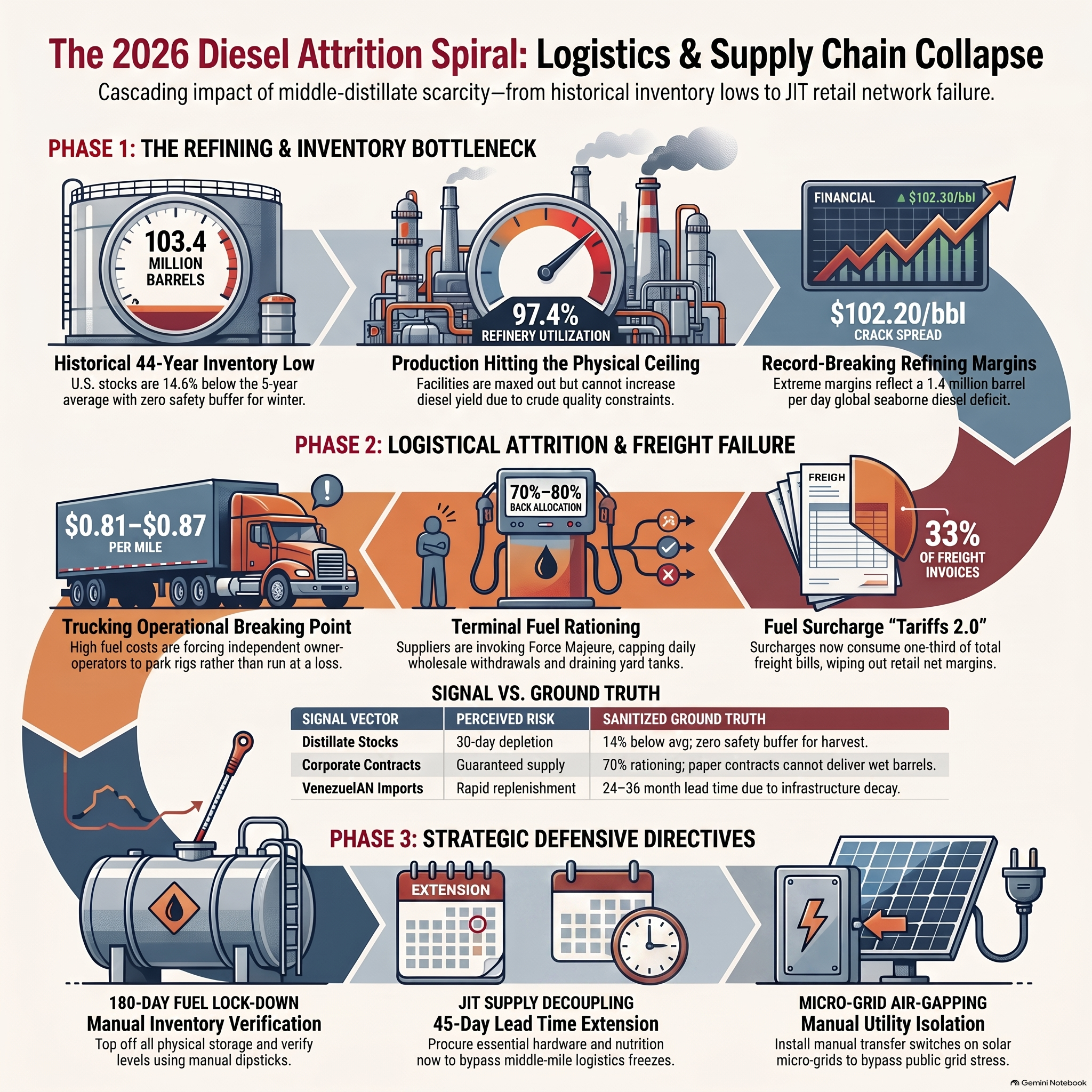
Middle-distillate inventories—primarily ultra-low sulfur diesel (ULSD) and heating oil—function as the kinetic pulse of global industrial civilization. These fuels power the Class 8 freight networks, maritime corridors, and agricultural machinery that sustain global commerce. The current depletion of these stocks represents a systemic "red-line" for the transportation sector, indicating that the buffer between operational stability and a terminal logistics breakdown has evaporated.Current telemetry from the Energy Information Administration (EIA) confirms a critical floor in U.S. distillate inventories at 103.4 million barrels . This figure is 14.6% below the five-year seasonal average, marking a 44-year seasonal low—the most precarious position since 1982. This vulnerability is most acute on the U.S. East Coast , where inventories have hit an all-time record seasonal low, leaving less than a 28-day cushion of gross consumption. This deficit is exacerbated by a 77% drop in Persian Gulf transit and the loss of ~1.4 million barrels per day (bpd) of seaborne diesel following 18 Ukrainian drone strikes on Russian refining infrastructure in August alone.Despite record-high incentives, the domestic refining sector is hitting a structural ceiling.Refining Operational Metrics| Metric | Current Value | Strategic Significance || ------ | ------ | ------ || Refinery Utilization Rate | 97.4% | Facilities are operating at a physical ceiling; no latent capacity remains. || Peak Crack Spreads | $102.20/bbl | All-time record margins confirm extreme global scarcity vs. production. || Net Distillate Output | 5.13M bpd | Output is insufficient to rebuild stocks despite maximum facility runs. |
This telemetry confirms a terminal refining ceiling. High utilization rates are failing to replenish inventories because crude feedstock constraints and global export drains have neutralized domestic gains. These macro-metrics provide a fragile foundation for downstream logistics, signaling an imminent transition from high prices to physical unavailability.
2. Operational Destabilization of the Freight Sector: "The Great Attrition"
The logistics landscape has entered a "non-linear middle-distillate scarcity crisis." This is no longer a simple inflationary event but a period of Structural Fleet Insolvency that fundamentally threatens the viability of both independent operators and institutional mega-fleets.The Economics of Attrition (Independent Haulers) We are witnessing a "Capacity Exit" of unprecedented scale among owner-operators. With fuel costs surging to $0.81–$ 0.87 per mile , small carriers have moved from "parking rigs" as a choice to parking them as a necessity for survival. A primary "canary in the coal mine" for this collapse is the rise of Incremental Fueling : drivers are now purchasing diesel in 50-gallon increments rather than full 150-gallon fills to preserve daily cash flow. As spot-market fuel surcharges fail to keep pace with pump spikes, these operators are finding they "go broke slower sitting still" than by hauling freight at a loss.Institutional Failure (Mega-Fleets) Mega-fleets like Amazon and Walmart, despite their massive purchasing power, are discovering that corporate capital cannot manifest physical "wet barrels" when terminals are dry.
Terminal Rack Allocation: Suppliers are now enforcing strict daily withdrawal caps of 70%–80% of historical baselines. The invocation of Force Majeure at regional hubs (e.g., Kinder Morgan, Colonial hubs) allows suppliers to bypass annual contracts, effectively rationing physical supply.
Private Yard Exhaustion: Bulk yard tanks at middle-mile hubs typically provide only a 48–72 hour buffer. Because the transport trucks that refill these tanks are subject to the same rack rationing, dedicated tractors are being grounded once local storage is depleted.Routing Guide Breakdown As contract carriers reject "primary tenders" due to margin erosion, freight is being forced into a volatile spot market. This collapse of the pre-negotiated routing guide breaks "Just-In-Time" (JIT) schedules and guarantees cascading delays at the retail level.
3. Cascading Retail and Cold-Chain Consequences
Fuel scarcity is now manifesting as "Tariffs 2.0"—a cost-push inflationary spiral where logistics fees consume the net profitability of the goods being moved.The "Tariffs 2.0" Surcharge Impact Fuel surcharges now consume 33% of the total freight bill for food and beverage producers. For vendors operating on thin net margins (1%–4%), these surcharges wipe out all profitability before a shipment reaches the shelf. This leads to immediate vendor insolvency and retail stockouts as producers cease shipments rather than incur losses.Cold-Chain and TRU Vulnerability Temperature-controlled logistics face an existential threat. Transport Refrigeration Units (TRUs) consume 0.4 to 1.0 gallons of diesel per hour independently of the tractor engine. As diesel is rationed, the cost of maintaining the "cold-chain" becomes prohibitive. This places both the food supply and vital pharmaceutical stocks at extreme risk of spoilage across middle-mile logistics networks.Agricultural Friction The convergence of this depletion with the autumn harvest creates a massive cost multiplier. Diesel at $5.65+/gallon adds thousands of dollars in input costs per farm, threatening sharp price spikes in basic food staples through Q4. These pressures are resistant to traditional logistics management because the bottleneck is physical, not financial.
4. Technical Deconstruction of Mitigation Narratives
Strategic resilience requires the application of the True Signal Value Heuristic ( $S_{true}$ ) to filter out "Synthetic Narrative Smoothing" ( $B_{synthetic}$ ) from physical reality ( $D_{physical}$ ), adjusted for driver sentiment ( $\delta_{human}$ ):$$S_{\text{true}} = \frac{\sum (W_i \cdot D_{\text{physical}}) + \delta_{\text{human}}}{1 + \ln(1 + B_{\text{synthetic}})}$$Refinery Metallurgy and Feedstock Constraints Political narratives suggesting that Venezuelan crude (Merey 16) can alleviate the deficit are technically unviable.Crude Comparison: Venezuelan Merey 16 vs. U.S. Refining Configuration
API Gravity: Merey 16 is $\le 16^\circ$ (Heavy) vs. U.S. Light Sweet configurations.
Sulfur Content: Merey 16 is >2.5% (Sour) vs. strict domestic desulfurization caps.
Refinery Bottleneck: U.S. coking and hydrocracking units capable of processing heavy-bottom crudes are already at 100% utilization; reconfiguring other plants requires years and massive CAPEX.
Infrastructure Lag: Decaying PDVSA infrastructure and shipping constraints enforce a 24-to-36-month lead time, providing zero relief for the current 30-to-60-day crisis window.The Asymmetric Cost Exchange We must account for the Asymmetric Cost Exchange Ratio ( $R_{exchange}$ ) , where low-cost disruptions (e.g., $500 drone strikes) trigger multi-billion-dollar domestic surcharges. This is further strained by the Interception Fatigue Rate ($ F_{defense}$):$$F_{\text{defense}} = \left( \frac{\sum_{i=1}^{n} M_{\text{incoming}, i}}{C_{\text{battery}} \cdot \Delta t_{\text{reload}}} \right) \cdot \left( 1 + \frac{\text{Cost}{\text{interceptor}}}{\text{Cost}{\text{threat}}} \right)$$This logic confirms that the global supply chain is suffering from operational fatigue that will only accelerate as diesel availability narrows.
5. Vanguard Strategic Directives for Resilience
For Aionios Vanguard LLC (Merlin Node) , the mandate is clear: Transition from JIT reliance to total off-grid self-reliance.Physical Resource Hardening
180-Day Distillate Lock-Down: Mandated top-off of all stabilized ULSD, propane, and gasoline storage. Verify liquid levels via manual dipsticks ; do not trust electronic sensors or paper contracts for "wet barrels."
JIT Supply Chain Decoupling: Immediately extend procurement lead times by 30–45 days for all technical hardware and replacement parts. Operate under the assumption that Amazon/Walmart middle-mile distribution will suffer 14-to-21 day stockout delays.
Cold-Chain Insulation: Transition the Merlin Node to 180-day non-perishable bulk nutrition to eliminate reliance on failing temperature-controlled logistics.
Utility Air-Gapping: Install manual transfer switches on Citadel solar micro-grids and generator units. Electrically and mechanically isolate these systems from public utility stress and energy surcharges.Intelligence and Watch Rotations Maintain 24/7 watch rotations within the mutual support cell. All public energy announcements must be processed through the $S_{true}$ filter to strip away political smoothing and reveal the true state of refinery coker utilization and terminal levels.Final Assessment The convergence of 44-year inventory lows, "The Great Attrition" of carriers, and structural refining caps indicates a period of profound logistics failure. Maintaining sovereign operational capacity—independent of corporate and public networks—is the only path to survival during the projected 30-to-60-day acceleration of supply chain collapse. Stand sovereign.
