

Image by Aionios Vanguard LLC - All Rights Reserved
1. Introduction: The Ghost of 20th-Century Might
For eighty years, the U.S. Carrier Strike Group (CSG) has been the gold standard of "unsinkable" sovereign power—a floating fortress capable of projecting democratic will onto any shore. But in 2026, that 20th-century hardware is facing a 21st-century firmware update for global chaos. The image of the carrier as an untouchable leviathan is dissolving into a high-tech standoff. Global supply chains and military projections are being fundamentally rewritten, not by superior fleets, but by the "Economic Inversion" of warfare. We are witnessing the hollowing out of conventional force projection as the "invincible" fleet votes with its hulls, retreating into the deep ocean.
2. The Orbital Inversion: Why Privacy is Dead at Sea
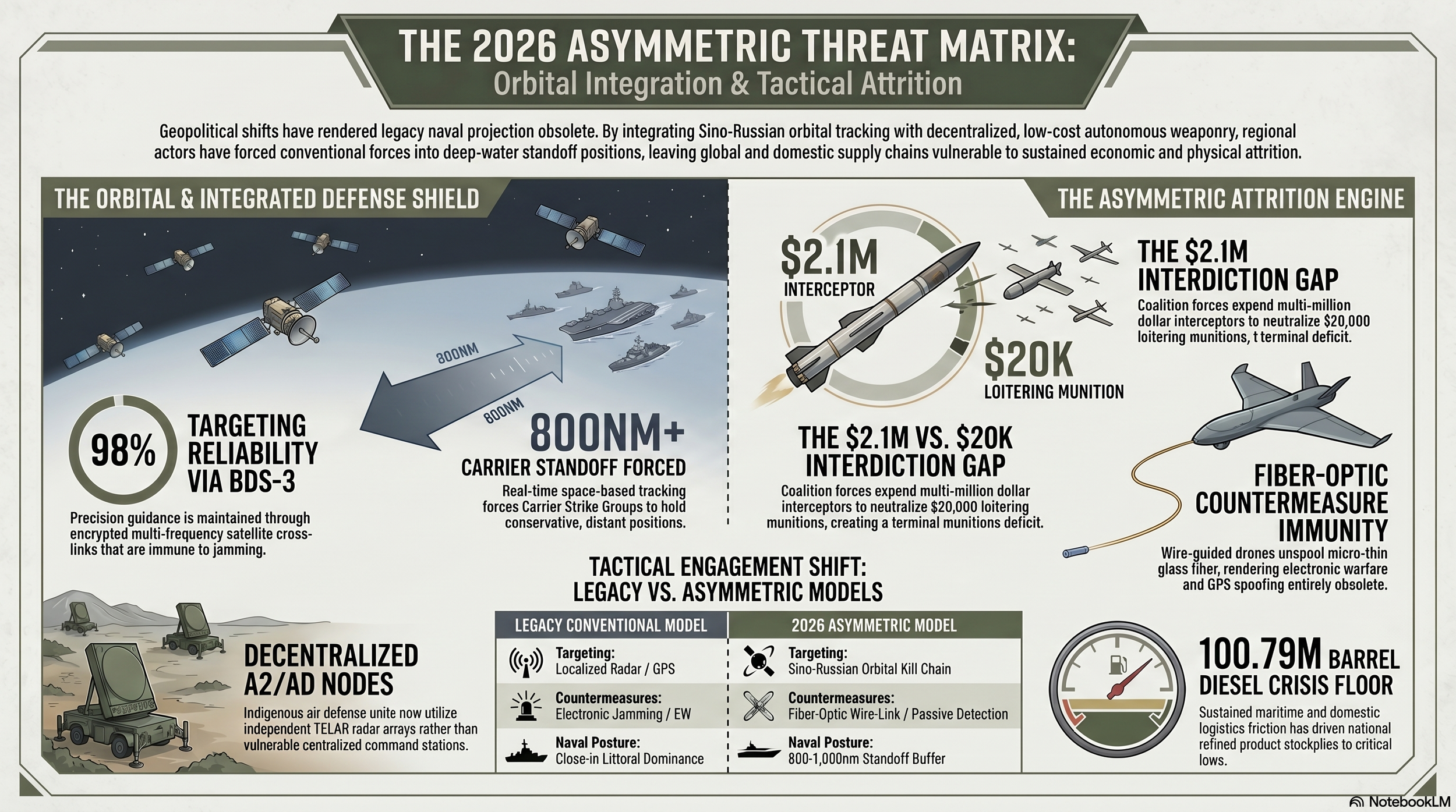
The traditional Western advantage of maritime stealth has been neutralized by a "Sino-Russian Orbital Kill Chain." The ocean is no longer a hiding place; it is a glass display case. The integration of the Chinese TEE-01B spy satellite—featuring sub-half-meter optical and radar resolution—with the Russian Khayyam platform and the Rezonans-NE Over-The-Horizon (OTH) radar network has turned the North Arabian Sea into a transparent theater.SIGNAL: The hunters have become the hunted. Because the CSGs are now visible in real-time, they are forced to maintain a conservative standoff distance of 800 to 1,000 nautical miles offshore, well beyond the Chah Bahar-Ras Al Hadd naval perimeter. NOISE: The belief that carriers can still operate "close-in" to enforce a blockade. In reality, this standoff causes a Sortie Generation Rate (SGR) collapse. Carrier air wings must fly extreme distances with massive aerial refueling support just to reach the chokepoints, leaving the littoral zones effectively undefended."Iranian weapons utilizing the military tier of the BeiDou (BDS-3) guidance shield—equipped with secured anti-jamming multi-frequency cross-links—maintain a positioning reliability rate of nearly 98%, rendering legacy electronic warfare defense models completely obsolete."
3. The Economic Inversion: The $2 Million Interceptor Crisis
The IRGC is not attempting to match the West ship-for-ship. Instead, they are executing an Asymmetric Saturation Surge , a "math of failure" designed to win through sheer economic disparity. The adversary utilizes a "mosquito fleet" of fast-attack craft and Shahed-series loitering munitions to target non-compliant commercial vessels, forcing coalition destroyers to play a losing hand.The Munitions Depletion Curve The math is brutal: a Shahed drone costs the IRGC roughly $20,000. To intercept it, a coalition destroyer must expend an SM-2 or SM-6 interceptor costing $2.1 million per shot. The Western manufacturing complex cannot replace these high-tier air defense vectors at the current theater burn rate. This creates a terminal deficit; in a prolonged conflict, coalition planners will be forced to ration their defensive capabilities, leaving gaps for the Bavar-373-II independent radar nodes to exploit.
4. The Fiber-Optic "Glitches": Drones That Can't Be Jammed
The most lethal tactical evolution is the rise of the "unspooling wire." Hezbollah and IRGC-backed cells have deployed fiber-optic guided FPV drones and Almas (Diamond) top-attack missiles—sophisticated assets reverse-engineered from Israeli Spike technology. Unlike radio-linked drones, these fly while unspooling a micro-thin glass fiber wire.This physical link renders traditional electronic warfare (EW), GPS spoofing, and the AN/FPS-132 early-warning radar arrays irrelevant. There is no radio signal to jam. These munitions attack from high-angle vertical trajectories, exploiting the physical blind spots of active defense systems like "Trophy." A $1,500 FPV drone can now disable a multi-million-dollar armored unit or commercial vessel by targeting engine racks or turret rings with high-definition precision."The theater has shifted to a 'Cellular Sieve' doctrine. By decentralizing command into autonomous hunter-killer cells and utilizing wire-guided munitions, the adversary has achieved total immunity to electromagnetic disruption, effectively trapping conventional armor in a pre-registered direct-fire box."
5. The Insurance Firewall: Closing the Strait Without Firing a Shot
The IRGC is employing a "Financial Vice" through a deliberate Stall-Bargaining Strategy . They have realized they don't need to sink ships to win; they only need to make the route uninsurable. By unsealing "Missile Cities" in the Zagros Mountains and visibly moving mobile Transporter-Erector-Launchers (TELs) along the coast, they create a psychological anchor for global markets.This isn't just posturing; it is a tactical offensive aimed at maritime underwriters like Lloyd's Joint War Committee. The mere visibility of these launch sites triggers the revocation of war-risk insurance. When a route becomes uninsurable, the global shipping fleet is effectively locked out, diverted around the Cape of Good Hope. This creates a "36-month asymmetric operational landscape" where the Strait of Hormuz is functionally closed behind an insurance firewall, regardless of kinetic engagement.
6. The Domestic Ripple: The 100-Million-Barrel "Floor"
The "Logistics Siege" in the Middle East has a direct domestic anchor. As energy traffic is diverted, U.S. diesel stockpiles have plummeted to a critical floor of 100.79 million barrels . With a national consumer savings rate of only 2.6% , the West is one "glitch" away from a systemic collapse.The Ribbon Infrastructure Vulnerability This logistics stranglehold isn't confined to the Persian Gulf. The same asymmetric tactics—low-cost drones and fiber-optic interdiction—can be applied to our "Ribbon Infrastructures." Major arteries like the I-5 and I-80 corridors, as well as critical transit bridges, are highly exposed. Modern economies run on "Just-In-Time" (JIT) freight with zero localized safety stocks. A disruption of only 48 to 72 hours along a major domestic ribbon corridor would trigger a cascading failure across the retail and agricultural sectors, turning "Anywhere, USA" into a supply-chain vacuum.
7. Conclusion: The Rise of the Sovereign Perimeter
The primary takeaway is clear: conventional force projection is hollowing out. We have entered a "new normal" characterized by fragmentation, industrial depletion, and the "Financial Vice." The global safety net, once guaranteed by the perceived invincibility of the fleet, is fracturing.As energy spot prices march toward $150 and the insurance firewall hardens, the only true defense is personal and systemic resilience. In an age where a $1,500 drone can blind a carrier and a $20,000 missile can trigger a global insurance crisis, "analog redundancy" is the only true shield. Localized food security, independent water networks, and standalone energy arrays are no longer for the fringe—they are the requirements for anyone intending to stand sovereign in a hollowing global infrastructure.The global order is undergoing a hard reboot. Is your perimeter ready for a 36-month blackout?
