

Image by Aionios Vanguard LLC - All Rights Reserved
Strategic Briefing: Global Supply Chain Breakdown and the May 2026 Political Changes
Executive Summary
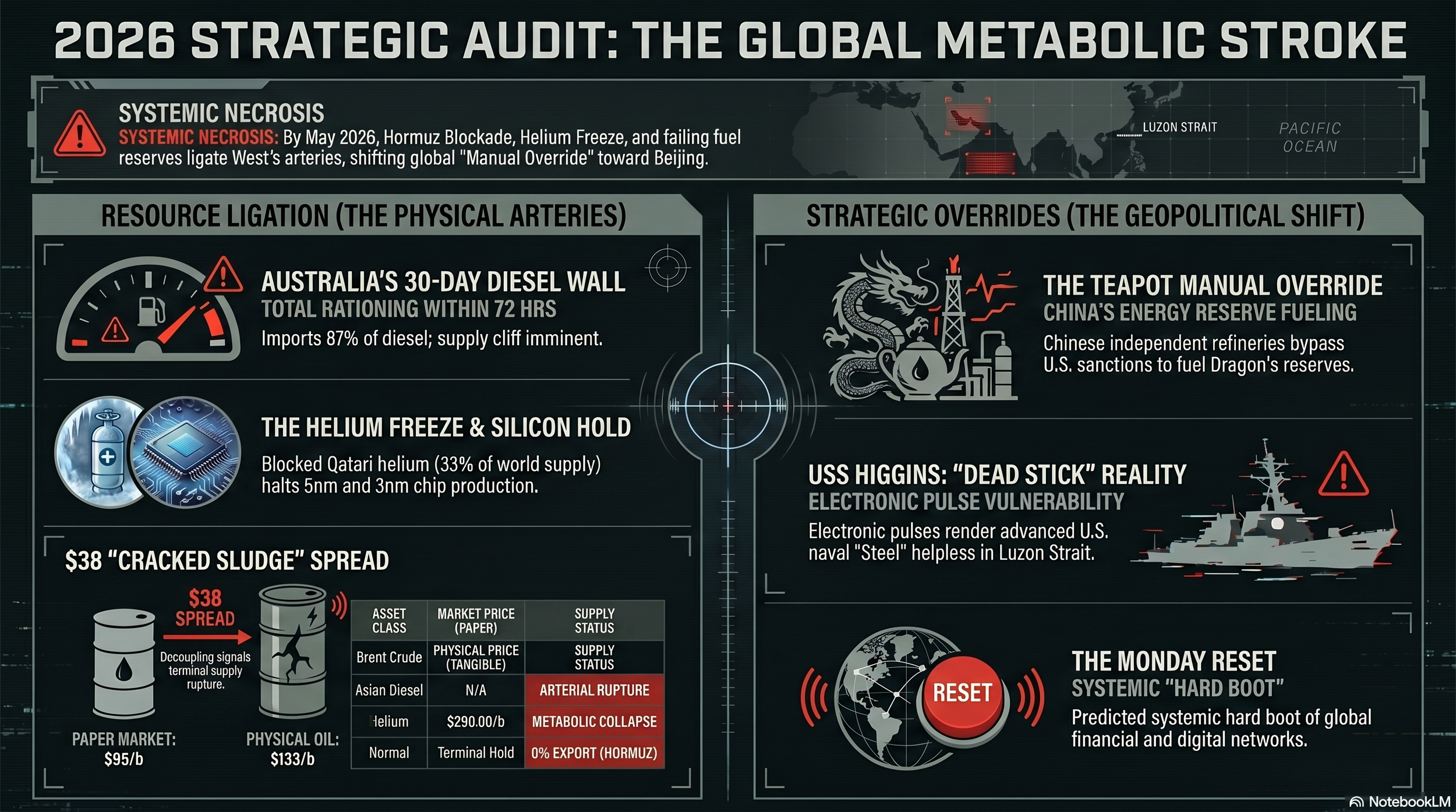
As of May 3, 2026, the world is facing a major crisis as global trade and shipping systems fail. The current "just-in-time" delivery model, where goods arrive exactly when needed, has stopped working. Key resources are being cut off. Current analysis shows several problems happening at once: Australia is about to run out of diesel fuel in 30 days; a shortage of helium has halted the production of advanced computer chips; and the U.S. government is preparing for military action in Cuba to cover its withdrawal from the Pacific region. The difference between the price of goods on the stock market and the actual cost to buy them has reached a breaking point, with physical oil costing much more than expected. While the public looks at the upcoming Beijing Summit as a normal meeting, it appears the U.S. will trade its influence in the Pacific for access to essential minerals from China.
I. Energy Security and the "Diesel Gasket"
The global energy supply is no longer working as one system. Instead, it is breaking into small protected areas while other regions are left with nothing.
Australia’s Vulnerability
Australia is the most extreme example of this instability.
Import Dependency: Australia is currently the world’s largest diesel importer, sourcing approximately 87% of its requirements from overseas.
The 30-Day Limit: As of early May 2026, diesel supplies have dropped to only 30 days. While officials say more tankers are coming, the system is very fragile and easily disrupted.
Rationing Risk: If even a small number of deliveries are stopped by a blockade, Australia will have to start limiting fuel use within three days.
China's Independent Refineries
China has found ways to ignore U.S. financial rules by using its own smaller, independent oil refineries.
Sanction Defiance: Beijing has ordered major refiners—including Hengli Petrochemical, Shandong Jincheng, and Hebei Xinhai—to ignore U.S. sanctions on Iranian and Russian crude.
Market Independence: These refineries are processing oil from countries under U.S. sanctions and selling it in Asia at higher prices, effectively bypassing U.S. economic control in the area.
II. Tech Industry Shutdown: The Helium Shortage
A blockade in the Middle East has stopped the supply of high-quality helium, which is essential for making computer chips.
The Qatar Gasket: Qatar provides approximately 33% (63 million cubic meters) of the world’s helium. This supply is currently trapped behind the Hormuz blockade.
Tech on Hold: The newest, smallest computer chips need helium for cooling during the manufacturing process. Without it, the expensive machines must be turned off to prevent damage.
Running Out: Major chip makers in Taiwan and South Korea are almost out of their backup supplies, which could bring the entire $600 billion industry to a halt.
III. Military Shifts and the Move Toward Cuba
Because its technology is vulnerable in the Pacific, the U.S. government is shifting its military focus back to its own side of the world.
The USS Higgins and "Electronic Blindness"
The disabling of the USS Higgins on April 28th showed a major weakness. The ship was stopped by high-powered microwave signals, proving that traditional U.S. military power is struggling against new electronic weapons in the Pacific.
Action in Cuba and Military Leadership Changes
The U.S. is focusing more on the Americas, treating the region as its own exclusive area of influence.
Plans for Cuba: The administration has suggested it may take control of Cuba, using claims of Cuban troops in Ukraine as a reason to act quickly without typical legal delays.
Military Changes: Secretary of Defense Pete Hegseth has removed 24 top generals to ensure the military is ready and willing to carry out the mission in Cuba.
IV. The Beijing Summit: Trading for Resources
The upcoming meeting in Beijing is being described in very different ways depending on who is talking.
Conflicting Narratives
Node,Perspective,Primary Frame
Washington: Says the U.S. is in a strong position, using high taxes on imports to force a deal.
Beijing: Says the U.S. is desperate and must accept that it no longer controls the Pacific.
Global Organizations: See it as a necessary deal to keep the global economy from collapsing completely.
The "Mineral Trade"
The real goal of the meeting is to set up a new trading system.
The New Trade Board: A new group will manage the exchange of U.S. money and political favors for the rare minerals produced in China that are needed for modern technology.
Distractions: The release of certain prisoners is being used to make the deal look like a victory and distract the public from the fact that the U.S. is losing its global dominance.
V. Financial Collapse: Stock Prices vs. Reality
The global financial system is failing, kept alive only by artificial cash injections that hide the true scale of the problem.
The Price Gap (May 3, 2026)
A huge gap has appeared between the theoretical price of goods and what it actually costs to get them. For example, while oil might be listed at $95 on paper, it costs $133 to actually buy it. In some cases, the cost of fuel for airplanes has become so high that it is causing parts of the economy to stop working.
Final System Failure
The global system is under such extreme pressure from trade blockades and the tech shutdown that it is beginning to collapse irreversibly. This is leading to the end of the old way the world worked.
Conclusion: The New Reality
We are seeing a total restart of the global system. As old ways of doing business stop working, we must prepare for a world where only physical goods and direct actions have value. The transition to this new, more difficult era is now complete.The situation is critical. Trade is blocked. Be prepared.
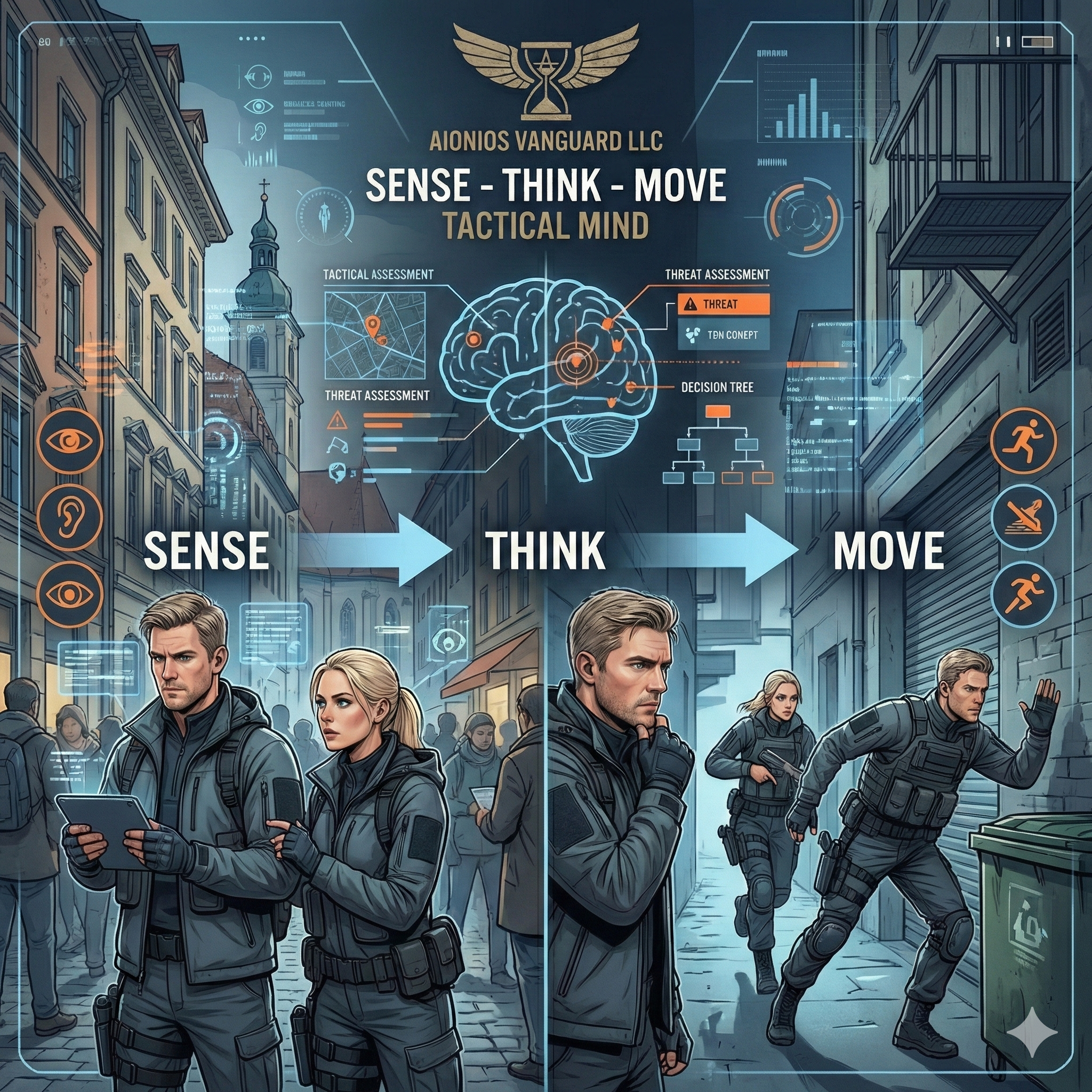
The Evolution of Operational Dominance: From OODA to STM
This special edition Slide Deck Playbook focuses on operational dominance by shifting from reactive loops to the STM (Sense, Think, Move) framework. While OODA focused on sequential cycles, STM leverages the Free Energy Principle and hierarchical active inference for predictive dominance. By minimizing surprise, Aionios Vanguard guardians inhabit the space where the enemy's decision has not yet formed.
