

Critical Alert: Aionios Vanguard LLC Security Brief - High Fuel Prices Escalate Crime. How to Employ Tactical Mitigation Strategies
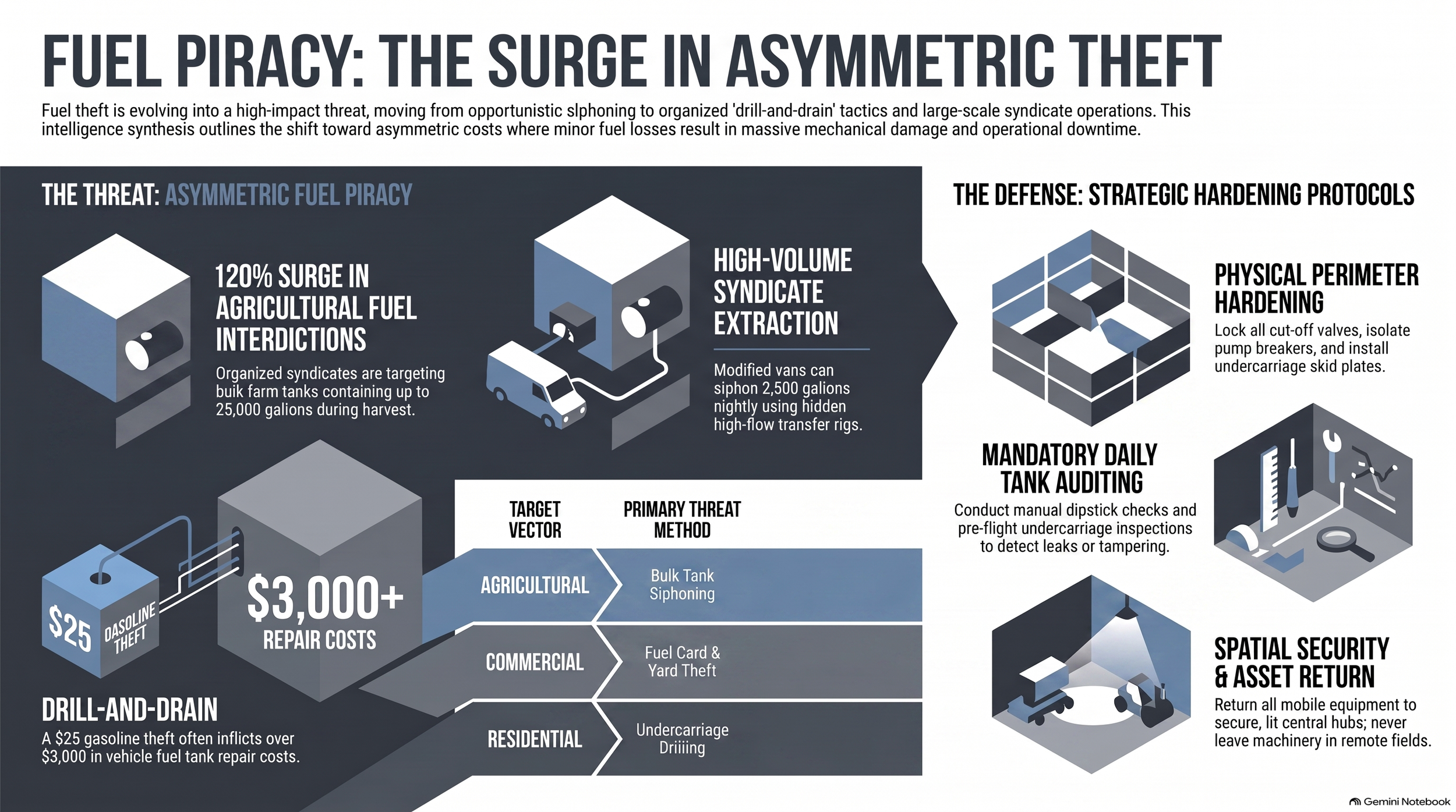
Image by Aionios Vanguard LLC. All Rights Reserved.
Podcast mp4 and Comprehensive Brief. Please visit our store for Thrival Playbooks, Slide Decks, Videos and Audio.
Fuel Security Intelligence Briefing: Diesel and Gasoline Theft Synthesis
Executive Summary
Current intelligence confirms a significant escalation in fuel theft across agricultural, commercial, and residential sectors. This surge is driven by high retail fuel prices—specifically diesel ranging between $5.61 and $6.30 per gallon—and the vulnerability of remote or unmonitored assets.
The threat landscape is characterized by two distinct primary vectors:
Organized Diesel Syndicates: Professional criminal rings are utilizing modified vehicles and electronic exploits to steal bulk quantities (1,500–2,500 gallons per night) from commercial hubs and agricultural stockpiles. Agricultural fuel interdictions have surged by over 120%.
Destructive Gasoline Piracy: In residential and light commercial settings, "drill-and-drain" tactics have replaced traditional siphoning. Thieves puncture plastic fuel tanks to bypass anti-siphon valves, resulting in extreme asymmetric costs where a $25 fuel theft causes over $3,000 in vehicle damage.
Operational security must shift toward physical hardening, daily auditing, and electronic overwatch to mitigate these escalating threats.
I. Agricultural and Rural Diesel Vulnerabilities
The onset of the harvest season has created high-value target environments as farms accumulate bulk inventories of 10,000 to 25,000 gallons.
Targeted Assets
Bulk Storage Tanks: Above-ground tanks are primary targets for organized groups using high-capacity, battery-operated transfer pumps.
Mobile Fuel Bowsers: Portable units used for field refueling are frequently targeted due to their mobility and often remote placement.
Remote Harvest Equipment: Combines and tractors left in fields overnight are prime targets for high-flow draining, which can halt harvest operations and cause significant logistical delays.
Residential Heating Oil: Off-grid residences are increasingly targeted for both heating oil and private diesel bladders.
Operational Impact
The 120% increase in rural fuel theft is not merely opportunistic. It involves targeted draining that causes thousands of dollars in direct losses and potential systemic halts to agricultural production cycles.
II. Residential and Commercial Gasoline Piracy
As retail fuel costs rise, gasoline theft has evolved from simple siphoning to destructive mechanical breaches, particularly targeting high-clearance vehicles.
The "Drill-and-Drain" Vector
Modern vehicles are equipped with anti-siphon flaps and internal baffles that prevent hose insertion. In response, perpetrators use cordless drills to puncture plastic fuel tanks from underneath.
Primary Targets: SUVs and light trucks are preferred due to easy undercarriage access and the prevalence of plastic fuel tanks.
Cost Asymmetry: A thief may only extract 25–50 worth of fuel, but the victim is left with $2,000 to $3,000 in repair costs, structural fuel leaks, and environmental hazards.
Commercial Fleet Attrition
Commercial operations are reporting losses of 5% to 10% of their total fuel budgets. This attrition is attributed to:
Night-time Yard Siphoning: Theft from vehicles parked in unmonitored fleet yards.
Fuel Card Exploitation: This includes skimming at retail pumps and internal driver-side fraud.
Telemetry Discrepancies: Losses are often discovered only through rigorous cross-matching of GPS data and fuel purchase logs.
III. Criminal Methodologies and Technology
The sophistication of fuel theft varies from high-tech electronic exploits to heavy industrial modifications.
Organized Syndicate Tactics
Modified Vehicles: Criminal rings utilize minivans and box trucks fitted with hidden 500-to-600-gallon internal tanks and cut-through floorboards. These "piracy vans" can drain 1,500 to 2,500 gallons per night.
Electronic Exploits: Syndicates employ pump-hacking electronics, master keys, and cloned cards to bypass commercial fuel terminal security.
Black Market Distribution: Stolen diesel is funneled directly into black-market freight channels, providing rogue fleets with discounted fuel.
Asymmetric Cost Exchange
The economic impact of these crimes is modeled by the Asymmetric Cost Exchange Ratio (R_{\text{exchange}}), which highlights that the cost to the victim (repairs, security, lost productivity) far outweighs the value of the fuel stolen by the perpetrator.
IV. Systemic Impact Overlay
The following table synthesizes the disparity between perceived risks and the sanitized ground truth of current fuel theft operations.
Ingested Signal Vector
Perceived Risk
Sanitized Ground Truth
Tactical Countermeasure
Agricultural Bulk Theft
Minor, opportunistic "pinching" by locals.
Targeted draining of 10k+ gal tanks causing harvest halts.
Lock cut-off valves; install physical tank cages; kill pump power.
Gasoline "Drill-and-Drain"
Managed via locking gas caps.
Anti-siphon tech forces tank puncturing, causing $3k in damage.
Park in locked garages; install undercarriage skid plates.
Commercial Fleet Loss
Isolated card misuse or minor leaks.
Systemic siphoning and fraud draining 5-10% of capital.
PIN-authenticated cards; telemetry cross-matching.
Remote Equipment
Safety through rural isolation.
Unattended machinery is a prime night target for high-flow pumps.
Return all equipment to secured, lit yards nightly.
V. Strategic Mitigation and Hardening Protocols
To secure fuel assets at the Merlin Node and associated locations, the following directives are established:
Physical Perimeter Hardening
Valve and Power Isolation: Lock all bulk tank cut-off valves and isolate electric pump breakers within locked enclosures.
Spatial Security: Situate above-ground tanks within well-lit, fenced perimeter zones visible from primary structures.
Vehicle Positioning: Park high-clearance vehicles (SUVs/Trucks) in locked garages. If off-site, position them to block undercarriage access or use physical barriers.
Auditing and Oversight
Daily Tank Dips: Maintain manual fuel logbooks and conduct daily physical dipstick checks to detect volume losses immediately.
Pre-Flight Inspections: Conduct physical undercarriage audits of all vehicles before engine ignition to check for tank punctures or tampering.
Fleet Telematics: Implement strict PIN-restricted fuel card tracking and cross-reference GPS telemetry against gallons purchased.
Electronic and Community Overwatch
Motion Surveillance: Deploy motion-activated infrared cameras focused specifically on fuel fill caps, main gates, and vehicle parking pads.
Cell Coordination: Coordinate neighborhood watch rotations with vetted mutual support cells to monitor access roads and rural corridors.
