

Systematic Strategic Briefing: Macro Supply Chain Fractures, Caloric Inflation, Energy Distillate Deficits, and Pharmaceutical Attrition
Executive Summary
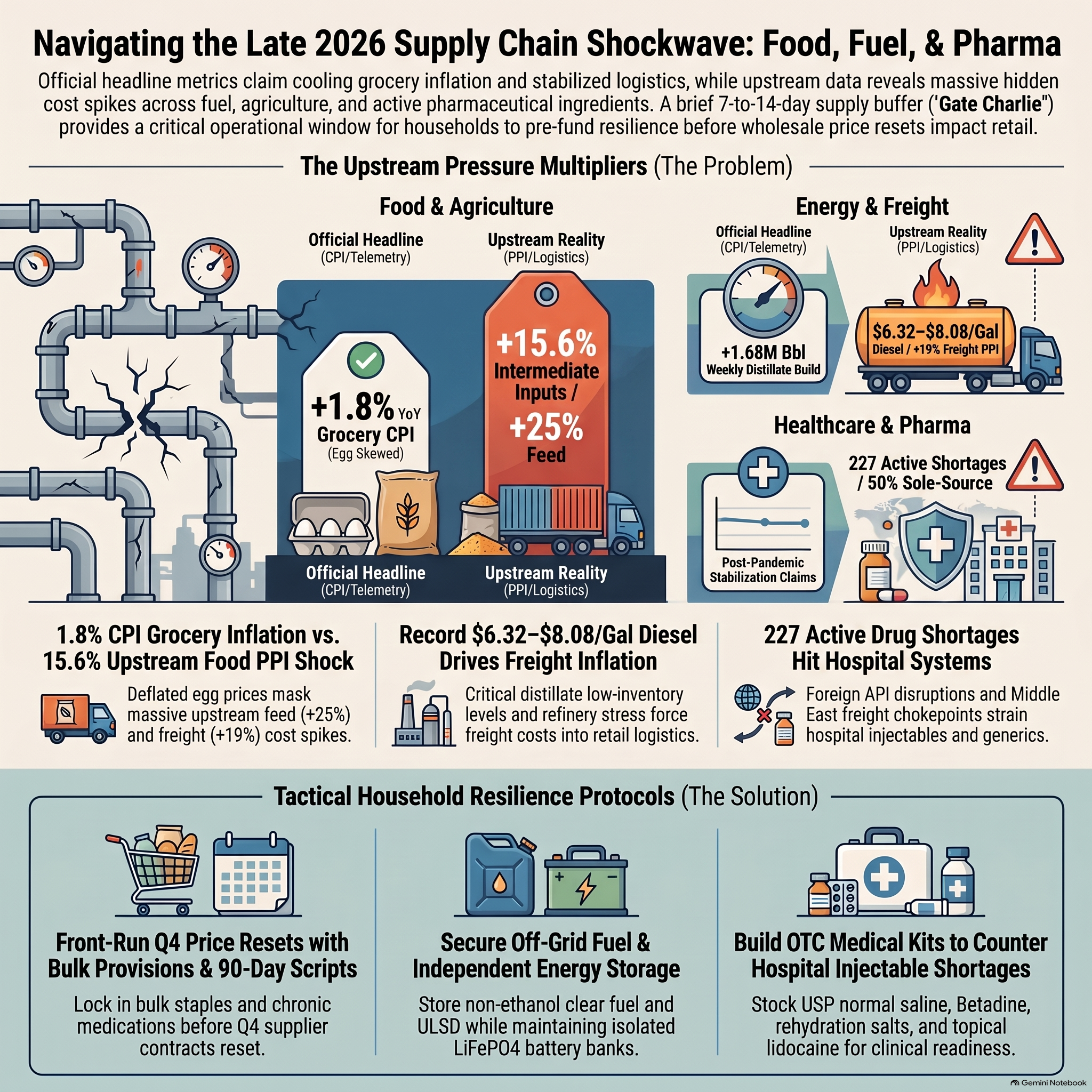
An integrated audit of public macro-ledgers, government telemetry, and supply chain tracking reveals that the U.S. domestic economy is facing systemic, compounding stress across three critical pillars: food supplies, energy distillates, and active pharmaceutical ingredients (APIs). While headline macroeconomic indicators portray short-term stability, structural disruptions trapped in upstream supply chains are reaching critical inflection points.
The primary takeaways from this synthesis include:
The Caloric Inflation Disconnect: The reported September 2026 Consumer Price Index (CPI) headline grocery inflation rate of 1.8% year-over-year (YoY) is a statistical mirage. It is heavily suppressed by a temporary 20.6% YoY collapse in egg prices following poultry flock recovery from the 2025 avian flu epidemic. Upstream Producer Price Index (PPI) metrics reveal a compounding surge: intermediate food inputs are up 15.6% YoY, truck freight PPI is up 19.0% YoY, and animal feed inputs have surged over 25.0% YoY. A three-wave caloric shock is projected through 2027 due to wholesale contract renewals, Middle Eastern fertilizer export blockades, and biofuel feedstock diversion.
Energy Telemetry & The "Gate Charlie" Window: On October 21, 2026, the U.S. Energy Information Administration (EIA) reported a temporary build of +1.68 million barrels in distillate inventories (totaling 104.3M bbl), driven primarily by demand destruction (-2.4% YoY) at record retail diesel prices ($6.32/gal national average; $7.23–$ 8.08/gal West Coast) and a pre-blockade import echo (+837,000 bpd). Simultaneously, commercial crude stocks drew down by -3.06 million barrels and gasoline stocks plummeted by -2.95 million barrels. Recognizing systemic risk, the Department of Energy executed an emergency release of 315,000 barrels (31.5% of capacity) from the Northeast Home Heating Oil Reserve (NEHHOR). This temporary supply plateau creates a 7-to-14-day operational breathing window ("Gate Charlie") to finalize fuel and resource staging before import losses manifest.
Pharmaceutical & Clinical Logistics Attrition: The American Society of Health-System Pharmacists (ASHP) has logged 227 active national drug shortages, marking the third consecutive quarterly increase. Over 50% of 2026 shortages involve sole-source drugs. Escalating conflict in the Persian Gulf has severed the Dubai air-cargo pharmaceutical hub, inflated Indian air-freight rates, and choked raw petrochemical solvent synthesis and Qatar liquid helium exports (threatening 50,000+ hospital MRI machines globally). Shortages have hit acute resuscitation (Dextrose 50%), surgical anesthetics (Bupivacaine, Etomidate), critical IV antibiotics (Azithromycin on strict allocation), and burn care.
Strategic Pivots for Sovereign Resilience: To insulate against upstream failure pass-throughs—which operate on a 4-to-8-week lag for pharmaceuticals and a quarterly reset for food provisions—households and local networks must deploy decentralized protocols. Key interventions include front-running wholesale price resets through bulk staple acquisition, securing non-ethanol clear gasoline and ultra-low-sulfur diesel (ULSD), converting 30-day prescriptions to 90-day fills with out-of-pocket cash overrides, acquiring over-the-counter (OTC) clinical field analogs, and anchoring local trade via peer-to-peer mutual credit ledgers (the Obol facility) synchronized through off-grid 915.0 MHz Meshtastic LoRa mesh networks.
1. Caloric Inflation & Agricultural Supply Chain Triage
The Headline CPI Illusion vs. Upstream PPI Pressure
Official reports from the Bureau of Labor Statistics (BLS), SmashMeals News, and Grocery Trade News indicate that September 2026 "food at home" (grocery) CPI cooled to 1.8% YoY, with restaurant prices climbing 3.5%. Concurrently, the USDA Economic Research Service trimmed its 2026 grocery inflation forecast to 2.4% and its 2027 projection to 1.8%.
However, underlying category data demonstrates that the 1.8% headline rate is distorted by a single category:
The Avian Flu Egg Deflation Base-Effect: Commercial egg prices dropped 20.6% YoY in September 2026 (with the USDA forecasting a full-year decline of 29.4%) due to flock repopulation following the 2025 avian flu wipeout. Because eggs are heavily weighted within the "Meats, Poultry, Fish, and Eggs" CPI category, this temporary drop pulled the entire category's inflation read down to +0.3% YoY.
Core Grocery Acceleration: Disaggregating the index reveals severe price increases in daily staples:
Retail Beef and Veal: +9.4% to +9.8% YoY (2026 forecast), with an additional +4.7% projected for 2027.
Coffee: +7.1% YoY.
Sugar and Sweets: +6.6% YoY.
Vegetables: +5.7% YoY (projected).
Fruits and Vegetables (CPI Sept): +3.7% YoY.
Nonalcoholic Beverages: +3.8% YoY.
[Hormuz / Black Sea Chokepoint
[29% Global Urea Trapped + Diesel >$6.30/gal
[PPI Trucking +19% / Ag Inputs +15.6% / Feed +25%
[Q4 2026 / Q1 2027 Retail Grocery Pass-Through]
Upstream producer costs are rising rapidly, creating a severe margin compression between wholesale costs and retail pricing. Food producers raised wholesale prices by +1.2% in September 2026 alone, with processed intermediate goods up +14.1% YoY and unprocessed goods surging +21.5% YoY.
Macro Food and Logistics Cost Matrix
Food / Logistics Vector,Official Current Readout (Sept/Oct 2026),Upstream / Category Reality,Operational Friction Point
Headline Grocery CPI vs. Dining Out,+1.8% YoY (Food at Home) +3.5% YoY (Restaurants),67% of Americans have reduced restaurant spending,"Consumer spending is shifting from dining out (+3.8% full-service labor/rent inflation) to grocery stores, accelerating shelf demand for staples."
"Beef, Veal & Herd Scarcity",+9.4% to +9.8% YoY (2026 Forecast); +4.7% in 2027,Wholesale beef +8.5% ; farm-level cattle +7.1%,"U.S. cattle herd at multi-year lows (production down 2% YoY). Hay, corn, and oilseed feed costs surged >25% YoY ."
"Produce, Coffee & Staples",Coffee: +7.1% YoY Sugar/Sweets: +6.6% YoY Vegetables: +5.7% YoY,Fruits & Vegetables: +3.7% YoY Nonalcoholic Beverages: +3.8% YoY,"Refrigerated (""reefer"") diesel surcharges disproportionately impact fresh produce, especially in PADD 5 ($8.08/gal CA diesel)."
Producer Price Index (PPI) Intermediate Goods,+1.3% MoM (Largest jump since March 2022); +6.3% YoY Final Demand,Processed Intermediate: +14.1% YoY Unprocessed Goods: +21.5% YoY,Food producers raised wholesale prices +1.2% in September alone . Retailers must reprice as contract terms expire.
Freight & Farm Diesel,+19.0% YoY Truck Freight PPI; +10.1% YoY Cass Linehaul Index,Diesel up 77% since Jan 2026 (peaked at $6.53/gal; $6.32/gal today),Fuel and oil constitute up to 30% of the projected 4.5% jump in 2026 U.S. farm production expenses.
The Three-Wave Caloric Shock (Q4 2026 – 2027)
Joint analysis from S&P Global and the North Dakota State University (NDSU) Agricultural Trade Monitor outlines a sequential, three-stage cost explosion facing agricultural supply chains over the next 6 to 12 months:
Wave 1: Q4 2026 Freight & Contract Pass-Through (November – December 2026)
According to New York Fed surveys, 59.5% of manufacturing and food processing firms report paying higher input costs, whereas only 30.6% have passed these costs onto end consumers. This delay exists because major supermarket chains operate under quarterly and semi-annual vendor contracts. As Q4 2026 and Q1 2027 supplier contracts undergo renewal, vendors facing a 19.0% truck freight PPI surge and elevated diesel crack spreads are pushing through delayed price hikes. The USDA's September 2026 model acknowledges this risk, extending its 95% confidence interval for 2027 grocery inflation up to +9.2% due to uncaptured fuel lag effects.
Wave 2: The Hormuz Fertilizer & Sulfur Stranglehold (Spring/Summer 2027 Harvest)
The Strait of Hormuz serves as a primary transit choke point for critical agricultural inputs, carrying:
29% of global urea trade (the dominant nitrogen fertilizer).
Nearly 50% of global sulfur trade (essential for phosphate fertilizer manufacturing).
21% of merchant ammonia trade .
Military blockades and naval mine escalations in the Persian Gulf caused global nitrogen and urea prices to spike over 28% in a matter of weeks. Unlike the 2022 Russia-Ukraine shock—where high global grain prices provided farmers with revenue to offset expensive fertilizer—the 2026 disruption combines elevated fertilizer and diesel costs with stagnant crop payout prices. Compounded by reports from the International Food Policy Research Institute (IFPRI), farmers reducing fertilizer application rates during autumn and spring planting windows will experience lower crop yields in 2027.
Wave 3: Biofuel "Food-vs.-Fuel" Cannibalization (2027 Structural Floor)
In September 2026, European biofuel spot prices fell below maritime oil-based shipping fuels for the first time on record. Driven by regulatory mandates (such as Portland's 50% renewable diesel rule), energy refiners are actively bidding vegetable oils, soy, and corn feedstocks away from human food and livestock feed supply chains. With animal feed costs already up >25% YoY and the egg deflation base effect expiring at year-end, poultry, pork, and beef production costs will experience structural price increases in early 2027.
2. EIA Petroleum Telemetry & Energy Grid Logistics
Breakdown of the Official EIA Ledger (October 21, 2026)
On October 21, 2026, at 07:30 PDT, the U.S. Energy Information Administration (EIA) released its Weekly Petroleum Status Report for the week ending October 16, 2026. The print revealed a divergence between commercial crude, motor gasoline, and middle distillate balances.
[EIA Crude: -3.06M bbl] + [EIA Gasoline: -2.95M bbl] + [EIA Distillate: +1.68M bbl (104.3M Total)
[DOE Simultaneously Taps 31.5% of Emergency Heating Oil Reserve as Retail Diesel Hits $6.32/gal]
[VERDICT: Demand Destruction (-2.4% YoY) + Temporary Import Surge (+837k bpd) = GATE CHARLIE WINDOW]
EIA Telemetry Data Summary
EIA Telemetry Vector,Official Print (Oct 21 @ 07:30 PDT),Reuters / Consensus Forecast,Prior Week Baseline / Delta,Operational Context & Analysis
U.S. Distillate Fuel Inventories,104.3M bbl (+1.68M bbl),-1.16M bbl (Draw),102.6M bbl (-2.53M bbl prior),"GATE CHARLIE TRIGGERED: Temporary build above 100M bbl floor, driven by demand destruction (-2.4% YoY) at $6.32/gal diesel."
U.S. Commercial Crude Stocks,412.5M bbl (-3.06M bbl),-0.82M bbl (Draw),415.6M bbl (-8.56M bbl prior),"3-Week Bleed (-14.8M bbl): Net crude import surge (+837,000 bpd) failed to offset 93.4% refinery utilization (16.6M bpd)."
U.S. Motor Gasoline Stocks,205.3M bbl (-2.95M bbl),-0.443M bbl (Draw),208.25M bbl,"6.6x Worse Than Expected: Refiners prioritized distillate yields, leading to a substantial draw in motor gasoline inventories."
"Cushing, OK Delivery Hub",+0.987M bbl (Build),Unlisted,+0.936M bbl (API),Mid-continent pipeline staging builds as coastal export facilities continue to drain.
Refinery Utilization,93.4% (-0.1%),Unlisted,93.5% (16.6M bpd runs),Refiners running at peak capacity during typical autumn maintenance season to chase middle distillate margins.
Upstream Drivers and Emergency Government Action
Eighteen minutes prior to the EIA report release (at 07:12 PDT), Energy Secretary Chris Wright announced an emergency release of up to 315,000 barrels of diesel and heating oil from the Northeast Home Heating Oil Reserve (NEHHOR). Tapping 31.5% of this 1-million-barrel reserve—an emergency asset utilized only twice previously in U.S. history—signals severe underlying concern in Washington despite the headline +1.68M barrel build.
The statistical build in distillates is attributable to two temporary drivers:
Demand Destruction (-2.4% YoY): Four-week average distillate product supplied fell to 3.9 million bpd. With national retail diesel reaching $6.32/gal and West Coast pricing exceeding $7.24–$ 8.08/gal, freight carriers and agricultural operators have curtailed discretionary operations.
Pre-Blockade Import Echo (+837,000 bpd): Net crude imports rose by 837,000 bpd for the week ending October 16. This represents waterborne shipments dispatched prior to the naval mine escalations in the Strait of Hormuz between October 13 and October 19.
Institutional projections from J.P. Morgan Private Bank confirm that total U.S. distillate inventories remain on track to break below the critical 100-million-barrel floor before year-end, remaining pinned near multi-year lows through 2027 while the Strategic Petroleum Reserve (SPR) sits at its lowest level since 1982.
Geopolitical Supply Disruptions
Energy markets remain under pressure due to escalating maritime kinetic actions:
Persian Gulf and Gulf of Oman: Kpler confirmed at least 18 commercial vessel attacks over a two-week period. LSEG analysts confirm Iranian forces have expanded targeting beyond the Strait of Hormuz into the Gulf of Oman to strike ship-to-ship (STS) transfer operations.
Red Sea and Infrastructure Strikes: Houthi forces launched strikes against Saudi Aramco's Yanbu Red Sea terminal and the Shaybah oilfield, prompting Riyadh to postpone its flagship Future Investment Initiative conference.
Price Realization: Following these developments, Brent crude settled at $109.16/bbl (after reaching $110.00/bbl) and West Texas Intermediate (WTI) held at $97.85/bbl.
3. Global Pharmaceutical & API Supply Chain Attrition
The Structural Petrochemical and Logistics Fracture
Data from the American Society of Health-System Pharmacists (ASHP) and PharmaTradz confirms 227 active national drug shortages as of October 2026. This marks the third consecutive quarterly increase, with approximately 50% of new shortages representing sole-source products.
[Hormuz/Red Sea Blockade + GCC Airspace Closure]
[Dubai Pharma Hub Halted & Indian Air-Freight Spike]
[Chinese/Indian API & Petrochemical Precursor Lag]
[Oct 2026 US Hospital Injectable & Antibiotic Allocations]
Pharmaceutical manufacturing functions as a downstream derivative of crude oil refining, fine petrochemical synthesis, and specialized cold-chain air logistics:
GCC Air-Cargo Paralysis: Dubai International Airport serves as the 11th largest air-freight hub globally and acts as a central distribution node for European and Indian finished generics. Regional airspace closures and military actions have halted WHO operations out of Dubai, driving Indian pharmaceutical air-freight rates to historic highs and blocking Red Sea transit routes.
Petrochemical Reagent & Solvent Bottlenecks: Reagents and organic solvents required for API synthesis (including precursors for acetaminophen, broad-spectrum antibiotics, and local anesthetics) depend directly on crude oil and natural gas condensates. With Brent crude exceeding $100/bbl and air-freight surcharges rising over 15%, manufacturers operating on tight margins are suspending low-yield generic product lines.
Medical Helium Shortage: Qatar and the Persian Gulf supply a large share of the global liquid helium market. Liquid helium is required to cool superconducting magnets in the world's 50,000+ hospital MRI scanners (which perform roughly 95 million diagnostic procedures annually). Export blockades have placed MRI coolant supplies under allocation.
Grey Market Counterfeiting: Acute shortages have led procurement officials to issue warnings regarding an increase in counterfeit and diverted pharmaceutical products entering grey-market distribution channels.
Active Shortage Tracking Ledger (October 2026 Update)
Therapeutic Category,Specific Medications Added / Escalated,Verified Status (Oct 2026),Clinical & Tactical Impact
Emergency & Resuscitation / IV Fluids,"Dextrose 50%, 70%, 10%, 5% Injection ; Sterile Water Irrigant ; 0.9% NaCl Irrigation ; Atropine; Dobutamine",Active Shortage (ASHP / FDA),Severe shortage of Dextrose 50% pre-filled syringes/vials impacts acute hypoglycemia and trauma resuscitation. Sterile irrigation fluids short nationwide.
Surgical Anesthetics & ICU Sedatives,Bupivacaine HCl Injection ; Dexmedetomidine ; Etomidate Injection ; Lorazepam Injection ; Sufentanil,Escalated (Sep 22 – Oct 6),"Nerve-block anesthetics (Bupivacaine) and critical ICU intubation sedatives (Etomidate, Dexmedetomidine, Lorazepam) constrained across acute care networks."
Critical Antibiotics & Antimicrobials,Azithromycin IV Vials (500mg) ; Aztreonam ; Clindamycin Injection ; Cefotaxime,Strict Allocation (Oct 13),Slate Run Pharma placed IV Azithromycin on strict allocation on Oct 13. Recarbrio discontinued; Clindamycin and Aztreonam supplies constrained.
"Steroids, Burn Care & Toxicology",Methylprednisolone Acetate ; Mafenide Acetate Cream ; Activated Charcoal Oral Suspension,Active Shortage (Sep 22 – Oct 8),"Injectable anti-inflammatories, specialized topical burn therapies (Mafenide), and emergency oral toxicology suspensions constrained."
"Cardiovascular, CNS & Antiparasitics",Felodipine ER Tablets ; Dextroamphetamine ; Ivermectin 3mg Tablets,Discontinued / API Shortage,Key blood pressure formulations (Felodipine ER) discontinued Oct 7; Dextroamphetamine hit by API short fall; branded Ivermectin discontinuing Oct 31.
Oncology Injectables & Biologics,Irinotecan Injection ; Bleomycin ; Cytarabine (Sole-source); Carboplatin ; Methotrexate,Severe Shortage (Oct 6 – Oct 15),Structural failure in oncology workflows: 10 Irinotecan lines affected; sole-source Cytarabine placed under emergency rationing.
Localized Healthcare Node Stress: Josephine County, OR
Overlaying national logistics failures onto regional health infrastructure highlights acute localized vulnerabilities:
Retail Pharmacy Consolidation: The permanent closure of the Grants Pass Rite Aid (915 NE D St) redirected its entire prescription volume to a single regional CVS on Williams Highway. Remaining retail access relies on a small network of pharmacies (Fred Meyer, Walmart, Safeway, Sav-On, Siskiyou Pharmacy, and Grants Pass Pharmacy on SW 6th St).
Regulatory & Compounding Constraints: The Oregon Board of Pharmacy implemented rule OAR 855-183-0010 (effective June 17, 2026) to increase oversight on emergency pharmacy closures and enforce strict compounding limits, preventing local pharmacies from compounding alternatives to commercial drug shortages.
Inpatient Hospital Strain: Asante Three Rivers Medical Center in Grants Pass is navigating 300+ staff layoffs and a 0/5 CMS staffing rating. Compounding this operational strain, national shortages of Bupivacaine, Etomidate, Dextrose 50%, and IV Azithromycin directly limit the facility's surgical, ICU, and emergency capabilities.
I-5 Transport Vulnerabilities: Regional pharmaceutical distributors (McKesson, Cencora, Cardinal Health) dispatch supplies from Wilsonville, OR, and Sacramento, CA, via Interstate 5. Fuel prices exceeding $8.50/gal for commercial fleets and winter mountain pass closures (Sexton Mountain and Stage Road Pass) create single-point transport risks for local healthcare delivery.
4. The Strategic Pivot Framework & Tactical Decoupling
Because API supply chain disruptions require 4 to 8 weeks to clear distribution channels and empty retail shelves, current global disruptions will directly impact retail availability in late Q4 2026. Similarly, upstream food PPI surges will pass through during Q4 supplier contract renewals. Households and local networks can utilize the current 7-to-14-day energy breathing window ("Gate Charlie") to implement self-reliant storage and staging protocols.
| THE PIVOT ARCHITECTURE |
| ENERGY DECOUPLING | CALORIC SOVEREIGNTY | CLINICAL PRESERVE |
| • Secure ULSD & Red-Dyed | • Lock in Bulk Staples | • Convert 30 to 90-Day |
| Fuel Reserves | (Beef, Oils, Grains) | Rx Scripts + Cash |
| • Secure Non-Ethanol | • Acquire Egg Powder & | Vacation Overrides |
| Clear Gasoline | Ghee at Price Floor | • Procure OTC Field |
| • Charge LiFePO4 Banks | • Generate Biochar & | Injectable Analogs |
| to 100% via Solar | Closed-Loop Produce | • Store Meds at 15–20°C |
| PARALLEL MICRO-ECONOMICS
| • Settle Local Labor/Trade via Mutual Credit Ledgers (500-Obol Facility)
| • Reconcile Offline Ledger Transactions via 915.0 MHz Meshtastic LoRa Nodes
Energy Grid & Fuel Decoupling
Exploit the Distillate Build: Utilize the temporary supply stabilization to fill on-site ultra-low-sulfur diesel (ULSD) and off-road red-dyed diesel storage before mid-October Persian Gulf shipping disruptions impact PADD 5 fuel terminals.
Hedge the Motor Gasoline Deficit: Address the weekly 2.95-million-barrel drop in motor gasoline inventories by securing stabilized, non-ethanol clear gasoline for utility vehicles, chainsaws, and backup generator systems.
Off-Grid Power Staging: Fully charge 12V LiFePO4 battery systems (3600Wh capacity targets) using dedicated solar arrays (1200W capacity) or engine alternators (350W kinetic systems). Integrate biomass pyrolysis systems for standalone heating and wood-gas production to reduce grid reliance.
Caloric Sovereignty & Nutritional Arbitrage
Capitalize on the Temporary Egg/Dairy Trough: Commercial egg (-20.6%) and butter (-10.3%) prices sit at cyclical lows prior to 2027 feed cost (+25% YoY) pass-throughs. Acquire shelf-stable freeze-dried whole egg powder and clarified butter (ghee) to lock in baseline pricing.
Front-Run Supplier Contract Resets: Acquire bulk shelf-stable provisions—including canned and freeze-dried beef, high-stability cooking oils, legumes, sugar (+6.6%), and coffee (+7.1%)—before retail tags reprice during Q4 vendor resets. Maintain a minimum of 45 to 60 days of shelf-stable household provisions.
Soil Fertility & Fertilizer Insulation: To insulate local food production against global nitrogen and urea shortages (29% of global supply trapped in Hormuz), produce biochar and organic compost via controlled pyrolysis to maintain soil fertility without chemical inputs.
Clinical Decoupling & OTC Field Substitutions
Prescription Extensions: Transition daily maintenance medications (blood pressure, cardiovascular, thyroid, respiratory) from 30-day fills to 90-day physical supplies. Request an out-of-pocket cash "vacation/emergency override" fill through independent local community pharmacies (e.g., Siskiyou Pharmacy, Grants Pass Pharmacy) rather than regional retail chains.
Procure OTC Field Analogs for Hospital Shortages: Assemble field medical kits designed to offset hospital supply shortages:
Hospital Shortage Vector,OTC / Field Equivalent Strategy,Operational Purpose
Sterile Water & Normal Saline Irrigants,"Sealed cases of USP Normal Saline Wound Wash , Povidone-Iodine (Betadine), and Chlorhexidine Gluconate (Hibiclens)","Wound decontamination, tissue irrigation, and surgical hygiene without municipal power."
Injectable Anesthetics & Steroids,"4%–5% Topical Lidocaine Creams/Sprays , 1% Hydrocortisone Ointment (ointments provide longer shelf life than creams)","Local pain management, dermatological trauma, and anti-inflammatory application."
Dextrose 50% & Charcoal Suspensions,"WHO-standard Oral Rehydration Salts (ORS) , Oral Glucose Gels, Food-Grade USP Activated Charcoal Powder","Management of acute dehydration, hypoglycemia, and gastrointestinal toxin exposure."
Hospital Burn Therapies (Mafenide),"Silver-Sulfadiazine Creams, Sterile Hydrogel Burn Dressings, Hemostatic Gauze, CAT7 Tourniquets","Field trauma care, burn mitigation, and hemorrhage control."
Storage Preservation Hygiene: Store all clinical provisions and field antibiotics (Doxycycline, Amoxicillin-Clavulanate, Azithromycin) in climate-controlled, dark environments maintained between 15°C and 20°C (59°F to 68°F), packed with silica desiccants. Enforce strict physical separation between fuel storage and stored dry food or medical supplies to prevent hydrocarbon vapor contamination.
Water Autonomy: Deploy gravity-fed water filtration systems capable of outputting at least 8 liters per hour, supported by an 18-month inventory of consumable filter elements.
Parallel Micro-Economics & Offline Communications
[Local Skilled Labor / Utility] ◄─── 1 Obol / Hour ───► [Mutual Credit Ledger (500 Obol Line)]
[Off-Grid Syncing via 915.0 MHz Meshtastic LoRa] ◄─── Encrypted Cryptographic Payloads
Mutual Credit Trading (The Obol Ledger): To conserve fiat currency amidst elevated freight costs and retail markups, execute local commerce through mutual credit trust lines. Standardize value exchange based on utility (e.g., equating 1 Obol to one hour of skilled labor or equivalent physical produce). Deploy credit facilities (such as the 500-Obol mutual credit line) to secure agricultural staples directly from regional producers (e.g., purchasing 100 lbs of hard red winter wheat from verified local sources).
Skill Liquidity Balances: Maintain ledger balance by offering technical skills—such as radio programming, engine repair, machining, or clinical trauma triage—to community peers at standard parity.
Encrypted Off-Grid Ledger Reconciliation: To maintain transactional integrity during power or cellular grid disruptions, transmit encrypted transaction hashes across peer-to-peer Meshtastic LoRa radio nodes operating on the 915.0 MHz frequency. This ensures real-time ledger synchronization, wellness checks, and resource coordination across local networks without internet access.
