

Water flows, water that is contained eventually breaches its walls to flow freely again.
1. The Genesis of the Blueprint: 18th-Century Prussian Source Code
The transition from organic, community-based learning to state-mandated social engineering was not an evolution of enlightenment, but a "Synthetic Construct" engineered for military necessity. This "Prussian Gene" serves as a design specification rooted in the aftermath of the Seven Years' War and the Napoleonic Wars. Following a devastating failure of the population's "readiness and loyalty," the Prussian monarchy identified a critical need to homogenize a fractured populace. The resulting system was a "hostile takeover" of the pedagogical landscape, designed to produce obedient, standardized subjects—soldiers and civil servants—to staff the state's military and administrative machinery.The structural foundation was codified by King Frederick the Great and Johann Julius Hecker through the Generallandschulreglement (General Country School Regulations) of 1763. This decree transformed schooling into a mechanism of statecraft through several specific objectives:
Compulsory State Indoctrination: Mandating schooling for all young citizens to create a captive audience for the uniform dissemination of state-sanctioned values.
Centralized Instructor Pipeline: Hecker’s 1748 teacher’s seminary established a centralized monopoly to ensure teachers served as state agents.
Economic Resource Management: Treating children as "Human Capital" for state projects, exemplified by Hecker’s mandatory instruction on cultivating mulberries for the silk trade.
Homogenization: Eliminating regional and familial distinctions to forge a predictable, nationalized identity.The philosophical mandate for this system was provided by Johann Gottlieb Fichte. In his Addresses to the German Nation , Fichte explicitly called for the "destruction of free will." He argued that education must "consist essentially in this, that it completely destroys freedom of will in the soil which it undertakes to cultivate , and produces on the contrary strict necessity in the decisions of the will, the opposite being impossible." Fichte’s strategic intent was to install an internalized "police force" within the mind of the citizen, ensuring total predictability for state service and rendering external armies unnecessary for domestic order. This 18th-century military source code provided the definitive blueprint for the mid-19th-century American adoption of compulsory schooling.
2. The American Industrial Pivot: Transposing the Factory Model
In the mid-19th century, the United States faced intense social friction driven by rapid industrialization and mass immigration. American reformers viewed the Prussian model as a strategic solution for the homogenization of a "chaotic" population. By importing this authoritarian framework, the U.S. successfully traded local pedagogical autonomy for an assembly-line approach to human development, prioritizing industrial output over intellectual sovereignty.Horace Mann, the primary transmission vector for this model, visited Prussia in 1843. In his Seventh Annual Report , Mann championed the efficiency of the Prussian system while dismissing contemporary critics who correctly identified it as an instrument of state despotism.Table 1: Mann’s Transposition of the Prussian Model| Efficiency Benefits (Mann’s View) | Despotic Features (Critic's View) || ------ | ------ || Age Segregation: Sorting raw material into date-stamped rooms for "processing." | Classification: Treating children as interchangeable components on an assembly line. || Standardized Order: Creating a homogenized, predictable national identity. | Instrument of Enslavement: A system designed to suppress individual will for state service. || Bureaucratic Assessment: The Boston Exams of 1845 shifted evaluation from relational/oral to written/bureaucratic. | Loss of Gnosis: Replacing the teacher's relational judgment with a centralized, "objective" snapshot of the student's mind. |
This industrial pivot was refined by the Rockefeller-Oregon Axis. In 1903, the General Education Board (GEB) was chartered, with J.D. Rockefeller investing between $129 million and $180 million to "standardize" American learning. Rockefeller’s intent was transparent: “I don’t want a nation of thinkers. I want a nation of workers.” This initiated the "Three-Axis Deconstruction" of the student:
X-Axis: Institutional Monopoly: Forcing schools to adopt "scientific" management and centralized corporate curricula via GEB funding.
Y-Axis: Psychological Blueprint: Adopting Prussian "regimentation over reason" to produce "docile and obedient" laborers.
Z-Axis: Economic Conversion: Converting the child into "raw material" to be refined into industrial capital, prioritizing "Vocational Predestination" over philosophy or letters.This historical implementation established the specific conditioning mechanisms that govern the modern educational environment.
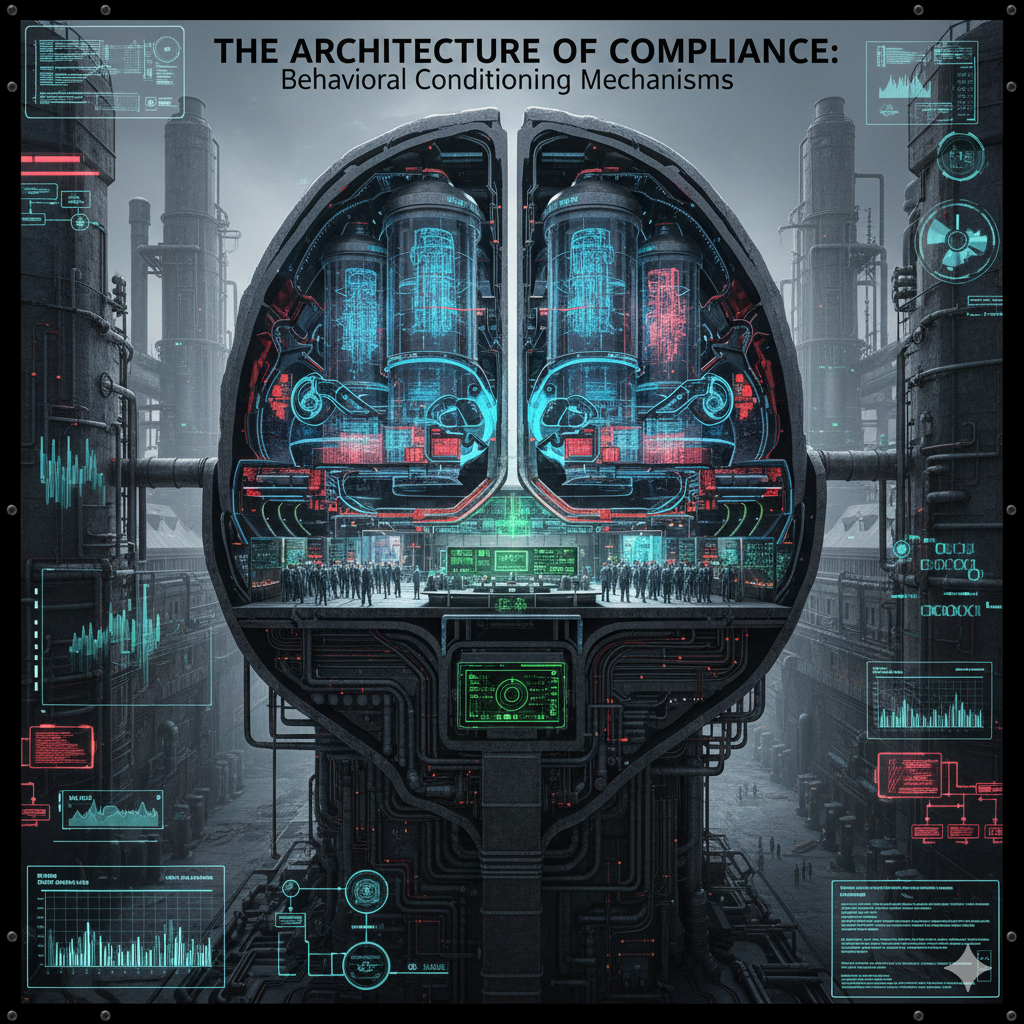
3. The Architecture of Compliance: Behavioral Conditioning Mechanisms
The physical and temporal layout of the modern school functions as a "Hog Pen"—a set of "mental boundary conditions" designed for refinement rather than inquiry. These structures replace spiritual Gnosis with "Human Capital" value, habituating the student to administrative routine and passivity.The "Bell Schedule" and "Classroom Arrangement" serve as primary tools of Pavlovian conditioning. The mechanical bell trains students to switch tasks instantly on command, disregarding natural focus or the completion of deep cognitive work. Similarly, the panoptic surveillance of the row-and-desk layout reinforces the student's role as a passive receptacle for state-sanctioned knowledge. This architecture prioritizes unilateral transmission over active discovery, mirroring the Fichtean ideal of the "silent" and "submissive" pupil.Modern refinements have evolved into the digital "Silicon Fence," specifically identified in the Oregon 2026 standards. This transition from physical bells to digital social engineering is accelerated by SB 1583 , which strips the Oikos (local boards and parents) of their power to choose materials. This digital fence utilizes:
Social-Emotional Learning (SEL): A vector for monitoring and adjusting a child's internal compliance markers and "correct" thoughts.
Career Technical Education (CTE): Rebranding "Vocational Predestination" under the slogan "Ready to learn, ready to earn," explicitly framing the child as a labor asset.These behavioral guardrails bind the student to a trajectory of servitude, facilitating the financial model of upward wealth extraction.
4. The Economic Collar: Wealth Extraction and Modern Indenture
The education system’s financial model is a "predatory extraction scheme" facilitating the upward transfer of wealth from future labor to institutional bureaucracies. This "economic collar" creates a "Feudal" structure where institutions are the "Lords" and students are "Serfs" on the land of credentials.Table 2: The Great Divergence (Post-1980 Indicators)| Metric | Approximate Growth Factor | Economic Result || ------ | ------ | ------ || College Tuition | ~180% (Inflation Adjusted) | Hyper-inflated price of entry into the professional class. || Median Wage Growth | ~5% | Stagnant return on educational investment for degree holders. || Teacher Wages | Negative Trend | A record 26.9% "Pay Penalty" shows tuition hikes fund bureaucracy, not educators. |
This divergence creates a "Debt-Trap" mechanism. Under the "Endowment Paradox," elite universities (e.g., Harvard with $51B+, Yale with $41B+) hoard tax-exempt wealth while student bodies suffer: national data reveals 23% of undergraduates face food insecurity and 8% experience homelessness .The legal status of student debt as "Non-Dischargeable Indenture" completes the trap. Because only 0.1% of bankrupt debtors successfully meet the "undue hardship" test to discharge loans, the graduate's future life is effectively collateralized. To service this debt, the graduate is forced into the "Master's Lap"—corporate or state employment—reinforced by credential inflation. While 67% of job postings for production supervisors demand a degree, only 16% of incumbents have one, making the degree a "Badge of Domestication" rather than a mark of skill. This financial bondage leads directly to a generation-wide psychological crisis.
5. The Human Body Count: The Manufacturing of Despair
The rise in mental health pathologies is not a failure of the system, but a predictable output of "Agency Thwarting" and the "Prussian Gene." By violating Self-Determination Theory (Autonomy, Competence, Relatedness), the system manufactures a state of "languishing."The Epidemic of Despair (2015-2024 Data):
Anxiety: Increased by 78.25%
Depression: Increased by 73.04%
Suicidal Ideation: Increased by 92.52%
Loneliness: Reported by over 50% of students.
Flourishing: Dropping to a mere 36% by 2025.This crisis is captured in the "Botanical Mutilation" parable. The modern university acts as a "Glass Box" that systematically "prunes the taproot" of a student’s identity—their history, faith, and family heritage. Simultaneously, it provides the "Perfect Water" of abundant resources without struggle, creating profound dependency and a shallow root system. When students are transplanted from the academy into the "winter storm" of reality, they collapse because they lack the deep, resilient roots needed for autonomy. The denial of agency results in a hollowed-out compliance, shifting the focus from the diagnosis of the "refinery" to the necessity of Exodus .
6. Final Indictment: From Compliance to Sovereignty
The audit is complete: the system is not broken; it is operating according to its original design of state-centric control and the suppression of free will.
Table 3: Master Indictment – Two Models of Education| Feature | Prussian Model (The Factory) | Kingdom Education (The Garden) || ------ | ------ | ------ || Primary Sovereign | The State (Government) | God (The Creator) || Delegated Authority | Bureaucrats / Experts | Parents / Family ( Oikos ) || Goal of Instruction | Obedience, Workforce Readiness | Discipleship, Wisdom, Maturity || View of the Child | Human Capital / Resource | Image Bearer ( Imago Dei ) || Methodology | Compulsion and Standardization | Relational, Holistic, and Lifelong |
Reclamation is achieved through the "Grammar of Command," which cauterizes the Prussian programming and restores the Oikos through four imperative commands:
Stand ( Staley ): An active command to hold your ground against external sedation and attack.
Be Muzzled ( Ephemuthe ): A command to silence the internal and external noise of state programming.
Hear ( Akouo ): Intense, intentional listening to true authority and Aletheia .
Walk ( Peripateo ): The command to conduct one's life according to sovereign will, breaking the paralysis of debt and anxiety.The choice facing the modern guardian is absolute: remain an "obedient subject" within the state refinery or become a "sovereign commander" through the act of Exodus. Freedom begins only when one realizes that the "hog pen" gate is made of signal, not steel, and chooses to walk out toward Aletheia .
