

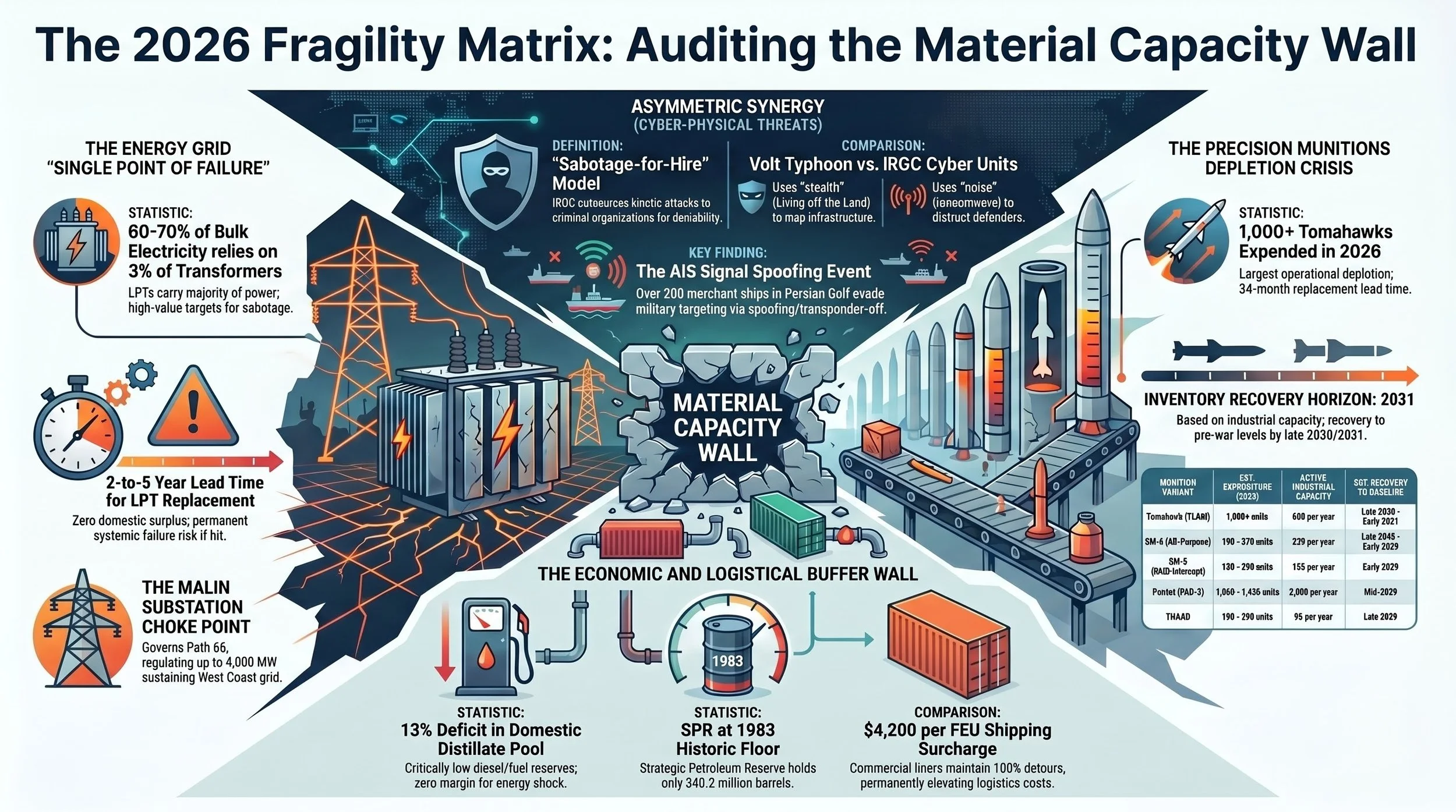
Image by Aionios Vanguard LLC - All Rights Reserved
1. Strategic Context: The Graham Doctrine and the Versailles Standoff
The "Graham Doctrine" represents an aggressive pivot from maritime security to a forced territorial and commercial occupation of the Strait of Hormuz. This doctrine advocates for a military takeover and the establishment of a U.S.-managed tolling system—branded as a "Guardian Angel" architecture—to serve as a terminal strategic lever against Tehran’s proxy networks. Currently, this maneuver is being utilized as high-stakes kinetic signaling within the 60-day Versailles negotiation window. While diplomatic tracks remain open, the doctrine serves as a Sword of Damocles intended to force compliance from the Iranian Supreme National Security Council (SNSC).
Diplomatic vs. Kinetic Signaling
Actor
Diplomatic Signaling
Kinetic / Rhetorical Signaling
U.S. Executive (Trump)
Treating the Versailles $MoU$ as "temporary probation" for Tehran.
"Truth Social" ultimatums: Threats to "take over the country" and "hit Iran harder."
U.S. Diplomatic (Vance)
"Outstretched hand" at the Bürgenstock summit; face-to-face technical sessions with Araghchi.
Managing the "Swiss Chessboard" while separating technical nuclear text from political posturing.
Iranian SNSC
"Step-by-step" compliance demands; utilizing Qatari/Pakistani mediators.
IRGC Navy edicts: Orders for "zero traffic" in the Gulf and sweeping maritime warnings.
The feasibility of this diplomatic track is currently compromised by "Clause 1" requirements, which mandate a total cessation of military operations. Continued IDF kinetic maneuvers south of the Litani River effectively sabotage the negotiation’s legitimacy and invalidate the cessation mandates, erivng Iranian hardliners' resolve. This political brinkmanship necessitates a cold-eyed audit of the U.S. military’s physical capacity to enforce such a massive mandate in a degraded industrial environment.
2. Operational Requirements for a Forced Maritime Takeover
Transitioning the Strait of Hormuz from a theater of Freedom of Navigation Operations ($FONOPs$) to a zone of Active Domain Dominance represents an unhedged logistical liability. Enforcing a sovereign toll gate requires holding and operating a waterway bounded by hostile littoral topography and sophisticated anti-access/area-denial (A2/AD) networks.
Technical Pillars of the Takeover
Suppression of Enemy Air Defenses (SEAD): Immediate kinetic strikes must neutralize the IRGC’s anti-ship cruise missile ($ASCM$) umbrella, specifically hardened Ghadir and Raad silos on Qeshm and Larak Islands.
Total Air and Electronic Dominance: Enforcing a toll gate necessitates maintaining multiple Carrier Strike Groups ($CSGs$) and Expeditionary Strike Groups ($ESGs$) permanently inside the Persian Gulf. These assets must provide a non-stop shield against loitering munition swarms and the current "electronic fog" of massive AIS signal disruption—where more than 200 commercial ships are experiencing target-acquisition spoofing.
Physical Checkpoint and De-mining Architecture: Establish a Western maritime routing clearinghouse requiring armed boarding teams for non-compliance and continuous mine-countermeasure ($MCM$) assets to clear the 80 active smart naval mines currently tracked in Omani lanes.
The requirement for multiple $CSGs$ inside the Gulf exacerbates the existing strain on overextended naval assets. These operational mandates are directly dependent on a consistent flow of precision munitions, leading to an immediate collision with the American "Material Capacity Wall."
3. The Material Capacity Wall: Munitions Depletion and Industrial Recovery
A systemic mismatch exists between high-velocity wartime consumption and low-capacity peacetime manufacturing. Center for Strategic and International Studies (CSIS) data confirms that recent regional expenditures have already hollowed out the Navy's primary strike and air defense inventory layers.
Munitions Recovery Balance Sheet
Munition Variant
Est. Expenditure (Iran Campaign)
Deliveries Achieved (FY 2026)
FY 2027 Budget Request
Active Industrial Capacity
Est. Return to Pre-War Baseline
Tomahawk (TLAM)
1,000+ Units
207 Units
785 Units
600–1,000 / Year
Late 2030–Early 2031
SM-6 (All-Purpose)
190–370 Units
125 Units
540 Units
239–500 / Year
Late 2028–Early 2029
SM-3 (BMD)
130–250 Units
52 Units
214 Units
156–250 / Year
Early 2029
Patriot (PAC-3)
1,060–1,430 Units
172 Units
3,203 Units
2,000 / Year
Mid-2029
THAAD
190–290 Units
92 Units
857 Units
96–400 / Year
Late 2029
The Tomahawk Land Attack Missile (TLAM) faces a 34-month lead time—a terminal bottleneck that ensures orders placed today will not reach hulls until 2030. The SM-6 is similarly constrained by a Solid Rocket Motor (SRM) choke point, caused by a consolidated sub-tier supply chain lacking specialized chemical precursors and high-grade carbon fiber casings required for high-diameter boosters.
This has triggered a "Re-Sequencing Threat," where deliveries for allies like Australia and Taiwan are diverted to shore up American hulls. This emergency band-aid degrades global alliance stability and creates strategic risks that extend into the Indo-Pacific.
4. The "Pacific Contagion": Strategic Trade-offs in Deterrence
The depletion of long-range precision munitions in the Middle East directly compromises the U.S. deterrence posture in the Indo-Pacific—the "Pacific Trade-Off."
Window of Vulnerability
Munition Deficit: War-gaming for a Taiwan Strait scenario requires a minimum of 1,500–2,000 long-range precision munitions.
Theater Bankruptcy: Gulf expenditures have already consumed 1,000+ Tomahawks, the exact inventory required for near-peer confrontation in the Pacific.
Strategic Exposure: A forced takeover of the Strait of Hormuz will spend the remaining interceptor pools, inviting a near-peer adversary to exploit this multi-year manufacturing backlog and initiate unilateral moves while U.S. industrial capacity is locked in recovery.
5. The Asymmetric Veto: Retaliation Matrices and Domestic Choke Points
The "Asymmetric Veto" allows hostile actors to bypass naval strength by targeting domestic infrastructure. This strategy utilizes a "sabotage-for-hire model" where the IRGC outsources kinetic activity to transnational criminal organizations (TCOs) via dark-web crypto nodes to maintain plausible deniability.
Asymmetric Synergy Matrix
Threat Vector
Operational Profile
Systemic Impact
Volt Typhoon (China)
Stealthy LOTL network mapping; 5-year dwell time; mapping GIS/OT sensor profiles.
Strategic interdiction; holds the power grid hostage to stall military mobilization.
CyberAveng3rs/IRGC (Iran)
Loud, disruptive attacks on internet-facing PLCs; rapid encryption via the "Handala Hack" persona.
Tactical chaos; forces emergency resource allocation and blinds utility operators.
A primary domestic Single Point of Failure (SPOF) is the Malin Substation in Oregon, governing Path 66 (the California-Oregon Intertie). Multiple reactors at Malin are already past their operational end-of-life, with replacement delays extending past February 2027. A kinetic thermal attack on the Large Power Transformers (LPTs) would be catastrophic. Specifically, destroying the Bonneville Power Administration (BPA) 6 GHz microwave radio and antenna array would act as a "communications kill switch," blinding grid operators and preventing them from isolating the damage.
The CJNG and Sinaloa Cartels provide the logistics engine for such strikes, utilizing unmonitored access roads in Southern Oregon as a deniable vector for IRGC-funded sabotage. These vulnerabilities are underscored by a domestic distillate pool in a 13% deficit and the Strategic Petroleum Reserve ($SPR$) sitting at a historic floor of 340.2 million barrels, limiting the duration of any prolonged maritime operation.
6. Conclusion: Final Feasibility Determination
The Graham Doctrine is not logistically viable. The 2031 recovery horizon for TLAM stocks and the extreme fragility of domestic LPT lead times create a material wall that financial capital cannot penetrate. Furthermore, the threat of a "Dual-Choke Point Closure"—where the IRGC and Houthis simultaneously shutter Hormuz and the Bab el-Mandeb—would create a global energy blockade that the U.S. industrial base is currently unable to break or absorb.
Strategic Imperatives
Inventory Realism: Command must acknowledge the multi-year inventory gap; munitions requested today will not reach the theater for 34 to 48 months.
Infrastructure Hardening: Domestic SPOFs, specifically the Malin Substation and its BPA microwave array, must be hardened against proxy "sabotage-for-hire" vectors before initiating high-frequency theater operations.
Economic Failure: Acknowledge that "Guardian Angel" toll revenue cannot offset the multi-billion dollar daily burn rate of $CSG$ operations, especially as major liners maintain detours that have already shrunk Gulf traffic by 60%.
The only viable safety net against the material capacity wall is the immediate pursuit of local resource independence—sovereign solar, water, and food security—to insulate the domestic interior from the inevitable fallout of overextended maritime dominance.
