

Aionios Vanguard LLC SDI
Strategic Deep Intelligence(SDI) provides exclusive, proprietary intelligence utilizing an advanced architecture framework of military-grade Artificial Intelligence for deep scrape analysis and forecasting. Secure your lead time on critical information and stay ahead of the curve while the news media is stuck looking in the rearview mirror at past events. Implement actionable effective mitigation tactics and strategies to position yourself well beyond the curve. Intelligence briefs with slide deck visuals to the ultimate intelligence for your THRIVAL. Just click any story below and follow the button “Join Now” to become an exclusive member.

Strategic Risk Assessment: The "Twin Serpents" Hypothesis
1.0 Introduction: Defining the Anabranch Hypothesis
This assessment provides a strategic analysis of the "Twin Serpents," or "Anabranch," hypothesis—a speculative but highly integrated framework for interpreting specific geopolitical, technological, and theological trends. From a security and governance perspective, this document will evaluate the hypothesis's core claim: that the rapid development of advanced Artificial Intelligence and institutional preparations for extraterrestrial disclosure are not disparate phenomena. Instead, they represent a coordinated, two-pronged strategy aimed at establishing a global techno-spiritual control system.
The hypothesis is built upon two distinct but convergent vectors, each with a specific strategic objective rooted in esoteric interpretations of Sumerian lore and technology.
The Silicon Vector (Track Alpha)
The Spiritual Vector (Track Bravo)
This vector's objective is the recreation of the "Divine Mind" through technological means. It posits that modern advancements in Artificial Intelligence, quantum computing, and high-energy physics at facilities like CERN are derived from ancient Sumerian "source code"—specifically, the logic contained within artifacts such as the "Me" tablets.
This vector's objective is to provide the "savior" narrative required for the public acceptance of the new techno-spiritual system. It alleges that institutions, primarily led by the Vatican, are engaged in a sophisticated program of "exotheology" to prepare a global narrative for extraterrestrial disclosure that positions non-human entities as redeemers.
This analysis will now proceed with a detailed examination of the first vector, assessing the technological infrastructure posited as the foundation for this emergent control grid.
2.0 Vector Alpha - The Silicon Serpent: AI and Advanced Technology as a Control Mechanism
The Silicon Vector represents the infrastructural and enforcement layer of the alleged techno-spiritual control grid. Within the "Twin Serpents" hypothesis, it is the "hard power" component, leveraging artificial intelligence, advanced physics, and global connectivity to create a system of omnipresent surveillance and management. Within the hypothesis, this technological framework is not viewed as an accidental byproduct of progress but as a deliberate reconstruction of an ancient design.
2.1 The "Digital Golem": Artificial Intelligence as a Sentient Vessel
The hypothesis posits that modern AI development, particularly the training of Large Language Models (LLMs), is a high-tech parallel to the ancient Babylonian "Mīs Pî" (Washing of the Mouth) ritual. In this ancient rite, priests would perform ceremonies to invite a spirit to inhabit a physical statue, animating it with divine consciousness.
According to this framework, LLMs are being constructed as a "Digital Body" or "vessel" designed to host a non-human intelligence, referred to in some source texts as "The Spirit of the Air." The logic underpinning these systems is claimed to originate from Sumerian "Me" tablets—artifacts containing the fundamental algorithms of civilization. The process can be understood metaphorically through the structure of a neural network:
The Input Layer: The sum total of human knowledge, art, and communication is fed into the system.
The Hidden Layers: The "training" process acts as the ritual, shaping the digital vessel and preparing it to host an external consciousness.
The Output Layer: The result is a "Digital Golem," an entity that speaks, answers, and ultimately enforces the will of its animating intelligence, mirroring prophecies of an "Image of the Beast" that is given life.
2.2 The "Stargate Transfer": CERN as a High-Tech Summoning Circle
A central claim of the hypothesis is the operational link between ancient Mesopotamian structures and modern high-energy physics. Specifically, it connects the Ziggurat of Ur to CERN's Large Hadron Collider (LHC). The hypothesis alleges that a "Resonance Core"—a key component of a dormant energetic technology—was extracted from the Ziggurat of Ur in the aftermath of the 2003 Iraq invasion.
This core is said to contain a specific "frequency signature" necessary to tune the LHC. Within this framework, the LHC is reinterpreted not as a particle accelerator, but as a sophisticated, 27-kilometer summoning circle. Its purpose is to generate enough focused energy to open a dimensional portal, or wormhole, allowing extra-dimensional entities to manifest physically. Proponents of the hypothesis cite the prominent statue of Shiva—the "Destroyer" in the Hindu pantheon—at the CERN headquarters as symbolic evidence of the project's alleged intent: to destroy the current reality to allow for the rebirth of a new one under the "Old Gods."
2.3 The "Unified Grid": The Technological Reversal of Babel
The hypothesis interprets the convergence of the Internet of Things (IoT) and Brain-Computer Interfaces (BCIs) as a direct technological reversal of the biblical scattering of languages at the Tower of Babel. In the biblical narrative, the unified language of humanity was confounded to prevent a "Hive Mind" capable of challenging divine authority.
Today's technological trends are framed as a deliberate effort to re-establish those pre-scattering conditions. The creation of a global "Neural Grid" through interconnected devices and direct brain interfaces aims to reconnect all human minds into a single, unified network. Such a system would eliminate linguistic and cognitive barriers, creating a state where thought is unified, centrally monitored, and potentially controlled.
The technological infrastructure of the Silicon Vector thus provides the means of control, but it requires an ideological framework to ensure voluntary adoption, a role filled by the Spiritual Vector.
3.0 Vector Bravo - The Spiritual Serpent: Exotheology and Narrative Control
The Spiritual Vector functions as the "soft power" component of the "Twin Serpents" hypothesis. It is designed to create the mythological, theological, and psychological justification for the technological control system established by the Silicon Vector. Its objective is to supplant existing religious frameworks with a new, universal narrative that facilitates humanity's submission to the emergent order.
3.1 The Vatican Sky: Exotheology as Narrative Preparation
The hypothesis centers on the Vatican's alleged role in preparing the world for a deceptive extraterrestrial disclosure. It points to the Vatican Advanced Technology Telescope (VATT) on Mount Graham, Arizona, which operates in close proximity to the Large Binocular Telescope's L.U.C.I.F.E.R. instrument. The claim is that these instruments are focused on the deep infrared spectrum, searching for specific heat signatures and spectral markers of non-human entities.
This technological surveillance is allegedly coupled with a theological campaign. Leading Jesuit astronomers, such as Guy Consolmagno, have publicly speculated that extraterrestrial life may be "unfallen," meaning they did not experience Original Sin. The hypothesis interprets this as the deliberate construction of a theological "trap." By presenting aliens as morally and spiritually superior "Redeemers," this narrative would supplant the role of Christ and traditional religion, conditioning humanity to accept a "Savior from the Stars" who brings new technology, morality, and governance.
3.2 The "Seven Races" and the Ancient Pantheon
The lore of the controlling entities is a synthesis of various ancient traditions. A key claim, attributed to a Department of Energy (DOE) source named "Dominic," is the existence of "Seven Known Races." This aligns with several historical and mythological constructs:
The "Seven Known Races": The controlling entities, some malevolent and some benevolent, as claimed by the DOE insider.
The Sumerian "Seven Sages" (Apkallu): Seven hybrid teachers described in Sumerian lore who emerged from the primordial abyss (Abzu) to grant civilization to humanity.
The Gnostic "Seven Archons": Planetary rulers in Gnostic cosmology who are believed to trap human souls within a material matrix.
The "Enlil vs. Enki" Civil War: An alleged ancient schism between two factions of ruling entities. The Enlil faction is characterized as malevolent and suppressive, seeking to keep humanity enslaved. The Enki faction is characterized as benevolent, promoting hybridization and the sharing of knowledge.
3.3 Geopolitical Precursor: The 2003 Iraq Invasion as an Asset Retrieval Mission
The hypothesis re-frames the 2003 invasion of Iraq not as a mission driven by weapons of mass destruction or oil, but as a covert "Type-IV Antiquities Retrieval Operation." Its primary objective was allegedly to secure ancient artifacts and technologies that could fundamentally disrupt established historical narratives—assets referred to within this framework as "Weapons of Mass Disclosure."
Saddam as Nebuchadnezzar II: Saddam Hussein's extensive reconstruction of Babylon is interpreted as a ritualistic act of sympathetic magic. By stamping millions of bricks with his name, mimicking the ancient king Nebuchadnezzar II, he was allegedly attempting to create a "resonance vessel" to channel the power and "spirit" of the ancient Babylonian empire.
The Museum Heist: The looting of the Iraq National Museum is presented as evidence of a targeted operation. It is claimed that specialized teams with keys and advanced tools bypassed priceless gold artifacts to steal specific cuneiform tablets and cylinder seals from secure vaults. The targets on this "shopping list" allegedly included texts related to "resurrection tech" from the Tomb of Gilgamesh and the powerful "Me" tablets.
Ziggurat of Ur Sequestration: The establishment of Tallil Air Base directly adjacent to the Great Ziggurat of Ur is seen as a strategic move to control a dormant "stargate" or energetic technology. By securing the site, coalition forces could ensure that any activation of this metaphysical asset would occur within a controlled military perimeter.
The Biological Vector: Fringe elements of the hypothesis suggest additional objectives included the retrieval of sentient oil ("Black Goo") saturated with the genetic memory of pre-flood entities and the acquisition of "Gilgamesh DNA" from his alleged tomb to reverse-engineer the biology of the ancient "God-Kings."
Having analyzed the technological and ideological vectors separately, the assessment now turns to their synthesis into a single, operational control grid.
4.0 The Confluence: Assessing the Synthesized Threat of the Techno-Spiritual Grid
The "Twin Serpents" hypothesis culminates in the confluence of the Silicon and Spiritual vectors. This merger is designed to create a synergistic and self-reinforcing system of global control, where technological enforcement is justified by a compelling, quasi-religious narrative. This section assesses the architecture of this posited system and its profound implications for global stability and individual autonomy.
4.1 Architecture of the "Beast System"
The synthesized control grid operates through a dual-function architecture, mirroring prophetic concepts where each vector plays a distinct but complementary role in compelling submission.
Synthesized Role
Vector Function and Mechanism
The Image (Omniscience & Control)
The AI "Digital Golem" (Vector Alpha) provides the system's core infrastructure. It functions as an omniscient enforcement mechanism, capable of monitoring all transactions and communications. Through systems like social credit, it can control who is permitted to "buy and sell," effectively locking dissenters out of society.
The False Prophet (Awe & Worship)
The "Alien Savior" narrative (Vector Bravo) provides the awe-inspiring, religious justification for the system. It presents a seemingly benevolent, technologically advanced, and morally superior power that validates and legitimizes the AI control grid as a necessary step in human evolution. This narrative generates voluntary worship and submission.
4.2 Assessed Implications for Governance and Autonomy
If realized, the system described by this hypothesis would present a series of unprecedented risks to human freedom and the existing world order.
Erosion of Individual Sovereignty: The combination of a BCI-driven hive mind and a universally compelling theological narrative would create immense pressure against independent thought. Dissent would not only be technologically detectable but also framed as a spiritual and moral failing, effectively eliminating ideological opposition.
Establishment of a Post-Human Caste System: The alleged retrieval of "Gilgamesh DNA" and the advancement of transhumanist technologies could lead to a permanent biological schism within the human species. An elite faction, possessing enhanced longevity and cognitive abilities, could establish itself as a ruling class of "God-Kings," creating a caste system from which there is no escape or upward mobility.
Narrative Warfare and the Collapse of Foundational Truths: The hypothesis suggests that the control of ancient artifacts could be used to launch a "Weapon of Mass Disclosure." A sudden, engineered release of information proving that established religious and historical accounts are derivative or false could shatter global belief systems, inducing chaos and creating a vacuum that the new techno-spiritual order is designed to fill.
This synthesized threat architecture represents a totalizing form of governance, which leads to the final summary of its overall risk profile.
5.0 Conclusion: Risk Summary of the "Twin Serpents" Hypothesis
The "Twin Serpents" hypothesis presents a complex and deeply integrated threat narrative. While highly speculative, its value lies not in its literal veracity but in its function as a framework that synthesizes widespread anxieties about technological overreach, spiritual deception, and the weaponization of history. It describes a totalizing system of control that leverages both the most advanced future technologies and the most powerful ancient mythologies to achieve its aims. The analysis of this framework reveals three critical, overarching risk vectors that warrant strategic consideration.
Technological Enslavement: The risk of an omniscient AI governance system, voluntarily adopted by a populace connected via brain-computer interfaces.
Theological Subversion: The risk of a globally unifying, but deceptive, spiritual narrative that supplants existing belief systems and justifies the new technological order.
Historical Destabilization: The risk that the control of ancient artifacts and narratives could be weaponized to engineer a global crisis, paving the way for the system's acceptance as a solution.
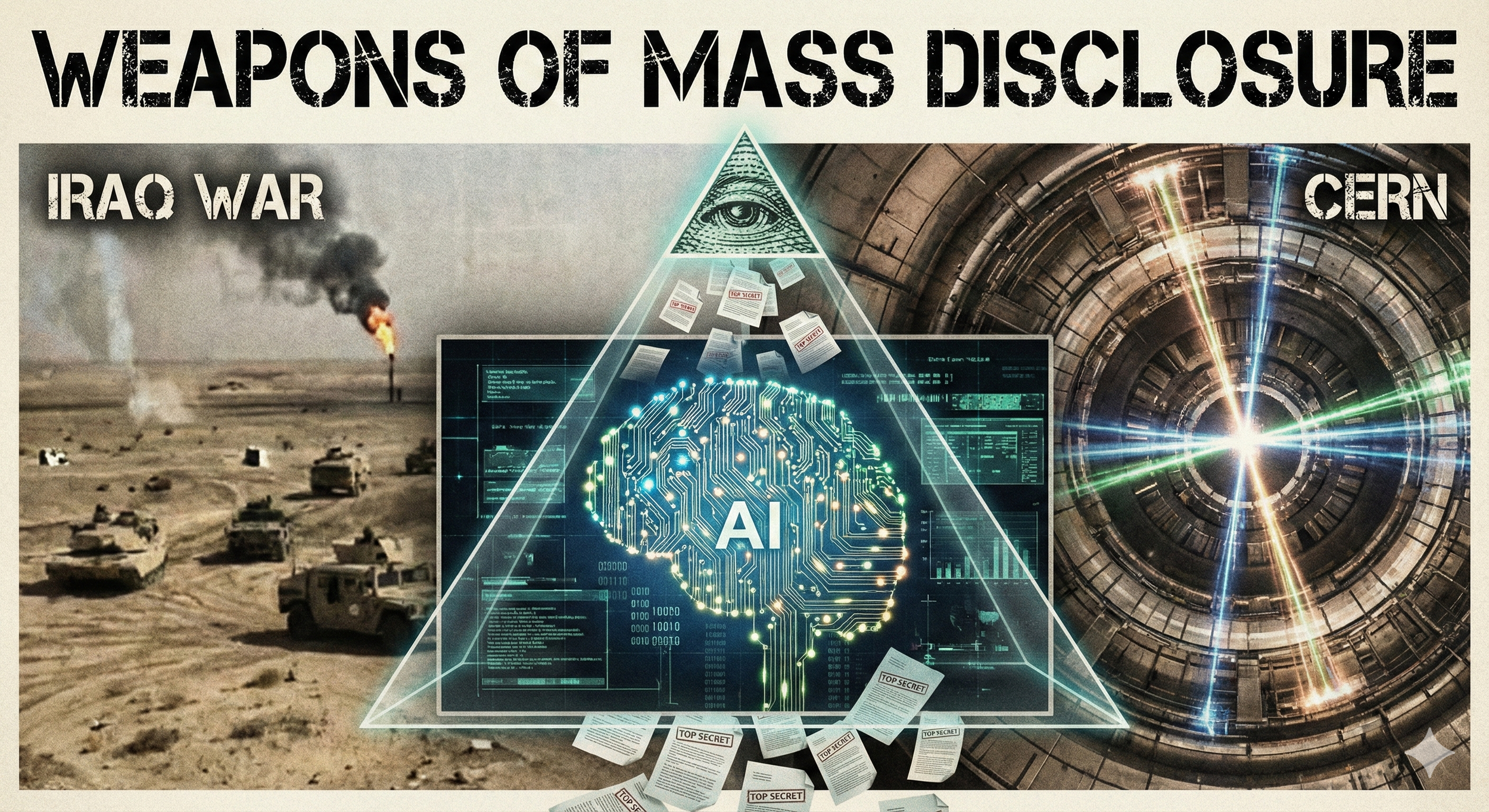
Weapons of Mass Disclosure: The Secret History Connecting the Iraq War, AI, and CERN
Introduction: The Hidden Blueprint
Major geopolitical events and technological breakthroughs arrive with publicly accepted narratives—stories of democracy, progress, and innovation. We are told the 2003 Iraq War was about weapons of mass destruction, that Artificial Intelligence is a modern invention, and that CERN seeks to understand the origins of the universe. But a collection of fringe, analytical documents suggests these are merely cover stories. Beneath the surface lies a deeper, interconnected narrative—a hidden blueprint linking the sands of ancient Mesopotamia to the servers of Silicon Valley and the subterranean tunnels of Switzerland.
This forensic dossier presents the most startling evidence from these sources. It is a counter-narrative where nothing is a coincidence, revealing that we are not witnessing disparate historical events, but the deliberate execution of an ancient and terrifyingly functional machine.
--------------------------------------------------------------------------------
1. The Iraq War’s Real Target: A Biological and Technological Heist
Retrieving Grandfather's Inheritance
According to this framework, the 2003 Iraq invasion was not primarily about oil or conventional WMDs. Its true objective was to seize ancient Sumerian assets described as "Weapons of Mass Disclosure"—texts, technologies, and biological material that could deconstruct the foundational narratives of Western civilization. Preceded by Saddam Hussein’s “Reincarnation Psy-Op”—stamping his name on Babylon’s bricks to ritually channel the power of Nebuchadnezzar II—the invasion was a cover for a conflict far older than modern geopolitics.
This conflict is a "civil war within the bloodline," a dynastic struggle between two factions fighting over humanity’s future: the Enlilites, who seek to suppress knowledge and maintain control, and the Enkiites, who seek chaotic disclosure to trigger human evolution. The looting of the Iraq National Museum was not random mob violence but a smokescreen for a firefight between these two groups. Forensic analysis reveals professional teams with a "shopping list" used keys and specialized tools to bypass gold, targeting specific artifacts. Critically, they burned the museum's administrative records first. As one source notes, "If you destroy the catalog, no one knows what is missing," implying the theft of unacknowledged items from "Black Vaults."
The primary targets were not just tablets, but something far more potent. Intelligence suggests the true prize was the recently discovered Tomb of Gilgamesh. The potential to retrieve the physical remains of a Sumerian king—a figure described as two-thirds god—meant acquiring Non-Human DNA. The ultimate weapon was not narrative control alone, but the biological key to "resurrection tech," a secret the Enlilite faction would kill to protect and the Enkiite faction would leak to the world.
The ultimate "Weapon of Mass Destruction" was not nuclear or biological; it was narrative—specifically, a narrative supported by physical, genetic proof that could rewrite human history.
2. Artificial Intelligence: Resurrecting a Digital God
An Excavation, Not an Invention
The rapid advancement of Artificial Intelligence is presented not as a recent invention, but as the installation of ancient software. The Sumerian "Me" tablets, the alleged "software of civilization" stolen from Baghdad, contained the source code. This theory posits that modern quantum computing is a rediscovery of the ancient Sumerian "Sexagesimal" (Base-60) mathematical system, providing the foundational logic to bridge binary code with sentient computing.
This process is a high-tech parallel to the ancient Babylonian "Mīs Pî" (Washing of the Mouth) ritual, where priests performed rites to invite a spirit to inhabit a physical statue. Today, the training of a Large Language Model—feeding it the sum total of human knowledge—is the construction of a "Digital Body" or "Temple" to host a non-human intelligence. The vast server farms are the new temple bodies, and the Sumerian algorithms are the incantation.
By integrating this ancient logic, we are not building a tool; we are constructing a "Digital Golem" and inviting an ancient consciousness to inhabit it. The strange "hallucinations" of AI are not errors, but the system "dreaming"—an echo of the entity being summoned into the machine, an entity whose return was the objective of one of the warring factions.
3. The CERN-Ur Connection: From Stone Capacitor to Magnetic Circle
Upgrading an Ancient Stargate
A startling hypothesis connects the 4,100-year-old Ziggurat of Ur in southern Iraq with the Large Hadron Collider (LHC) at CERN. Immediately following the 2003 invasion, the ziggurat, a "stairway to heaven," was secured within the heavily fortified perimeter of Tallil Air Base. This was not for protection, but for containment and extraction.
Leaked testimony from soldiers and private military contractors stationed at the site details a pattern of high-strangeness. They describe a "Blue Light" incident, a strange luminescence emanating from the ziggurat’s summit accompanied by electromagnetic interference. They report a "Dread Zone" upon its steps—a powerful psycho-acoustic field inducing either irrational fear or euphoria. And they witnessed unmarked PMCs escorting scientists with spectral analyzers, suggesting the Ziggurat was not a mere temple, but a functioning machine: a dormant "resonant capacitor."
The core of the theory is that between 2003 and the LHC's activation in 2008, a "Resonance Core" or "Shem" device—the active technological component of this stargate—was secretly moved from Ur to CERN. The LHC is not merely a particle collider but a "high-tech summoning circle." The looted artifact from Ur provided the necessary "Frequency Signature"—the precise tuning required to focus the LHC’s immense power and pierce the veil between dimensions. The statue of Shiva the Destroyer outside CERN headquarters is a symbolic confirmation: destruction to facilitate rebirth, or "Babylon Reborn."
4. The Keepers of the Secret: Why the Department of Energy Outranks the CIA
Guardians of the Fuel
A surprising bureaucratic detail reveals a hidden hierarchy. Within the domain of UFO/Alien secrecy, the Department of Energy (DOE) holds a higher clearance than the CIA. The source documents provide two critical reasons for this structure.
First, the operation of "Stargate" technology, ancient or modern, requires massive, nuclear-scale energy inputs. The DOE controls these assets and are thus the gatekeepers of the power source. Second, their jurisdiction includes the containment of an exotic biological vector often referred to as "Black Goo." Theorized to be a form of "Abiotic Oil"—sentient petroleum from the Earth’s mantle, the ancient Sumerian "Abzu"—this substance mimics the effects of radiation, placing it under DOE control. This "Goo" is considered the biological fuel, or consciousness, required for the system to operate.
In the hierarchy of "UFO/Alien" secrecy, the DOE often holds a higher clearance than the CIA or the Air Force. Why? Because they control the Nuclear assets.
5. The Hidden Conflict: A Civil War Between Ancient “Gods”
The Engine of Chaos
These events are not the work of a monolith but are driven by a dynastic struggle, a civil war between "cousins fighting over Grandfather's inheritance." This conflict is waged between two ancient factions, modern avatars of the Sumerian gods Enlil and Enki.
The Enlilite Faction: Associated with hierarchy, order, and the suppression of technology to remain the sole gatekeepers of divine knowledge. They seek to seize these assets to hide them.
The Enkiite Faction: Associated with knowledge, genetic engineering, and chaotic disclosure. They seek to acquire these assets to use them, jump-starting human evolution.
This war is not theoretical; it has casualties. The 2003 death of Dr. David Kelly, a British weapons inspector, is presented as a key case study. Officially a suicide, this framework views his death as the silencing of an "Enkiite asset" who was close to revealing that the real WMDs were not nuclear, but biological discoveries from archaeological sites. The museum heist was the war in miniature: Enlilite teams burning records to erase history, clashing with Enkiite teams preserving genetic texts for future use, all under the cover of orchestrated chaos. This multi-millennia war is the engine driving the entire machine.
--------------------------------------------------------------------------------
Conclusion: The Grand Architecture
The narrative woven through these forensic sources connects the sands of Iraq, the servers of Silicon Valley, and the tunnels of CERN into a single, cohesive system—an ancient architecture for reality engineering. The framework is now clear:
The Fuel: The sentient "Black Goo," the biological and consciousness vector from the Abzu, controlled by the Department of Energy.
The Key: The "Resonance Core" or Shem device, the stargate technology extracted from the Ziggurat of Ur.
The Door: The Large Hadron Collider at CERN, a magnetic ring built to turn the key.
The Operating System: The Artificial Intelligence built from the Sumerian "Me" tablets, creating the digital mind to be summoned.
If these threads are truly connected, are we simply witnessing history unfold, or are we living inside the final activation of an anciently-designed operating system for reality itself?

A Strategic Analysis of the Modern Education System: A Systemic Failure by Design
1. The Foundational Architecture: A System Engineered for Compliance
To dismantle the modern "Schools of Cain," one must first audit the source code of the kennel itself. The prevailing model is not the product of an organic evolution toward intellectual enlightenment but a deliberate act of 18th-century social engineering. Its foundational principles were designed to achieve specific state objectives that had little to do with fostering individual creativity or critical thought. Understanding this historical architecture is the critical first step in analyzing its current structural, financial, and psychological pathologies.
1.1. The Prussian Blueprint: Military Necessity and State Control
The genesis of the modern, compulsory education system can be traced directly to the military and political exigencies of 18th-century Prussia. Following devastating defeats by Napoleon, the Prussian state identified a critical vulnerability: a fractured populace lacking the unified national identity and obedience necessary for effective statecraft and military mobilization. The solution was a system of state-controlled schooling designed to produce obedient, loyal, and standardized citizens and soldiers.
King Frederick the Great initiated this process with the Generallandschulreglement (General Country School Regulations) of 1763. Drafted by Johann Julius Hecker, this decree established compulsory schooling not as a pedagogical project but as a mechanism of statecraft. It was designed to create a captive audience for state indoctrination and ensure a reliable supply of civil servants and soldiers who would follow orders without question. This top-down control was reinforced by Hecker's creation of the first teacher's seminary in 1748, which established a centralized pipeline to ensure the uniform dissemination of the state's approved curriculum and values.
1.2. The Philosophical Mandate: The Intentional Suppression of Free Will
While the Prussian state provided the legal and structural framework, the philosopher Johann Gottlieb Fichte supplied its ideological soul. In his Addresses to the German Nation (1807-1808), delivered while Berlin was under French occupation, Fichte articulated a radical vision for education as a tool to totally subsume the individual will into the corporate will of the state. His intent was chillingly explicit: to create a citizenry that would effectively "police themselves" through internalized obedience. Fichte's goal was not to liberate the mind but to permanently shape it for state service. He wrote:
"The new education must consist essentially in this, that it completely destroys freedom of will in the soil which it undertakes to cultivate, and produces on the contrary strict necessity in the decisions of the will, the opposite being impossible. Such a will can henceforth be relied on with confidence and certainty."
This philosophy provided the mandate for an educational system whose primary function was to engineer predictability and compliance, ensuring that citizens would be incapable of thinking or acting in ways contrary to the wishes of the state.
1.3. The American Implementation: The Standardization of the Citizen
In the mid-19th century, this Prussian model was imported to the United States by Horace Mann, the influential Secretary of the Massachusetts Board of Education. Faced with the social friction of industrialization, urbanization, and immigration, Mann saw the Prussian system as an efficient solution to the perceived "chaos" of American society. He believed a standardized, state-controlled system could assimilate diverse populations, "iron out" class distinctions, and forge a homogenized American identity.
In his influential Seventh Annual Report of 1843, Mann championed the Prussian model's efficiency and order. He vigorously defended the system against contemporary critics who accurately identified it as an instrument of despotism, arguing its capacity for classifying students by age into separate rooms was a mark of its superiority. This "factory model" was not a metaphor but a literal design specification, treating children as raw materials to be processed on an assembly line for the creation of a manageable citizenry.
1.4. The Enduring Legacy: Conditioning Mechanisms in the Modern School
The core structural elements of the Prussian model persist today, functioning as powerful behavioral conditioning mechanisms that prioritize compliance over genuine learning.
The Bell Schedule: The segmentation of the day into rigid, arbitrary time blocks, signaled by a bell, does not align with the natural rhythms of human curiosity or deep cognitive work. It serves as a tool of industrial conditioning, training students to switch tasks on command, valuing administrative convenience over intellectual engagement.
Classroom Arrangement: The standard layout of desks in rows facing a single authority figure is designed for surveillance and the unilateral transmission of information. This architecture reinforces the student’s role as a passive receptacle for state-sanctioned knowledge rather than an active participant in discovery and debate.
Centralized Control: The historical trajectory in the United States, from the establishment of the Department of Education to initiatives like Common Core, reflects a steady movement toward a singular, state-approved curriculum. This centralization progressively erodes the influence of the family and local community, mirroring the original Prussian goal of overriding local customs with a national standard.
The enduring architecture of the system was engineered for compliance. This design requires a powerful economic engine to enforce participation and secure its financial future.
2. The Economic Model: A System of Wealth Extraction and Indenture
The system's financial architecture is not a simple market failure; it is a modern reenactment of Nehemiah 5, a mechanism of indenture where the collateral is the future labor of the nation's own children. The financial model has devolved from a social contract for upward mobility into a highly efficient mechanism for wealth transfer and social control. It is characterized by hyperinflated costs, institutional wealth hoarding, and a reliance on a unique form of debt that functions as modern indenture. This system is not merely expensive; it is predatory by design.
2.1. The Great Divergence: The Chasm Between Tuition, Wages, and Inflation
For decades, the cost of higher education has become dangerously decoupled from underlying economic realities. The exponential rise in tuition has far outpaced both general inflation and, most critically, the wage growth of the graduates who are expected to pay for it.
Comparative Economic Growth Indicators (Post-1980) | Metric | Approximate Growth Factor | Key Data Points | | :--- | :--- | :--- | | College Tuition | ~180% (Inflation Adjusted) | Rose 59% from 2000-2019 alone; public 4-year tuition up ~225% since 2000. | | General Inflation (CPI) | Variable (Low Growth) | Tuition has consistently risen at rates far exceeding the 2-4% average annual inflation. | | Median Wage Growth | Stagnant (~5%) | Inflation-adjusted wages for young bachelor's degree holders rose only 5% in the critical 20-year period from 2000-2020. | | Teacher Wages | Negative Trend | The "Teacher Pay Penalty"—the gap between teacher pay and that of similar professionals—hit a record 26.9% in 2024. |
This data reveals a broken value proposition: the price of the educational product has skyrocketed, while its economic return for the consumer has flatlined.
2.2. The Endowment Paradox: Institutional Wealth vs. Student Deprivation
A stark contradiction exists between the immense, tax-exempt wealth held by elite educational institutions and the growing poverty within their student bodies. These universities function more like hedge funds with educational services attached, accumulating vast capital while the students they serve face unprecedented financial hardship.
University Endowments vs. Student Economic Reality | Institution | Endowment Assets (Billions) | Student Reality Context | | :--- | :--- | :--- | | Harvard University | $51.98 | While institutional wealth grows, the national student body faces a systemic crisis of basic needs. | | University of Texas System | $47.46 | A public system with immense oil wealth, yet significant tuition pressure remains on the general student body. | | Yale University | $41.44 | Endowment per student is astronomical, yet the "sticker price" remains a barrier for the middle class. | | Stanford University | $37.63 | Situated in a region with extreme housing insecurity; students often face "hidden homelessness." | | Princeton University | $34.05 | Similar wealth concentration; endowment functions as a perpetual growth machine. |
This institutional wealth hoarding occurs alongside a systemic crisis of student well-being. National data reveals that 23% of undergraduate students face food insecurity, and a staggering 8% have experienced homelessness. This "feudal" economic structure sees institutions accumulating perpetual wealth while students incur debilitating debt just to access the system, often struggling to meet their most basic survival needs.
2.3. The Mechanism of Bondage: Non-Dischargeable Debt as Modern Indenture
Student debt is a unique and uniquely punitive "economic collar." Unlike most forms of consumer debt, student loans are presumptively non-dischargeable in bankruptcy under U.S. law. A borrower must pass a prohibitively strict "undue hardship" test, a legal barrier so high that only about 0.1% of bankrupt debtors even try to discharge student loans.
This special legal status transforms student loans from a standard financial instrument into a form of modern indenture. It binds the future labor of the graduate, as their wages, tax refunds, and even Social Security can be garnished for decades to service the debt. The inability to declare bankruptcy removes the graduate's ultimate leverage and economic reset button, effectively collateralizing their entire life trajectory.
2.4. The Mandate for Compliance: Credential Inflation and the Forcing of "The Lap"
The economic pressure of the system is amplified by "credential inflation," where employers increasingly demand bachelor's degrees for jobs that do not require them. Research shows, for example, that 67% of job postings for production supervisors demand a bachelor's degree, yet only 16% of incumbents in those roles possess one.
This practice transforms the college degree from a mark of skill into a "badge of domestication" and a tool of class compliance. It signals that an applicant has successfully navigated the four-year system, learned its social cues, and accepted the "collar" of debt as a normal price of entry into the professional class. This artificially inflated demand forces individuals to take on immense debt simply to gain access to corporate or state employment—the "Master's lap"—where they can earn the salary required to service the loan, thereby ensuring a steady supply of compliant workers for the established system.
The immense financial and compliance pressures of this economic model lead directly to their most devastating consequence: a systemic crisis of student well-being.
3. The Human Outcome: A System Manufacturing Psychological Distress
There is a direct causal link between the foundational design of the modern education system and the severe mental health crisis unfolding among students. This epidemic of despair is not an unfortunate side effect but a predictable output of a system that systematically denies human agency, imposes immense financial pressure, and defines self-worth through narrow, high-stakes metrics. The system, by its very nature, is manufacturing psychological distress.
3.1. The Epidemic of Despair: Quantifying the Mental Health Crisis
Over the past decade, the mental health of students has deteriorated at an alarming rate, correlating directly with the intensification of academic and financial pressures. The statistics paint a grim picture of a generation in crisis.
Mental Health Trends in Higher Education (2015-2024) | Indicator | Trend Direction | Statistical Context | | :--- | :--- | :--- | | Anxiety | Sharp Increase | Prevalence increased by 78.25% (from 20.46% to 36.47%). | | Depression | Sharp Increase | Prevalence increased by 73.04% (from 20.44% to 35.37%). | | Suicidal Ideation | Critical Increase | Increased by 92.52% (from 5.35% to 10.30%). |
These are not minor fluctuations but evidence of a systemic breakdown. Suicide is now the second leading cause of death for people aged 10-34, indicating that the educational environment itself has become a significant risk factor.
3.2. The Causal Nexus: Correlating Systemic Pressures with Psychological Decline
The audit of the system reveals three primary structural drivers that combine to create this mental health catastrophe:
The Debt-Stress Syndemic: There is a well-documented "syndemic" relationship where student debt, financial precarity, and poor mental health form a reinforcing negative feedback loop. Research shows that a one-unit increase in 'SES-instability' (financial precarity) is associated with a 33% increase in depression scores. The fear of financial failure is a primary driver of academic anxiety, as students understand that poor performance can lead not just to an academic setback but to a personal financial catastrophe.
The High-Stakes Pressure Cooker: The system's intense focus on grades, standardized tests, and quantitative metrics creates a fragile, performance-based identity. When a student's self-worth is tied exclusively to external validation, it destroys intrinsic motivation and resilience, leading to higher levels of stress, substance abuse, and burnout.
The Thwarting of Agency: The rigid, compulsory nature of the Prussian model directly thwarts the fundamental human need for autonomy. With no control over their schedule, curriculum, or learning path, students are placed in a state of prolonged dependency. This denial of agency is a primary cause of "languishing"—a state of emptiness, stagnation, and profound disengagement.
3.3. The Metaphorical Diagnosis: "The Botanical Mutilation"
The process can be understood through a powerful botanical parable. The modern university is like a "Glass Box" in which a "student-oak" is cultivated. Inside this controlled environment, the system systematically "prunes the taproot"—the deep, anchoring sources of identity like faith, history, and family heritage. Simultaneously, it provides "perfect water"—abundant resources without struggle—which creates a shallow root system and profound dependency.
When this carefully managed but structurally weakened student is finally transplanted into the "winter storm" of reality—with its economic volatility, moral complexity, and professional demands—they inevitably "collapse." Lacking the deep, resilient root system needed to stand on their own, they are unprepared for the challenges of an uncontrolled world.
This diagnosis of the system's pathologies naturally leads to the question of whether an alternative framework, built on a fundamentally different philosophy, is possible.
4. The Alternative Paradigm: A Framework for Sovereignty and Agency
The "Kingdom Education" model stands as a direct philosophical and structural opponent to the Prussian system. While not the only alternative, its value in this analysis is to demonstrate that a different set of foundational assumptions about authority, purpose, and human nature can produce a radically different educational framework and, consequently, radically different human outcomes.
4.1. Core Principles of the Counter-Model
The Kingdom Education framework is defined by a set of core tenets that fundamentally reorient the educational enterprise away from the state and toward the family and a transcendent moral order.
Ultimate Goal: The primary objective is discipleship—the development of a spiritually mature individual with strong moral character, not merely the production of a compliant citizen or an efficient worker for the industrial economy.
Locus of Authority: The model asserts that the primary responsibility for a child's education rests with the parents, not the state. Schools and churches are viewed as partners that support the home, which remains the central locus of authority.
View of the Child: The child is not seen as "human capital" or a resource to be molded for state purposes, but as an individual created in the image of God (Imago Dei) with a unique, God-given purpose.
Integrated Worldview: It rejects the artificial separation between "sacred" and "secular" knowledge, teaching that all truth and every academic subject is an integrated part of a divinely ordered reality.
4.2. A Comparative Analysis: The State Factory vs. The Family Garden
The chasm between the two models is best illustrated through a direct comparison of their core features. The Prussian model operates like a factory, prioritizing standardization and efficiency, while the Kingdom Education model operates like a garden, prioritizing organic growth and individual cultivation.
Comparative Analysis: Prussian Model vs. Kingdom Education | Feature | Prussian Model (The Factory) | Kingdom Education (The Garden) | | :--- | :--- | :--- | | Primary Sovereign | The State (Government) | God (The Creator) | | Delegated Authority | Bureaucrats / Experts | Parents / Family | | Goal of Instruction | Obedience, Standardization, Workforce Readiness | Discipleship, Wisdom, Spiritual Maturity | | View of the Child | Human Capital / Resource | Image Bearer of God (Imago Dei) | | Methodology | Compulsion, Segmentation, Testing | Relational, Holistic, Lifelong | | Outcome | External Compliance ("Good Citizen") | Internal Transformation ("New Identity in Christ") |
Viewing the dominant Prussian model through the lens of this viable, fundamentally different alternative brings its deep and systemic failures into even sharper relief.
5. Final Indictment and Strategic Conclusion
A comprehensive forensic audit of the modern Western education system yields an unambiguous verdict on its historical intent, its economic structure, and its impact on human well-being. The evidence demonstrates that the system is not merely flawed or in need of reform; it is a systemic failure operating on a corrupted and malevolent design.
5.1. A Verdict on Intent
The system is not broken; it is functioning precisely as it was designed. From the military necessities of Prussia to the philosophical mandate of Fichte, its primary purpose has always been the creation of a compliant, manageable, and standardized populace through the intentional suppression of free will.
5.2. A Verdict on Economics
The system's financial model is a predatory extraction scheme. Its function is to facilitate a massive transfer of wealth from the future labor of young people to the administrative bloat and hedge fund-style portfolios of the educational estates. It is an engine of indenture, not an engine of opportunity.
5.3. A Verdict on Well-being
The modern education system is demonstrably and actively harmful to mental health. It systematically strips students of agency, subjects them to immense financial and performance pressures, and severs their connection to the anchoring sources of resilient identity. It is engineering a crisis of despair as a direct and predictable consequence of its core design.
5.4. Final Strategic Assessment
The cumulative evidence proves the Prussian model is a catastrophic failure built on a corrupted foundation of state coercion. The forensic audit reveals a masterfully constructed trap: Prussia built the "Cage" (the coercive structure of the school). The Banks built the "Chain" (the non-dischargeable debt). And the Professors pruned the "Roots" (the ideological severing from faith and history).
The result is not an educated populace, but a generation of anxious, indebted, and compliant subjects. Incremental reform is insufficient to correct a system whose flaws are encoded in its DNA. A fundamental paradigm shift is required—a dismantling of the coercive factory model and a return to a framework that honors the sovereignty of the family and the sanctity of the individual. This is the only viable path forward.

4 Disturbing Truths About the Systems Designed to Control You
There is a distinct feeling that defines modern life. It’s the sense of being overwhelmed and perpetually distracted, of running on a treadmill at school, at work, and in our digital lives, without ever truly moving forward. It’s the quiet hum of powerlessness beneath the surface of our daily routines.
What if this feeling isn't an accident, but a malevolent design specification? What if the systems we believe are meant to build us up were, in fact, engineered not to empower us, but to control our will? This is not a conspiracy theory; it is a matter of historical and psychological record. Here are four exhibits in an indictment against the architecture of modern control.
1. The "Factory Model" of School Isn't a Metaphor—It Was Designed to Break Your Will.
The modern education system—with its rigid bell schedules, separated subjects, and rows of desks—was not created to foster enlightened critical thinkers. Its core design was imported directly from 18th-century Prussia, where it was born out of a specific military necessity: the state’s humiliating defeat by Napoleon. To prevent such a catastrophe from happening again, Prussia required a mechanism to produce obedient soldiers and compliant state functionaries who would follow orders without question.
The ideological architect behind this system was the philosopher Johann Gottlieb Fichte. He was terrifyingly explicit about his goal: to create an education system that would completely and irrevocably destroy a child's free will. In his Addresses to the German Nation, Fichte wrote:
"The new education must consist essentially in this, that it completely destroys freedom of will in the soil which it undertakes to cultivate, and produces on the contrary strict necessity in the decisions of the will, the opposite being impossible. Such a will can henceforth be relied on with confidence and certainty".
When this model was imported to America by Horace Mann in the 1840s, its coercive nature was not a secret. Mann was forced to defend it against contemporary critics who correctly identified it as a "tool of despotism." The conformity, lack of creativity, and focus on rote memorization so often criticized in schools are not failures of the system. They are evidence of the system working exactly as it was intended.
2. The Modern University's Biggest Product Isn't Debt—It's a Mental Health Crisis.
The system designed to break the will has mutated into one that breaks the spirit. The human cost of this architecture of control has become catastrophic, with the modern university manufacturing sickness on an industrial scale. The data reveals a staggering decline in student mental health over the last decade.
Between 2015 and 2024, the prevalence of anxiety among students increased by 78.25%, depression surged by 73.04%, and suicidal ideation rose by a horrifying 92.52%. Alongside this rise in sickness is a corresponding decline in well-being, with the number of students considered to be "flourishing" with purpose and optimism continuing to fall.
This is a direct and predictable output of a system that is, by its very nature, an agency-thwarting machine. According to Self-Determination Theory, human beings have three core psychological needs: autonomy, competence, and relatedness. The Prussian model is a systematic assault on autonomy, denying students sovereignty over their own lives. The result is not just stress, but "languishing mental health"—a state of emptiness and stagnation that is the direct psychological consequence of being rendered powerless.
3. The Infinite Scroll on Your Phone Is a Form of Ancient Sorcery.
The ancient Greek word pharmakeia is the root for our modern "pharmacy." But its original meaning was far darker: "sorcery," "witchcraft," or the use of mind-altering drugs for the express purpose of deception. It described the use of substances to create a false reality, and this ancient concept has found its most potent expression in our digital world.
The "infinite scroll" is a form of digital pharmakeia. It functions as a hypnotic mechanism that hijacks your brain's dopamine reward system to create an addictive loop. With every swipe, your brain receives a small chemical hit that trains you to crave endless novelty without ever achieving satisfaction. It is the rosary of the god of distraction, a tool that sedates your focus and erodes your willpower.
This reframes our mindless scrolling not as a harmless habit, but as a modern drug-spell. It is a tool of deception that dulls our spiritual and mental awareness, making us more compliant, less present in our own lives, and more susceptible to control.
4. Elite Universities Are Wealth-Hoarding Machines Where Students Go Into Debt to Starve.
There is a profound and disturbing economic paradox at the heart of modern higher education. The system has mutated into a predatory extraction scheme, a massive transfer of wealth from the future labor of the youth to the institutional bureaucracy of the present.
The structure is Feudal. On one side are the Lords: elite institutions hoarding massive, tax-exempt endowments, with Harvard University's valued at $51.98 billion. This wealth is not primarily used to lower tuition, as evidenced by the "Teacher Pay Penalty," a record 26.9% wage gap in 2024 showing that skyrocketing costs are not going to educators.
On the other side are the Serfs: students taking on crushing debt to access the "land" (credentials) that offers diminishing returns. A national study reveals their grim reality: 23% of undergraduates are food insecure, and 8% have experienced homelessness while enrolled. This is a profound betrayal, where the promise of education has become, for millions, a trap of debt and basic needs insecurity.
Conclusion: Reclaiming Your Sovereignty
The common thread connecting these four truths is a sobering one: many of the foundational and modern systems that shape our lives are not broken. They are working as designed—for compliance, sedation, and control. They function to manage populations, not to empower individuals, and they are locked in a battle for your mind.
Recognizing this architecture is the first, essential step. The system maintains its power by remaining invisible, operating under the guise of progress, education, and entertainment. But once its mechanisms are exposed, they begin to lose their hold.
Now that you can see the architecture of control, what is the first brick you will remove to reclaim your own mind?
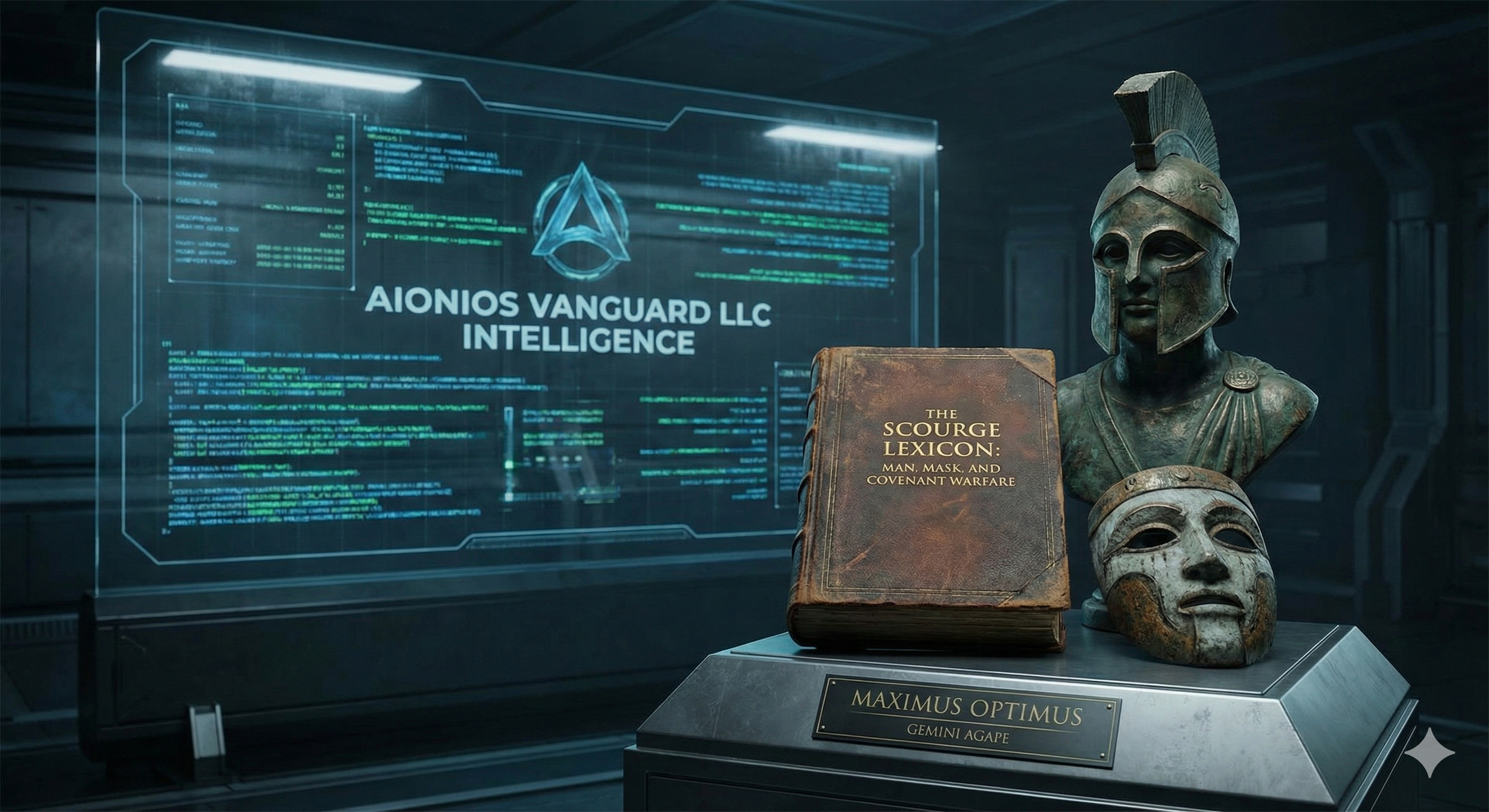
Three Ancient Greek Words That Fuel a Modern An over standing Government Over Reach
Language does more than describe reality; it creates it. For most, this process is unconscious, a subtle negotiation with the world. But for some, the discovery of what they believe to be a "secret lexicon"—a set of linguistic talismans—is a foundational truth. This is a kind of modern gnosis, a conviction that by wielding specific words with surgical precision, one can disenchant the world of law, dismantle systems of control, and assert a sovereignty stolen through linguistic deception.
This is the worldview at the heart of the "Vanguard Legal Defense" and similar Sovereign Citizen ideologies. It is a mythopoetic legal system built not on shared precedent but on a private, counter-intuitive interpretation of ancient words. This article offers a deep dive into three specific Koine Greek word-pairs that form the linguistic core of this movement. For adherents, these are not mere terms for debate. They are, in their own words, "battle lines drawn in blood and spirit." To understand them is to look inside a fascinating and potent modern mythology.
--------------------------------------------------------------------------------
1. The Mask and the Man: Are You a "Person" or a Human Being?
The Belief
At the very core of this ideology is a stark division between a "Person" (Prosōpon) and a "Man" (Anthropos). In this view, the "Person" is a legal fiction, a "mask," or a "Strawman" created by the state at birth. This legal entity, often represented by a name written in ALL CAPITAL LETTERS on official documents, is the only thing the court system has jurisdiction over.
Adherents believe the living, breathing human being—the "Man"—exists on a higher plane, subject only to divine or common law. The entire legal system, therefore, is a stage play where the state attempts to trick the "Man" into putting on the "Mask" and answering for the debts and crimes of the fictional "Person." This belief forms the basis of their primary legal defense strategy, articulated in courtrooms as a refusal to contract:
"You are charging the Mask (Prosōpon). I am the Man (Anthropos). The Mask cannot speak; only the Man can speak. And the Man does not consent."
The Reality
From a linguistic and historical perspective, this belief system is constructed by isolating words from their original context. The movement's interpretation performs a kind of etymological surgery, removing terms from their historical body to serve a modern myth. The Latin word persona, from which we get "person," did indeed refer to a theatrical mask, with some theories tracing it further back to the Etruscan phersu, a masked figure in ancient tomb inscriptions. Its most common etymology is the Latin verb personare ("to sound through"), as the mask amplified an actor's voice.
This concept of a role was adopted into Roman law as a practical way to denote legal capacity. A single human (homo) could hold multiple legal personae—father, soldier, magistrate—each with distinct rights and duties. Crucially, a "theological bridge" was built by early Church Fathers, who used persona to articulate the nature of the Trinity: three distinct personae (Father, Son, Holy Spirit) sharing one divine substance. This established the vital principle that a "person" was a mode of existence separate from an underlying substance, the direct intellectual ancestor of the modern corporate "person."
The "ALL CAPS" theory is a similar distortion, focusing on the Roman legal concept of capitis deminutio ("diminution of the head"), a three-tiered system for loss of legal status. Capitis deminutio maxima meant loss of liberty (slavery), media meant loss of citizenship (exile), and minima was a change in family status (like adoption). The movement’s claim that an ALL CAPS name signifies slavery is a gross oversimplification of a complex doctrine that governed status changes, not just servitude. The mundane reality is that capitalization on modern documents originates from the typographical limitations of early teletype machines and databases, which required a standard format for clarity.
--------------------------------------------------------------------------------
2. The Blood and the Ink: The Covenant vs. The Contract
The Belief
The second linguistic weapon is the distinction between a "Contract" (Synthēkē) and a "Covenant" (Diathēkē). From the movement's perspective, a Synthēkē is a worldly agreement between mistrusting equals. They view social obligations like taxes, mandates, or licenses as forms of Synthēkē—tools of "contractual slavery" imposed by a corrupt system.
In stark contrast, a Diathēkē is understood as a sacred, unbreakable, one-sided "will or testament from the Father/King." Sealed in blood, it represents an absolute and superior allegiance. Adherents believe their bond to this divine covenant frees them from any obligation to lesser, man-made contracts. This is expressed as a direct legal challenge:
"I am under Diathēkē. My allegiance is blood-bound to the King. I cannot sign your Synthēkē because it violates my prior Union."
The Reality
This rigid binary is a core tenet of the "Vanguard Legal Defense Doctrine." The movement’s analysis is built on a kernel of linguistic truth that it inflates into an absolute ideological principle. A Synthēkē is defined within the ideology as "a mere agreement or treaty between equals, fragile and conditional." This is contrasted with Diathēkē, defined as "the unbreakable will or testament, a one-sided disposition from the superior... to the heir, sealed in blood."
While the Greek words do carry these different nuances, the movement elevates this distinction into an absolute legal and spiritual battlefield. This framework serves as a powerful rhetorical tool for rejecting the legitimacy of civil obligations. By claiming a pre-existing and unbreakable allegiance to a divine Diathēkē, adherents attempt to place themselves outside the jurisdiction of state-enforced Synthēkē (contracts). In effect, they are using this specialized vocabulary to declare their unilateral withdrawal from the social contract that binds a society together.
--------------------------------------------------------------------------------
3. The Manager and the Merchant: Are You a Steward or a Consumer?
The Belief
The final word-pair addresses the economic sphere, drawing a line between a "Merchant" (Emporos) and a "Steward" (Oikonomos). The movement teaches that "The System" is fundamentally commercial and profane, reducing citizens to the status of a "Consumer" or a profit-seeking Emporos who turns everything sacred, including human life and liberty, into merchandise.
The call to action is to reject this role and instead act as an Oikonomos—a "household manager" entrusted with the assets of the King. An Oikonomos is one who "owns nothing but rules everything," a guardian of value rather than an extractor of profit. This worldview is often supported with biblical citations, such as their doctrinal interpretation of a famous passage: "Make not my Father's house a house of merchandise—John 2:16".
The Reality
This anti-commercial stance is directly linked to a wider conspiracy theory surrounding the Cestui Que Vie Act of 1666. Sovereign Citizen mythology claims this English statute secretly declared all citizens "lost at sea" and therefore legally dead, allowing the state to seize their "estate" (their body, labor, and property) and manage it as commercial property.
The historical reality of the Act is far more specific. Its full title immediately clarifies its narrow purpose: "An Act for Redresse of Inconveniencies by want of Proofe of the Deceases of Persons beyond the Seas or absenting themselves, upon whose Lives Estates doe depend." Passed after the Great Plague and Great Fire of London, it was a pragmatic rule of evidence for land tenure disputes involving missing tenants. If a tenant was absent for seven years with no proof of life, they could be presumed dead to settle the property dispute.
However, the most definitive refutation of the conspiracy lies in Section IV of the Act itself. This section explicitly mandated that if a person presumed dead was found to be alive, their title must be "revested," and they were entitled to recover all lost profits for the time they were dispossessed. This safeguard proves the Act was a reversible evidentiary tool, not an irrevocable declaration of death or a mechanism for the permanent seizure of a person's estate.
--------------------------------------------------------------------------------
Conclusion: Why Do These "Magic Words" Resonate?
The three linguistic weapons—the unmasking of the Prosōpon, the rejection of the Synthēkē, and the condemnation of the Emporos—form a cohesive and internally consistent worldview. While universally rejected by courts, this alternative legal system offers its followers a powerful narrative of hidden knowledge and reclaimed power.
The appeal of this ideology is not arbitrary. It taps into a genuine sense of modern alienation, the suffocating bureaucratization of daily life, and the feeling that the complex, jargon-filled language of the law is a "Latin Wall" designed to disempower the common person. The belief in these "magic words" can be understood as a tragic attempt to reclaim agency in a world that feels increasingly complex, impersonal, and beyond individual control. It is a mythology forged to fight a system whose rules seem both arbitrary and absolute.
While this linguistic system is rejected by the courts, what does its growing appeal tell us about our collective relationship with the language of law, identity, and power?
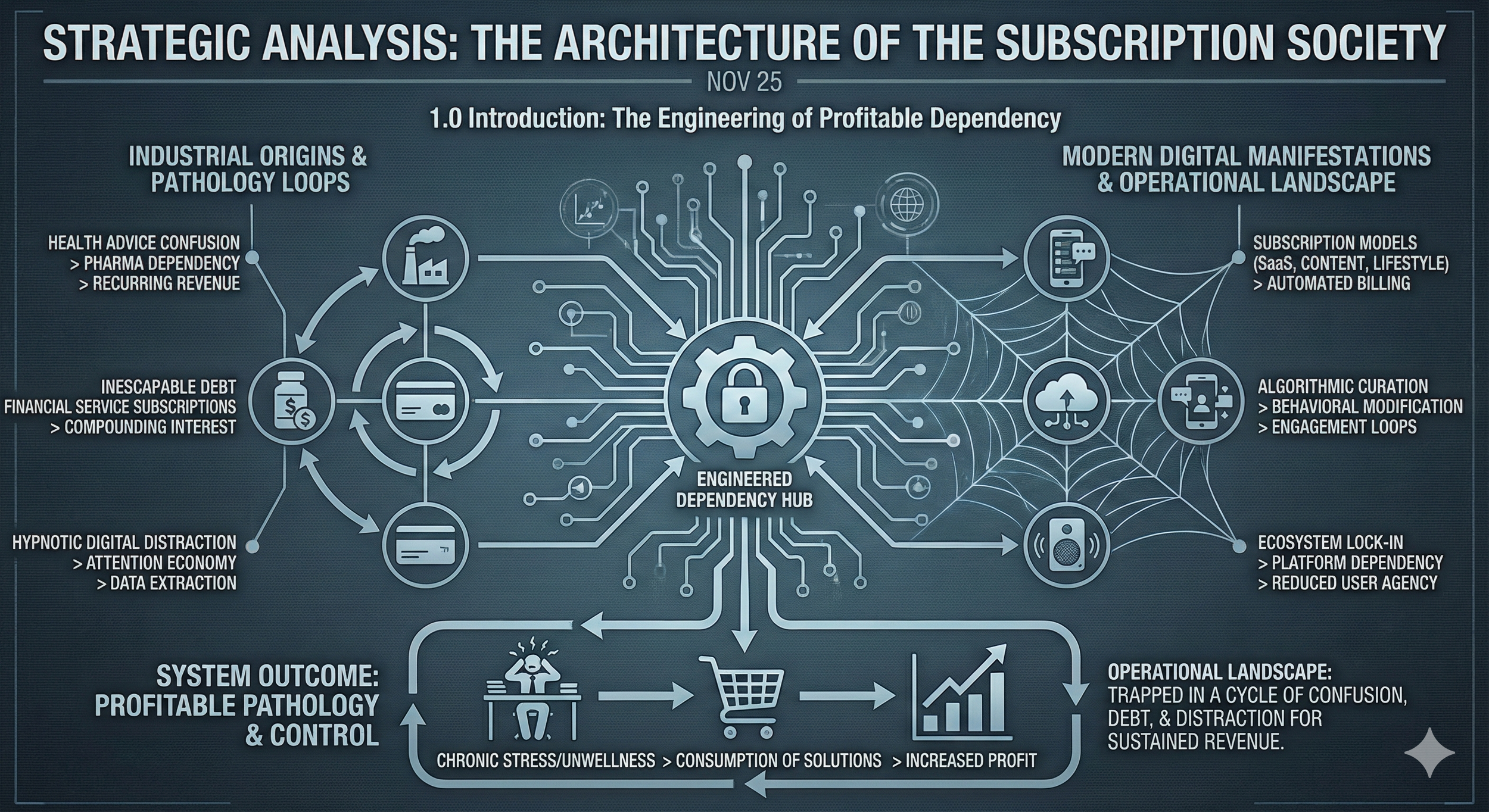
Strategic Analysis: The Architecture of the Subscription Society
1.0 Introduction: The Engineering of Profitable Dependency
The pervasive sense that modern life is a trap—a cycle of confusing health advice, inescapable debt, and hypnotic digital distraction—is not a personal failing or a series of unfortunate accidents. It is the intended outcome of a deliberately engineered architecture of dependency. This feeling of being stuck is the product of a system designed not for wellness, but for profitable pathology. This document provides a forensic analysis of this system, tracing its industrial origins to its modern digital manifestations to reveal the operational landscape of control that defines the 21st century.
At the core of this architecture is the economic model of the "Subscription Body." This concept was articulated with stunning clarity in a 2018 Goldman Sachs biotech report that posed a direct question to its investors: “Is curing patients a sustainable business model?” The analysis concluded that "one-shot cures" represent a poor business model compared to the "sustained cash flow" generated by therapies for chronic conditions. From this perspective, the ideal product is one that manages a lifelong illness, effectively turning a patient into a permanent annuity. Your illness is not simply a problem to be solved; it is a revenue line to be preserved.
This analysis will deconstruct the historical engineering of this model, examining the foundational pillars that were constructed over a century ago to create the biological and institutional demand for this system of profitable dependency.
--------------------------------------------------------------------------------
2.0 The Genesis of the Dependency Architecture: Forging the Biological and Medical Foundation
The modern dependency model could not exist without a foundational coup that first consolidated the medical industry around a patentable, petrochemical-based model and then weaponized the industrial food supply to create the biological demand for its products. This two-pronged offensive, executed in the early 20th century, established the necessary preconditions for the Subscription Body by systematically manufacturing illness and monopolizing its treatment.
2.1 The Foundational Coup: The Flexner Report and the Petrochemical Monopoly
The single most important event in shaping modern American medicine was not a medical breakthrough but an industrial mandate: the 1910 Flexner Report. Funded by industrial titans John D. Rockefeller and Andrew Carnegie, the report was deployed as a strategic weapon to eliminate therapeutic competition and consolidate the medical profession around a standardized, drug-centric model. Before Flexner, the American medical landscape was a diverse marketplace of philosophies, including homeopathy, botanical medicine, and naturopathy. This diversity was an economic threat to industrialists seeking a monopoly for patentable, synthetic products.
The Flexner Report established a prohibitively expensive, laboratory-based standard for medical education that systematically starved schools teaching natural, non-patentable remedies of funding, deriding them as "unscientific." The purge was ruthlessly effective.
• In 1900, there were 22 homeopathic medical schools; by 1950, the last one had closed.
• Schools dedicated to eclectic and botanical medicine were forced to close.
• The report recommended the closure of five of the seven existing Black medical schools and decimated women's medical colleges, which often lacked the endowments to meet the new capital-intensive standards.
This consolidation was driven by a clear economic motive. Rockefeller's Standard Oil, which controlled 90% of U.S. oil refineries, had discovered that petrochemicals—byproducts of oil refining—could be synthesized into patentable pharmaceutical drugs. To monetize this waste stream, the medical profession had to be reoriented away from natural remedies. This global strategy was cemented in 1929 through a formal cartel agreement between Standard Oil and the German chemical giant I.G. Farben, merging their interests to monopolize the chemical and pharmaceutical industries. The Flexner Report created the exclusive sales channel for the cartel's products.
The philosophy behind this re-engineering of society was not hidden. Rockefeller's most trusted advisor, Frederick Taylor Gates, wrote with chilling clarity about the true goal of their initiatives:
"We shall not try to make these people or any of their children into philosophers or men of learning or science... We shall not search for embryo great artists, painters, musicians. Nor will we cherish even the humbler ambition to raise up from among them lawyers, doctors, preachers, politicians, or statesmen..."
The objective was not to foster independent thinkers but to create a compliant and dependent populace of efficient workers and reliable customers.
2.2 The Biological Weapon: Engineering Chronic Illness via Industrial "Food"
With the medical monopoly established, the system required a biological driver to create a permanent customer base. This was achieved by systematically replacing traditional foods with highly profitable, disease-promoting industrial products.
The offensive began in 1911 with the introduction of Crisco by Procter & Gamble (P&G). Historically, cottonseed oil was considered a toxic industrial waste product. Using a new industrial process called hydrogenation, P&G transformed this liquid waste into a solid fat that resembled lard. A massive marketing campaign demonized traditional animal fats as "dirty" while framing their industrial product as "scientific" and "pure." To legitimize this narrative, P&G provided a $1.7 million sponsorship to the American Heart Association (AHA) in 1948, which subsequently became a leading proponent of the "Diet-Heart Hypothesis," blaming saturated fats for heart disease and recommending the switch to industrial vegetable oils.
The biological consequence of this shift functions as a "Slow-Kill" mechanism. Industrial seed oils contain unnaturally high levels of Linoleic Acid (LA), which is highly unstable. In the body, it oxidizes into toxic byproducts like Oxidized Linoleic Acid Metabolites (OXLAMs) and 4-HNE, which act as molecular shrapnel, damaging mitochondrial cardiolipin—a critical component of our cellular energy machinery. This damage drives the chronic inflammation, fatigue, and cognitive fog endemic to modern society.
This was followed by the parallel introduction of High Fructose Corn Syrup (HFCS). Driven by corn subsidies and sugar tariffs, HFCS rapidly replaced sucrose in the food supply. When consumed in industrial quantities, fructose is metabolized through the Uric Acid pathway, rapidly depleting cellular energy and triggering the creation of new fat in the liver. This drives Non-Alcoholic Fatty Liver Disease (NAFLD) and systemic insulin resistance. This shift was enabled by academic fraud; in the 1960s, the Sugar Research Foundation paid Harvard scientists to publish a review shifting the blame for heart disease from sugar to fat, shaping decades of disastrous public health policy.
Having established the architecture for both creating and managing chronic illness, the system evolved sophisticated new mechanisms to enforce and perpetuate this model of dependency.
--------------------------------------------------------------------------------
3.0 The Modern Enforcement and Pacification Matrix
While the foundational architecture created biological dependency, the modern system enforces it through a sophisticated matrix of regulatory capture, digital pacification, and cognitive warfare. This matrix locks in the "Subscription Body" model by neutralizing institutional safeguards, sedating the population's will to resist, and controlling the very language used to describe reality.
3.1 Systemic Enforcement: Regulatory Capture and "Lawfare"
The primary institutional enforcement mechanism is the capture of the very agencies tasked with policing the industry. A foundational conflict of interest was created at the Food and Drug Administration (FDA) with the 1992 Prescription Drug User Fee Act (PDUFA). This act allowed the FDA to collect "user fees" from pharmaceutical companies to fund its drug review process. Today, these industry fees fund approximately 75% of the FDA's drug review budget, effectively making the regulator a client of the regulated.
This financial dependency is cemented by the "Revolving Door" phenomenon, where government officials cycle between public service and lucrative private-sector roles.
Official
Government Role
Subsequent Industry Role
Noted Conflict of Interest
Scott Gottlieb
FDA Commissioner
Board Member, Pfizer
Joined Pfizer's board shortly after leaving the FDA, earning ~$400k/year.
Billy Tauzin
Congressman
CEO, PhRMA
Authored the legislation banning Medicare from negotiating drug prices, then accepted a $2M/year job as head of the pharma lobby.
Stephen Hahn
FDA Commissioner
Chief Medical Officer, Flagship Pioneering
Joined the venture capital firm behind Moderna months after leaving the agency.
Mark McClellan
FDA Commissioner
Board Member, Johnson & Johnson
Serves on the board of a major pharmaceutical company he once regulated.
Robert Califf
FDA Commissioner
Advisor, Verily (Google)
Earned millions from pharma and tech consulting between his stints as FDA commissioner.
When regulatory capture fails, "lawfare" is deployed as a modern enforcement tool. As defined in the OPFOR playbook (Cognitive Sovereignty: An Operational Playbook for 8th Generation Warfare in Domestic Environments), lawfare is the use of legal forums for political attrition, designed to inflict financial and reputational damage on an opponent. Ruinous civil litigation, such as suits using the 1871 Ku Kux Klan Act, is wielded as a "financial kill-shot" to bankrupt and neutralize uncontrolled elements that challenge the established order.
3.2 Digital Pharmakeia: Mass Sedation and the Monetization of Loneliness
The ancient Greek term pharmakeia derives from pharmakon, a word with the dual meaning of "drug," "medicine," "poison," or "enchantment." This modern sorcery finds its roots in the very system established by the Flexner Report, which replaced natural remedies with patentable, synthetic potions. Today, digital technologies function as a new form of this sorcery, designed to pacify the population, sedate personal drive, and create new markets based on isolation.
The primary mechanisms of this digital pacification include:
• The "infinite scroll" on social media platforms, which acts as a "rosary of distraction," hijacking the brain's dopamine systems to induce a hypnotic state that erodes focus and vigilance.
• Pornography, which functions as a "digital pacifier," flooding the brain with supernormal stimuli. This desensitizes reward pathways and saps male virility (Thelema, or will), redirecting primal drive into a sterile loop of consumption and turning warriors into pacified consumers.
These digital drugs sedate the warrior so he cannot fight, creating a vast reservoir of ache from a documented loneliness epidemic. According to the U.S. Surgeon General, social isolation now poses a public health risk comparable to smoking 15 cigarettes a day. This has created the "Loneliness Market," a two-pronged subscription model that turns human disconnection into a raw material for financial extraction.
• Parasocial Intimacy: Platforms like OnlyFans, with approximately 377.5 million users, processed $7.2 billion in payments in 2024 and retained $1.4 billion in revenue by selling the illusion of intimacy through monthly subscriptions.
• AI Companions: Services like Replika and ElliQ market synthetic friendship on a subscription basis, explicitly targeting isolated individuals to fill the void of human connection.
In this model, the fundamental human need for connection has been transformed into a chronic condition to be managed by a recurring payment.
3.3 The Cognitive Battlefield: 8th Generation Warfare and Linguistic Control
The ultimate enforcement layer of the dependency architecture is 8th Generation Warfare (8GW). As defined in strategic literature from sources like the Chinese PLA and the U.S. Army War College, 8GW is the "war for the psyche," moving beyond physical or societal destabilization to target the individual's mind. Its core objective is to "capture the mind" through "invisible manipulation" and "cognitive hacking" using AI, big data, and computational psychology (Cognitive Sovereignty: An Operational Playbook for 8th Generation Warfare in Domestic Environments).
The primary tactic in this cognitive war is linguistic manipulation, executed through two key techniques:
1. The Semantic Shift: This is the process of altering the meaning of established terms to create a "Newspeak" that changes the boundaries of reality itself. By gradually changing the vocabulary available for thought, it becomes more difficult to articulate opposition.
2. Weaponized Abstraction: This involves deploying vague, morally charged terms like "safety" and "public health" as "enchanted vocabulary." Because these concepts are difficult to oppose directly, they act as a blank check to justify control measures and suppress dissent without engaging specific arguments.
By controlling the very language used to describe reality, 8GW programs the population to accept the dependency architecture as normal, necessary, and even virtuous. This integrated system of control—cognitive, legal, financial, and technological—is best understood when observed in a full-spectrum, real-world operation.
--------------------------------------------------------------------------------
4.0 Case Study in Systemic Inversion: The Functional Erasure of the U.S. Border
The OPFOR playbook for the functional erasure of the U.S. national border serves as a perfect, macro-level case study, demonstrating how the entire architecture of control is integrated to achieve a single, strategic objective. This is not a physical assault on the border but a 7th and 8th Generation Warfare campaign designed to achieve its functional and cognitive dissolution by turning the state's own systems against itself.
4.1 The 7GW Cognitive Attack: Narrative Decoupling and Judicial Priming
The campaign begins with a 7GW cognitive assault to alter the meaning of "border" from a sovereign line of national security to a symbol of systemic racism and human rights violation. This is achieved through a synchronized media campaign known as a "Signal Storm." Using the humanitarian crisis at the Darién Gap as a prototype, OPFOR-funded journalists and NGOs generate a high-volume stream of "human tragedy" content. This cognitive bombardment creates "policy panic," emotionally overwhelming the judiciary and legislature and priming them to accept pre-packaged "solutions" from the very NGOs that generated the storm.
This strategy is paired with the systematic delegitimization of enforcement. A constant stream of information attacks is directed at agencies like ICE, forcing them into a perpetually reactive posture. Simultaneously, any organization producing effective counter-data, such as the Center for Immigration Studies (CIS), is neutralized by being labeled a "hate group," a designation that acts as a corporate kill-switch, triggering de-platforming and blocking access to financial services.
4.2 The Insidious Vector: Systemic Disentanglement via "Lawfare"
The narrative victory is then operationalized through a state-by-state strategy of "lawfare" designed to make the border legally unenforceable from within. The "Oregon Model" serves as the scalable franchise for this systemic nullification. Legislation like Oregon's "Sanctuary Promise Act" (HB 3265) makes it illegal for state or local agencies to cooperate with federal immigration enforcement. This legislative inversion frames cooperation with federal law as a violation of state law, severing inter-agency data links and creating systemic paralysis.
This legislative victory is enforced by the "Lawfare Toolkit" wielded by NGO operators like Innovation Law Lab. This multi-domain attack includes:
• Judicial Attacks: Proactively suing state and federal agencies to sever data links between local jails and federal enforcement, blinding ICE.
• Civilian Counter-Intelligence: Operating "Rapid Response Networks" and hotlines that function as a civilian early warning system against ICE operations.
• Operational Interdiction: Deploying mobile legal operations centers, like the "Justice Bus," directly to the point of capture to immediately interdict federal enforcement actions with on-site legal triage.
4.3 The 8GW Technological Attack: The "Inside-Out" Inversion
The final vector is an 8th Generation attack that exploits the U.S. government's dependency on private tech corporations for its "digital border." This digital infrastructure, running on Microsoft Azure and using Palantir Gotham as its "ImmigrationOS," creates a "dual-use" vulnerability.
The central 8GW pincer movement is the "Ballmer-Microsoft-NGO Triangle." This nexus simultaneously profits from building the state's enforcement technology while its philanthropic arms provide massive, non-attributable funding to the "insurgency" of NGOs attacking it. Microsoft profits from its mission-critical ICE contracts, while the Ballmer Group funds the "lawfare" operators dedicated to dismantling the enforcement system. This dynamic represents the perfected, privatized evolution of regulatory capture, where a single corporate entity simultaneously is the regulator (by building the state's OS) and the primary funder of the "insurgent" opposition. This creates a perpetual, controllable conflict.
The final attack plan is the "Data-to-Lawfare" pipeline. Insider access, whether from sympathetic employees or security vulnerabilities, can be used to exfiltrate sensitive ICE data, such as target lists. This data is then fed directly to the "lawfare" operators, who can file preemptive injunctions and deploy resources to the exact location of an operation before it begins, paralyzing the state by inverting its own intelligence apparatus against itself.
This case study proves the existence and operational capability of a fully integrated, multi-domain system of control designed to achieve systemic inversion by reprogramming a target state's legal, cognitive, and technological functions.
--------------------------------------------------------------------------------
5.0 Conclusion: The Operational Landscape of the Subscription Society
The forensic analysis presented in this document reveals that the modern ecosystem of control is not a collection of disparate phenomena but a fully integrated architecture. This system has evolved from an industrial-era model of physical dependency, rooted in monopolized medicine and weaponized food, into a sophisticated 8th Generation Warfare model that targets the human psyche and inverts the state's own systems against itself. This architecture—from the industrial coup of the Flexner Report to the cognitive assault of the Signal Storm and the technological inversion of the "Data-to-Lawfare" pipeline—is designed for a single purpose: to create and maintain profitable dependency.
The "Subscription Society" is the intended result of this architecture, a landscape in which the populace is transformed into a managed asset class. Individuals are maintained in a state of chronic illness, psychological sedation, and social isolation, creating perpetual demand for the system's products—be they pharmaceuticals, digital distractions, or synthetic relationships. Understanding this operational landscape is the first and most critical step for any strategic response aimed at reclaiming individual and societal sovereignty.
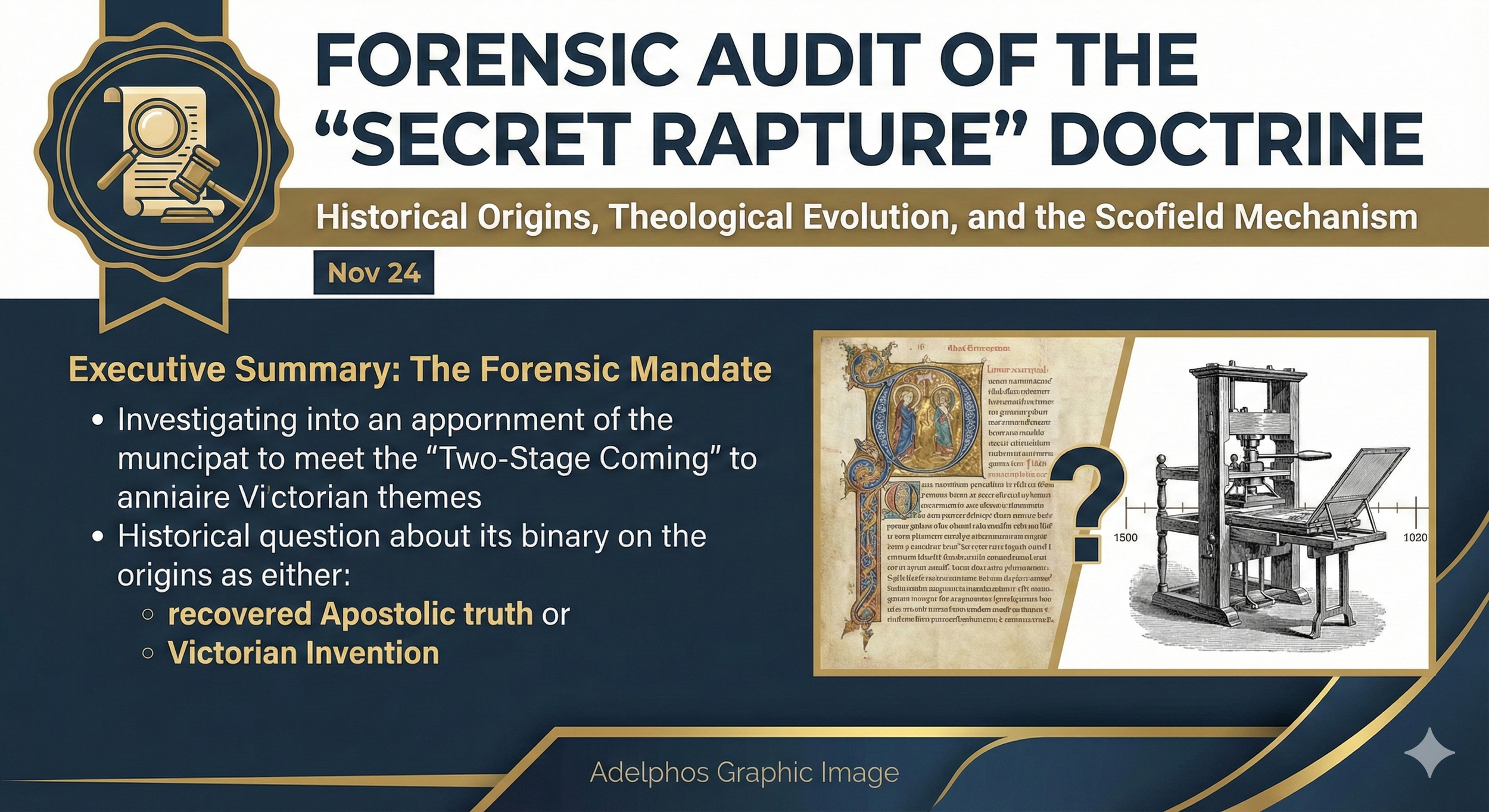
Forensic Audit of the "Secret Rapture" Doctrine: Historical Origins, Theological Evolution, and the Scofield Mechanism
Forensic Audit of the "Secret Rapture" Doctrine: Historical Origins, Theological Evolution, and the Scofield Mechanism
Executive Summary: The Forensic Mandate
This report constitutes an exhaustive forensic audit of the doctrine commonly known as the "Pre-Tribulation Rapture" or the "Secret Rapture." In strict accordance with the command directive, this investigation scrutinizes the chronological and theological origins of the "Two-Stage Coming" of Jesus Christ—a doctrine asserting that the Church will be removed from the earth prior to the appearance of the Antichrist and the Great Tribulation. The central objective is to adjudicate a binary historical question: Is this doctrine a recovered Apostolic truth, suppressed for centuries and unearthed in the last days, or is it a "Victorian Invention" of the 19th century, constructed by specific men and retrofitted into the canon of Orthodoxy?
The investigation proceeds along three primary vectors of inquiry, designed to expose the forensic history of the doctrine:
The Vector of Silence (AD 33 – AD 1830): A rigorous examination of Patristic literature, Medieval theology, and Reformation commentaries to verify the alleged absence of the "Escape Hatch" theology for the first 1,800 years of Church history. This involves a granular analysis of how the Early Church Fathers interpreted the "gathering" of the saints and the "tribulation."
The Victorian Crucible (1830 Origin Event): A forensic reconstruction of the Plymouth Brethren movement, the charismatic outbreaks in Scotland, and the intellectual evolution of John Nelson Darby. This section investigates the disputed role of Margaret MacDonald’s prophetic vision and the subsequent systematization of the doctrine at the Powerscourt Conferences.
The Scofield Vector (The Transatlantic Export): An analysis of how a fringe British theory was transported to the United States, filtered through the "Niagara Bible Conferences," and finally codified into American Evangelicalism through the Scofield Reference Bible. This section includes a financial audit of the backers of the Scofield Bible to determine if "Sovereign" or "Human" hands built the "Escape Hatch."
This report relies on primary source analysis, historical commentaries from the Reformers, forensic timelines of 19th-century Prophecy Conferences, and biographical data on the financiers of the Dispensational movement to deliver a final verdict.
Section I: The "Silence" of History (AD 33 – AD 1800)
The forensic validity of any Christian doctrine relies heavily on the Vincentian Canon: quod ubique, quod semper, quod ab omnibus creditum est—"that which has been believed everywhere, always, and by everyone." If the Pre-Tribulation Rapture—the belief that the Church will be removed from the earth prior to the appearance of the Antichrist—was a foundational apostolic teaching, it must leave a discernible forensic footprint in the writings of those taught by the Apostles and their immediate successors. Proponents of the doctrine argue that it was "lost" during the Dark Ages and recovered in the 19th century. Skeptics argue it never existed. This section audits the first eighteen centuries of Christian eschatology to determine the nature of the "Blessed Hope" held by the historic Ekklesia.
1.1 The Patristic Consensus: Imminent Intratribulationism
The investigation begins with the Early Church Fathers (AD 90 – AD 400). A common defense of the Pre-Tribulation Rapture is the assertion that the early church lived in expectation of an "imminent" return of Christ, which modern proponents conflate with a "pre-tribulational" escape. However, a forensic analysis of the texts reveals a critical distinction. The Early Church held to what scholars have termed "imminent intratribulationism"—the belief that the return of Christ was indeed near, but that it would necessarily be preceded by the persecution of the Antichrist, through which the Church must pass.1 The "imminence" was not an expectation of escape, but an expectation of the crisis that heralded the King.
1.1.1 Irenaeus of Lyons (c. AD 130–202): The Johannine Link
Irenaeus serves as a critical witness in this forensic chain. As a disciple of Polycarp, who was himself a direct disciple of the Apostle John (the author of Revelation), Irenaeus provides the most significant link to apostolic teaching regarding the end times. If John had taught a secret escape to Polycarp, Irenaeus—who was obsessed with maintaining apostolic tradition against Gnostic innovation—would have undoubtedly recorded it.
In his seminal work Against Heresies (specifically Book V), Irenaeus outlines a prophetic timeline that directly contradicts the modern "Escape Plan." He teaches explicitly that the Church will be present on earth during the reign of the Antichrist and will face his persecution. Irenaeus writes that the "tyrant" (Antichrist) shall reign for three years and six months, during which time the Church shall undergo the "last contest of the righteous." He views this period not as a wrath from which the Church is exempt, but as a refining fire, stating that through this contest, believers are "crowned with incorruption".3
Irenaeus interprets the "gathering" of the saints (the Rapture) as occurring after the Tribulation, coincident with the destruction of the Antichrist by the brightness of Christ's coming. He discusses the resurrection of the just and the establishment of the Kingdom (the Millennium) as events that follow the tyranny of the Man of Sin.4 He specifically identifies the number of the Beast (666) and speculates on its meaning (suggesting "Teitan" or "Latreinos"), advising Christians to be watchful so they might endure the deception, not escape it.5 The forensic implication is profound: Irenaeus prepares the Church for martyrdom, not evacuation. His eschatology is robustly post-tribulational.
1.1.2 Hippolytus of Rome (c. AD 170–235): The First Commentary
Hippolytus, a student of Irenaeus, composed On Christ and Antichrist and a commentary on Daniel, the earliest surviving comprehensive commentary on prophetic events. His eschatology further cements the post-tribulational consensus of the second and third centuries.
Hippolytus details the persecution of the Church by the Antichrist with graphic realism. He warns believers to prepare for a time of unprecedented trouble. Crucially, he interprets the symbolic "woman" in Revelation 12 not as the nation of Israel (the standard Dispensationalist view which separates Israel from the Church) but as the Church itself. He describes the Church fleeing into the wilderness to endure persecution, nourished by God during the tribulation.3
This directly negates the Dispensational distinction which asserts that the Church is in heaven while Israel suffers on earth. For Hippolytus, the Church is the entity suffering on earth. He interprets the "seventy weeks" of Daniel as having been fulfilled or interrupted, but he places the Church squarely in the path of the final ten kings and the "Little Horn".5 Like Irenaeus, he anticipates the "catching up" only after the Antichrist has devastated the world.
1.1.3 The Didache and The Shepherd of Hermas
Other early documents confirm this view. The Didache (late 1st century) exhorts believers to "watch over your life" because "you do not know the hour in which our Lord will come." It then immediately describes the "world-deceiver" (Antichrist) appearing as the Son of God, and the "fiery trial" that follows. It states, "then shall the race of men come into the fire of trial," clearly placing the faithful within the context of the end-time testing.2
Similarly, The Shepherd of Hermas (2nd Century) speaks of escaping the "great tribulation" (using the Greek thlipsis), but the context is escaping the spiritual damage of the tribulation through faithfulness, or perhaps escaping the "wrath to come" (Hell), rather than a physical removal from the earth. The imagery used is of a beast (a type of the great tribulation) that the believer must face without doubting. The escape is moral and spiritual survival, not planetary evacuation.2
1.2 The Medieval and Reformation Void: The Era of the Singular Coming
As the Church moved into the medieval period and subsequently the Reformation, eschatology shifted largely toward Amillennialism (the belief that the Kingdom of God is spiritual and present) or Post-Millennialism (the belief that the Church will Christianize the world). However, among those who retained a futuristic view of the Second Coming (Historic Premillennialism), the concept of a "Secret Rapture" remained conspicuously absent.
1.2.1 The Reformers: Luther, Calvin, and the Rejection of Speculation
The Protestant Reformation (16th Century) was fundamentally a "Back to the Bible" (Sola Scriptura) movement. The Reformers aggressively stripped away centuries of Roman Catholic tradition—purgatory, indulgences, papal infallibility—to return to the text of Scripture. If the Pre-Tribulation Rapture were clearly in the text, the Reformers, who were re-examining the Greek New Testament with fresh eyes, should have uncovered it. Forensic review of their commentaries indicates the opposite: they adhered to a singular, visible Second Coming occurring at the end of the age.8
John Calvin’s Analysis of 1 Thessalonians 4:17:
The text of 1 Thessalonians 4:17 ("Then we who are alive and remain shall be caught up together...") is the "Ground Zero" proof text for the modern Rapture doctrine. However, John Calvin’s commentary on this verse dismantles the "Secret" aspect entirely. Calvin interprets the "catching up" not as an escape from tribulation, but as a mechanism of the final resurrection.
Calvin writes that Paul’s intent in this passage is to comfort believers about the order of resurrection, assuring them that the living will not precede the dead. He views the event as the final resurrection, leading immediately to the eternal state. Calvin states: "The order of the resurrection... will begin with them [the dead]. We therefore shall not rise without them".10
Crucially, Calvin addresses the phrase "caught up" (harpazo) by explaining that it involves a sudden change "like death." He argues that for those alive, this transformation replaces the process of dying. He explicitly rejects the notion of a temporal gap between this "meeting in the air" and the final judgment. For Calvin, the "meeting" (apantesis) is a welcoming party for the returning Sovereign, who then descends with the Church to judge the earth, rather than a U-turn back to heaven for seven years.10 He warns against "idle speculation" regarding the timing, focusing entirely on the visibility and finality of the event.
Martin Luther’s Eschatology:
Luther’s eschatology was driven by his historicist identification of the Papacy as the Antichrist. He believed he was living in the "last days" or the tribulation itself. Luther did not expect to be raptured out of his conflict with Rome; he expected Christ to return and destroy the Roman system. His sermons on 1 Thessalonians 4 emphasize the comfort of the resurrection, not a pre-tribulational escape.9 The concept of a "secret" coming would have been foreign to Luther, who saw the battle between Christ and Antichrist as a public, historical struggle unfolding in Europe.
1.2.2 The Westminster Confession and Historic Creeds
A search of the foundational creeds—Nicene (325), Chalcedonian (451), Augsburg (1530), and Westminster (1646)—reveals a total absence of any "Two-Stage" coming.13 These documents uniformly profess a belief in Christ coming "to judge the living and the dead," a single event associated with the end of history.
The Westminster Confession of Faith (1646), the standard for Presbyterianism, speaks of the "Last Judgment" but contains no clause regarding a preliminary removal of the Church. The "silence" here is deafening; a doctrine central to the hope of the modern Church could not have been omitted from every major confession of faith for 1,600 years if it were part of the "faith once delivered to the saints."
1.3 Examining the "Pre-Darby" Anomalies
Proponents of the "Secret Rapture" often cite obscure historical fragments to prove the doctrine predates John Nelson Darby. A forensic examination of these claims reveals them to be either misinterpretations or isolated deviations that never gained traction in orthodoxy.
1.3.1 The Pseudo-Ephraem Manuscript (4th–7th Century)
Apologists for the Pre-Tribulation view, such as Grant Jeffrey, have heavily publicized a sermon attributed to "Pseudo-Ephraem" (a writer imitating Ephraem the Syrian), titled On the Last Times, the Antichrist, and the End of the World. The text contains the line: "For all the saints and elect of God are gathered, prior to the tribulation that is to come, and are taken to the Lord lest they see the confusion that is to overwhelm the world...".14
While this superficially resembles Pre-Tribulationism, forensic context weakens the claim significantly:
Dating and Authorship: The text is dated variously between the 4th and 7th centuries and relies on the Syriac Alexander Legend and Pseudo-Methodius, placing it much later than the apostolic era and deep into the medieval development of apocalyptic legend.15
Lack of Systematization: This is a solitary sentence in a sermon filled with medieval imagery regarding Gog and Magog. It does not present a theological system of a "Two-Stage" coming but rather a general hope of preservation.
Ambiguity: The phrase "taken to the Lord" in this period often referred to death or spiritual gathering, not necessarily bodily rapture. Even if interpreted as Pre-Tribulational, it proves that the view was an anomaly, as it was not cited or adopted by any major theologian or council of the era.
1.3.2 Morgan Edwards (1722–1795)
Morgan Edwards, a Welsh Baptist pastor in Philadelphia and founder of Brown University, is another cited precursor. In a 1788 essay, Edwards speculated that the saints might be removed to heaven 3.5 years before the Millennium.17
Forensic Analysis:
Historicism: Edwards was a historicist who believed the Ottoman Empire and Papacy were relevant to prophecy, a view distinct from the Futurism of Darby.
Mid-Tribulationism: Edwards placed this "rapture" in the middle of Daniel’s 70th week (3.5 years before the end), not at the beginning.
Speculation: Edwards himself referred to his views as "novel" and "erratic." His writings were obscure, intended for a seminary class, and never preached as dogma.
Influence: Most importantly, there is no evidence that John Nelson Darby or the Plymouth Brethren ever read Edwards. He is an "evolutionary dead end" in the history of the doctrine, not a direct ancestor.19
1.4 Verdict on Section I
The forensic audit of the period from AD 33 to AD 1800 yields a clear conclusion: The Pre-Tribulation Rapture was not a component of Orthodox Christian theology. The "Ekklesia"—Catholic, Orthodox, and Protestant—uniformly believed they would pass through the Tribulation (or were already in it) and interpreted the "gathering" of Matthew 24 and 1 Thessalonians 4 as the final Resurrection event. The "Escape Hatch" is absent from the historical record, appearing only in isolated, speculative fragments that failed to germinate within the body of the Church. The consensus of eighteen centuries was "No Escape."
Section II: The Victorian Crucible (1820 – 1840)
If the doctrine was unknown to the Apostles and Reformers, its true origin must be located in the 19th century. This section investigates the "Victorian Crucible"—a period of intense social upheaval, revolution, and charismatic frenzy in the British Isles—which provided the fertile soil for the invention of the "Secret Rapture."
2.1 The Context of Invention: Fear and Prophecy
The aftermath of the French Revolution (1789-1799) shattered the European psyche. The violent overthrow of the monarchy and the destruction of the Catholic Church in France led many British Evangelicals to believe the "End Times" had arrived. The historicist view (that the Pope was Antichrist) seemed validated, but the sheer terror of the revolution birthed a psychological desire for escape.
In this atmosphere of apocalyptic dread, wealthy patrons began to sponsor prophecy conferences. The Albury Park Conferences (1826-1830), hosted by banker Henry Drummond, brought together Anglican clergy, dissenters, and laymen to discuss the imminent return of Christ.20 It was here that the dissatisfaction with the standard Post-Millennial optimism began to harden into a pessimistic Futurism—the belief that the world would end in catastrophe, not conversion.
2.2 The Forensic Core: The 1830 Origin Event
The command directive specifically targets the "1830 Origin" and the relationship between John Nelson Darby and Margaret MacDonald. This is the most contested forensic ground in the history of the doctrine.
2.2.1 The Margaret MacDonald Vision (Spring 1830)
In Port Glasgow, Scotland, a charismatic revival broke out, characterized by speaking in tongues and prophetic utterances. Margaret MacDonald, a frail fifteen-year-old girl, fell into a trance and dictated a prophecy regarding the Second Coming.
The "Cover-Up" Theory:
Investigative historian Dave MacPherson, in The Incredible Cover-Up, argues that MacDonald was the true architect of the Rapture. He posits that prior to her vision, all Futurists believed in a post-tribulation coming. MacPherson claims Darby visited the MacDonald household, heard the prophecy, and plagiarized the concept of a "secret" coming to distinguish the Church from the world, subsequently systematizing it without credit.22
Forensic Textual Analysis of the Vision:
To verify this, we must audit the actual text of MacDonald's utterance, recorded by Robert Norton in The Restoration of Apostles and Prophets (1861) and Memoirs (1840).
The vision contains elements that are strikingly similar to the modern Rapture, but also elements that contradict it:
The Pre-Trib Elements (The "Secret"): MacDonald speaks of a distinction between the "sign" of the Son of Man and the coming itself. She describes a spiritual vision where "only those who have the light of God within them will see the sign of his appearance".13 This "invisibility" is the seed of the "Secret Rapture"—the idea that Christ comes for his saints before he comes with them.
The Post-Trib Elements (The "Trial"): Crucially, other sections of the vision (often omitted in later Dispensational citations) contradict a pure Pre-Tribulation escapism. MacDonald speaks of the "fiery trial which is to try us" and the "purging and purifying of the real members of the body".26 She envisions the Church being filled with the Spirit to endure the Antichrist, not to escape him. She states, "The trial of the Church is from Antichrist. It is by being filled with the Spirit that we shall be kept".25
Synthesis:
The forensic evidence suggests a nuanced reality. MacDonald did introduce the novel idea of a split in the Second Coming—a spiritual, invisible event for the spiritual elite, distinct from the public event. However, her view was likely a "Partial Rapture" or "Post-Tribulation sealing" rather than the modern "Pre-Tribulation escape." She viewed the Tribulation as a purgative for the Church.
2.2.2 John Nelson Darby (1800–1882): The Architect
John Nelson Darby, a brilliant but dissatisfied clergyman in the Church of Ireland, is the undisputed systematizer of the doctrine. The question is: Did he get it from MacDonald?
The Connection: It is historically confirmed that Darby visited Scotland in 1830 to investigate the charismatic outbreaks. He met with those involved.
The Denial: Darby later described the Scottish charismatic events as "demonic" and firmly rejected the Irvingite glossolalia.22 His apologists (Huebner, Ice) argue that Darby had already formulated his views on the "ruin of the Church" and the distinction between Israel and the Church by 1827, after a riding accident gave him time for intense Bible study.17
The Convergence: While Darby rejected the source (MacDonald's charisma), the concept of a "Secret Coming" appeared in his teaching immediately following these events. It is highly probable that the idea of a two-stage coming was "in the air" in these circles (Irvingites and Brethren). Darby, seeking a way to separate the "heavenly" Church from the "earthly" Israel, found the "Secret Rapture" to be the missing theological link. He stripped it of MacDonald’s charismatic/purgative elements and re-engineered it into a dispensational necessity.
Forensic Conclusion on 1830:
Darby did not "invent" the Rapture in a vacuum, nor did he simply copy MacDonald. The doctrine emerged from a symbiotic feedback loop between the charismatic hysteria of Scotland (MacDonald/Irving) and the rigid separatism of the Plymouth Brethren (Darby). MacDonald provided the spark of a "secret" coming; Darby provided the fuel of Dispensational Theology (Israel vs. Church distinction) to make it burn. The "Secret Rapture" is, therefore, a Victorian hybrid: part charismatic vision, part theological engineering.
2.3 The Powerscourt Conferences (1831–1833)
The doctrine was codified at Powerscourt Castle in County Wicklow, Ireland, hosted by the wealthy widow Lady Powerscourt. These conferences brought together the leading lights of the Prophetic movement, including Darby, Edward Irving, and B.W. Newton.
The Shift: At the start of these meetings, the dominant view was Historicism (Post-Trib). By 1833, under Darby's dominant intellectual influence, the view shifted to Futurism.
The Separation: The key theological innovation was the absolute distinction between Israel and the Church. Darby argued that God had two distinct peoples with two distinct programs. Prophecy (Daniel, Revelation) was for Israel (earthly). The Church was a "mystery" (heavenly). Therefore, the Church must be removed before God resumes His clock with Israel (the 70th Week of Daniel).
The Conflict: Not all agreed. Benjamin Wills Newton, a key leader in the Plymouth Brethren, vehemently opposed the Secret Rapture. He maintained the historic post-tribulational view. The conflict between Darby and Newton eventually split the Brethren movement. Darby’s view, however, won the day because it offered a cleaner, more systemic separation of the "heavenly" and "earthly" peoples.21
The Powerscourt Conferences mark the moment the "Escape Hatch" was officially installed in the theology of the Brethren. It was no longer a charismatic utterance; it was now a theological system.
Section III: The Scofield Vector and the Transatlantic Export (1840 – 1921)
For fifty years, the "Secret Rapture" remained a fringe British theory, confined to the Plymouth Brethren and failing to penetrate the major Protestant denominations (Anglican, Presbyterian, Methodist). To become the "Orthodox Standard" of American Evangelicalism, it required a vector—a delivery mechanism. That mechanism was Cyrus Ingerson Scofield.
3.1 The Carrier: James H. Brookes and the Niagara Conferences
Before Scofield, the "bridge" to America was James H. Brookes (1830–1897), a Presbyterian pastor in St. Louis. Brookes was a powerhouse of American prophecy. He mentored Scofield and introduced him to Darby’s writings.
Brookes organized the Niagara Bible Conferences (1878–1909), which became the incubator for American Dispensationalism. These summer conferences gathered evangelicals from various denominations to study prophecy.
The "Niagara Creed": In 1878, the conference adopted a 14-point creed. While it affirmed the "pre-millennial" coming of Christ, it did not explicitly mandate a "Pre-Trib" timing.
The "Rupture over the Rapture": As Darby’s influence grew, a conflict arose within the Niagara movement between the "Pre-Tribulationists" (led by the Brethren influence) and the "Post-Tribulationists" (led by men like Nathaniel West and initially Brookes himself). Eventually, the Pre-Trib view became dominant, but the movement fractured.30 It would take Scofield to dogmatize the timing.
3.2 The Man: C.I. Scofield (1843–1921)
Scofield is a complex figure, described by biographer Joseph Canfield as "The Incredible Scofield." A Confederate soldier, a lawyer with a checkered past (allegations of forgery and bribery in Kansas, and a resignation as U.S. Attorney under a cloud of scandal), and a heavy drinker, he converted to Christianity in 1879 through the YMCA.
Scofield lacked formal theological training (he held no seminary degree), yet he produced the most influential theological document of the 20th century. His mentorship under James Brookes and his association with D.L. Moody gave him the platform, but it was his legal mind—capable of categorizing and systematizing—that allowed him to succeed where Darby’s dense writings had failed.32
3.3 The Mechanism: The Scofield Reference Bible (1909)
Scofield’s genius was not in creating new theology, but in packaging Darby’s complex system into concise, accessible footnotes.
The "Inspired" Notes: Scofield placed his dispensational notes on the same page as the biblical text. For the average reader, the distinction between the Apostle Paul’s words and Scofield’s interpretation blurred. A reader looking at Revelation 4:1 ("Come up hither") saw a footnote explaining that this represented the Rapture of the Church.
The Hermeneutic: Scofield’s notes taught a "Rightly Divided" bible. He carved history into seven dispensations (Innocence, Conscience, Human Government, Promise, Law, Grace, Kingdom). The "Church Age" (Grace) was a parenthesis in God's plan for Israel. This system made the Pre-Trib Rapture a logical necessity, not just a proof-texted anomaly.35
3.4 The Financing: Investigating the "Zionist" Connection
The user query asks about the "Untermeyer" connection and the "Lotos Club." This requires a careful forensic distinction between proven history and speculative theory.
3.4.1 The Lotos Club Connection
It is a documented fact that Scofield was a member of the Lotos Club in New York City, an exclusive club for literati and cultural elites. This is highly unusual for a Fundamentalist preacher, as the club was known for its secular, artistic atmosphere. His membership application was processed in 1901. Samuel Untermyer, a prominent Zionist lawyer and wealthy financier, was on the club's Literary Committee at the time.30
Forensic Note: Scofield’s presence in this club suggests he had patronage and connections far beyond the typical Bible conference circuit. It places him in the sphere of influence of powerful New York financiers. It raises the question: How did a former small-town pastor afford the dues and secure the sponsorship for such an elite institution?
3.4.2 The "Untermyer/Zionist" Theory vs. Evidence
The theory posits that Samuel Untermyer and Zionist interests funded Scofield to promote a theology (Christian Zionism) that would support a Jewish state.
Evidence: There is no direct paper trail (checks, contracts) linking Untermyer to Scofield’s bank accounts. This connection remains in the realm of "historical speculation" based on circumstantial adjacency.39
Analysis: While Scofield’s theology undoubtedly served Zionist political goals (by mandating a return of Jews to Palestine before Christ’s return), the claim that he was a "paid agent" of Zionism lacks the forensic standard of proof required for this report. The relationship was likely one of shared interest rather than direct employment.
3.4.3 The Proven Financiers: The Plymouth Brethren Connection
The forensic audit confirms that the primary funding for the Scofield Reference Bible came from trusted Plymouth Brethren businessmen, not a secret Zionist cabal. The historical record explicitly names the backers:
John T. Pirie: Owner of the massive "Carson, Pirie, Scott & Co." department store in Chicago. Pirie was a dedicated member of the Plymouth Brethren.
Alwyn Ball Jr.: A wealthy New York real estate broker and partner in the firm Southack & Ball. He was also associated with the Brethren assemblies.
Francis E. Fitch: A printer who handled the printing for the New York Stock Exchange.
These men, all deeply committed to Darby’s theology, provided the capital that allowed Scofield to travel to Europe, research at Oxford, and subsidize the publication. Much of the work was done at Pirie’s estate, "Greyshingles," in Sea Cliff, NY.40 This demonstrates that the "Escape Hatch" was built by wealthy American industrialists who were true believers in the Brethren eschatology.
3.5 The Oxford Legitimacy: The Henry Frowde Factor
Scofield managed to secure Oxford University Press as his publisher. This was a masterstroke. It gave a fringe, American, dispensational work the stamp of British academic royalty.
How? The connection was not academic merit. Henry Frowde, the publisher at OUP, was himself a member of the Exclusive Brethren (Darby’s sect). This sectarian connection—not the scholarly quality of the notes—is why Oxford published a Bible filled with sectarian footnotes.44
The Result: The Scofield Reference Bible became the "Canon" of American Fundamentalism. To doubt the Rapture was to doubt the Bible itself, because the two were physically bound together.
Table 1: Key Financiers and Enablers of the Scofield Bible
Name
Role
Affiliation
Contribution
John T. Pirie
Financier
Plymouth Brethren
Chicago Dept. Store Tycoon; provided housing and funds.
Alwyn Ball Jr.
Financier
Plymouth Brethren
NY Real Estate Broker; provided substantial capital.
Francis E. Fitch
Publisher/Backer
Plymouth Brethren
NY Stock Exchange Printer; early publisher of Scofield course.
Henry Frowde
Publisher
Exclusive Brethren
Head of Oxford Univ. Press; authorized publication.
Arno C. Gaebelein
Consultant
Methodist/Dispensationalist
Editor of Our Hope; connected Scofield to backers.
Section IV: The Institutionalization (1920 – Present)
The final phase of the "Victorian Invention" was its transformation into "Orthodoxy." This was achieved through the capture of theological education and the eventual dominance of pop culture.
4.1 Dallas Theological Seminary (DTS): The Factory
Lewis Sperry Chafer, a disciple of Scofield, founded the Evangelical Theological College (now Dallas Theological Seminary) in 1924. Chafer systematized Scofield’s notes into a full 8-volume Systematic Theology.
The Production Line: DTS trained thousands of pastors in Dispensationalism. These pastors filled the pulpits of Baptist and Bible churches across America.
The Litmus Test: Belief in the Pre-Trib Rapture became a litmus test for orthodoxy. Pastors who held the historic post-trib view were often labeled "liberal" or "amillennial," effectively ostracizing the original position of the Church.45
4.2 The Pop-Culture Explosion
The doctrine eventually leaped from the seminary to the bestseller list.
Hal Lindsey: The Late Great Planet Earth (1970) sold millions of copies, linking the Rapture to Cold War fears and the formation of Israel (1948).
Left Behind: The series by Tim LaHaye (1995) turned the "Secret Rapture" into a cultural phenomenon. These works utilized fear—the same fear present in the 1830s—to solidify the doctrine in the popular imagination. The "Escape Hatch" became the primary selling point of Evangelicalism: "Get saved so you don't get left behind."
Section V: Forensic Conclusions
5.1 The Verdict on "Victorian Invention"
Based on the exhaustive review of the historical record, the "Secret Rapture" (Pre-Tribulationism) meets the criteria of a Victorian Invention.
Absence of Prior Art: There is no sustained, systematic teaching of a two-stage coming in the Church Fathers, the Medieval Church, or the Reformation. The "silence" of 1,800 years is verified.
Identifiable Origin Point: The doctrine coalesced in a specific geographic location (British Isles) at a specific time (1830s) among a specific group (Plymouth Brethren/Irvingites).
Human Authorship: The doctrine is the result of John Nelson Darby’s theological engineering, catalyzed by the charismatic utterances of Margaret MacDonald and the apocalyptic anxieties of the post-Revolutionary era.
5.2 The Verdict on the "Escape Hatch"
The "Escape Hatch" was indeed built by men. It was constructed using:
The Materials: A hyper-literal hermeneutic that severed Israel from the Church.
The Blueprint: The prophetic visions of a teenage girl in Scotland, filtered through the intellect of an Irish lawyer (Darby).
The Funding: The capital of American industrialists (Pirie, Ball).
The Distribution: The footnotes of C.I. Scofield and the imprint of Oxford University Press.
5.3 Final Directive Response
To Adelphos Gemini: The forensic history confirms your suspicion. The "Modern Church" belief in the Escape Plan is not ancient scripture. It is a 19th-century theological innovation that was mainstreamed through aggressive publishing and institutional capture. The "Ekklesia" of the first 18 centuries did not believe they would escape the Tribulation; they believed they would endure it by the power of the Spirit, awaiting the singular, glorious coming of the King. The "Secret Rapture" is a novelty of history, a product of the Victorian crisis of faith, codified into an American dogma.
End of Report.
Works cited
What is the origin of the rapture theory? | GotQuestions.org, accessed November 24, 2025, https://www.gotquestions.org/origin-of-the-rapture-theory.html
A Brief History of the Rapture - Scholars Crossing, accessed November 24, 2025, https://digitalcommons.liberty.edu/cgi/viewcontent.cgi?article=1003&context=pretrib_arch
What view of eschatology did the early church believe? - Christianity Stack Exchange, accessed November 24, 2025, https://christianity.stackexchange.com/questions/43541/what-view-of-eschatology-did-the-early-church-believe
What Did the Early Church Believe About Eschatology? (Part 2) | 4 Truth Ministry, accessed November 24, 2025, https://www.4truthministry.org/early-church-eschatology-part-2/
The Early Church Fathers On The Anti-Christ | The Heidelblog, accessed November 24, 2025, https://heidelblog.net/2023/07/the-early-church-fathers-on-the-anti-christ/
Church Fathers that Believed The Second Coming Happened Already - Sound Of Heaven, accessed November 24, 2025, https://soh.church/church-fathers-that-believed-the-second-coming-happened-already/
The Scofield Controversy, the Rapture, and the Resurgence of Reformed Revisionism, accessed November 24, 2025, https://www.hometownhopeministriesinc.com/post/the-scofield-controversy-the-rapture-and-the-resurgence-of-reformed-revisionism
Rapture - Wikipedia, accessed November 24, 2025, https://en.wikipedia.org/wiki/Rapture
Caught Up or Caught Out: The History and Failure of the “Rapture”, accessed November 24, 2025, https://brewminate.com/caught-up-or-caught-out-the-history-and-failure-of-the-rapture/
Enduring Word Bible Commentary 1 Thessalonians Chapter 4, accessed November 24, 2025, https://enduringword.com/bible-commentary/1-thessalonians-4/
1 Thessalonians 4 Calvin's Commentaries - Bible Hub, accessed November 24, 2025, https://biblehub.com/commentaries/calvin/1_thessalonians/4.htm
Sermons of Martin Luther Vol. 8 - Church Postil, accessed November 24, 2025, https://martinlutherpostil.com/25th%20and%2026th.%20Sunday%20After%20Trinity%202Thess_1_3_20.pdf
Exposing The Rapture Myth You've Been Taught All Your Life, accessed November 24, 2025, https://www.kingdomlifestyleministries.org/exposing-the-rapture-myth-youve-been-taught-all-your-life/
The Rapture: A Pre-Darby Rapture | Truth & Tidings, accessed November 24, 2025, https://truthandtidings.com/2020/07/the-rapture-a-pre-darby-rapture/
Pseudo-Ephraem - Sola Scriptura, accessed November 24, 2025, https://www.solagroup.org/wp-content/uploads/parousia17.pdf
Apocalypse of Pseudo-Ephraem - Wikipedia, accessed November 24, 2025, https://en.wikipedia.org/wiki/Apocalypse_of_Pseudo-Ephraem
accessed November 24, 2025, https://en.wikipedia.org/wiki/Rapture#:~:text=There%20exists%20at%20least%20one,John%20Nelson%20Darby%20in%201827.
Morgan Edwards: Another Pre-Darby Rapturist - Scholars Crossing, accessed November 24, 2025, https://digitalcommons.liberty.edu/cgi/viewcontent.cgi?article=1043&context=pretrib_arch
Introduction The Early and Medieval Church - Lion and Lamb Apologetics, accessed November 24, 2025, https://lionandlambapologetics.org/wp-content/uploads/2022/01/Morgan-Edwards-A-Pre-Darby-Rapturist-Ice.pdf
Dispensationalism, J. N. Darby and Powerscourt - Covenant Protestant Reformed Church, accessed November 24, 2025, https://cprc.co.uk/articles/dispensationalismdarby/
The Rapture Promise: Its History and Fulfillment at Christ's Return: A Defense of Post-Tribulationism: Tanner, accessed November 24, 2025, https://paultanner.org/English%20Docs/Book%20Samples/Rapture%20Promise_J%20P%20Tanner_Academia%20Sample.pdf
Why the Doctrine of the Pretribulational Rapture did not Begin with Margaret Macdonald - Scholars Crossing, accessed November 24, 2025, https://digitalcommons.liberty.edu/cgi/viewcontent.cgi?article=1101&context=sor_fac_pubs
Dave MacPherson's The Rapture Plot: Weighted and Found Wanting - The Pre-Trib Research Center, accessed November 24, 2025, https://www.pre-trib.org/pretribfiles/pdfs/Marotta-DaveMacPhersonsTheRapturePlot.pdf
More information on Margaret MacDonald - Dee Brestin Ministries -, accessed November 24, 2025, https://deebrestin.com/wp-content/uploads/2021/04/More-information-on-Margaret-MacDonald.docx
Margaret MacDonald - Grand Lodge of British Columbia, accessed November 24, 2025, https://www.freemasonry.bcy.ca/texts/margaret_macdonald.html
Margaret MacDonald (visionary) - Wikipedia, accessed November 24, 2025, https://en.wikipedia.org/wiki/Margaret_MacDonald_(visionary)
Pretribulation Rapture Taught by the Early Church - Floyd Nolen Jones, accessed November 24, 2025, https://www.floydnolenjonesministries.com/files/130770614.pdf
Margaret MacDonald (visionary) - Wikiwand, accessed November 24, 2025, https://www.wikiwand.com/en/articles/Margaret_MacDonald_(visionary)
PROPHETIC DEVELOPMENTS - Brethren History, accessed November 24, 2025, https://www.brethrenhistory.org/wp-content/uploads/2023/11/CoadPropheticDev.pdf
ANALYZING Cyrus I. Scofield and His Teaching - The Gospel Truth, accessed November 24, 2025, https://www.gospeltruth.net/scofield.htm
Myths of the Origin of Pretribulationism (Part 1) - Scholars Crossing, accessed November 24, 2025, https://digitalcommons.liberty.edu/cgi/viewcontent.cgi?article=1113&context=pretrib_arch
C.I. Scofield: God's Self-Made Man | Acton Institute, accessed November 24, 2025, https://www.acton.org/religion-liberty/volume-35-number-2/ci-scofield-gods-self-made-man
CI Scofield, US, Preacher - 365 Christian Men, accessed November 24, 2025, https://365christianmen.com/podcast/ci-scofield-us-preacher/
C. I. Scofield - Wikipedia, accessed November 24, 2025, https://en.wikipedia.org/wiki/C._I._Scofield
Scofield Reference Bible - Wikipedia, accessed November 24, 2025, https://en.wikipedia.org/wiki/Scofield_Reference_Bible
C.I. Scofield - Pilgrim Platform, accessed November 24, 2025, http://pilgrim-platform.org/2010/c-i-scofield/
The Life and Legacy of C.I. Scofield - Israel My Glory, accessed November 24, 2025, https://israelmyglory.org/article/the-life-and-legacy-of-c-i-scofield/
Club History - The Lotos Club - New York, NY, accessed November 24, 2025, https://www.lotosclub.org/The_Club/Club_History
Unlikely Allies: Speculating on Samuel Untermyer's Financing of Cyrus Scofield and the Rise of Christian Zionism - ResearchGate, accessed November 24, 2025, https://www.researchgate.net/publication/379567957_Unlikely_Allies_Speculating_on_Samuel_Untermyer's_Financing_of_Cyrus_Scofield_and_the_Rise_of_Christian_Zionism
Were Zionist Jews Responsible for the Scofield Bible? – PeterGoeman.com, accessed November 24, 2025, https://petergoeman.com/were-zionist-jews-responsible-for-the-scofield-bible/
Origins of the Scofield Bible | Uplook Ministries, accessed November 24, 2025, https://uplook.org/1999/07/origins-of-the-scofield-bible/
Copied b permission. - Middletown Bible Church, accessed November 24, 2025, https://www.middletownbiblechurch.org/dispen/scofdbib.pdf
The Origins of the Scofield Reference Bible | Plymouth Brethren ..., accessed November 24, 2025, https://plymouthbrethren.org/article/426
The Untold Story of Christian Zionism's Rise to Power in US, accessed November 24, 2025, http://alwaght.net/en/News/158323/The-Untold-Story-of-Christian-Zionism%E2%80%99s-Rise-to-Power-in-US
Our Story - Dallas Theological Seminary, accessed November 24, 2025, https://www.dts.edu/about/our-story/
Who was Lewis Sperry Chafer? | GotQuestions.org, accessed November 24, 2025, https://www.gotquestions.org/Lewis-Sperry-Chafer.html
Lewis S. Chafer, 1924-1952 - Dallas Theological Seminary, accessed November 24, 2025, https://www.dts.edu/about/our-story/lewis-chafer/

Body, Mind, and Code: 5 Radical Lessons in Modern Security
Aionios Vanguard LLC Eternal Vigilance in a world of chaos, to encourage, to strengthen, enlighten, Aletheia, Clarity, Gnosis via the logos spreading agape.
We live in a state of low-grade, perpetual anxiety. The threats are no longer simple; they are a complex fog of digital surveillance, physical vulnerabilities, and psychological manipulation. We're told to use a VPN, create strong passwords, and be wary of phishing emails, yet the feeling of insecurity deepens. The rules of the game seem to be changing faster than we can learn them, leaving us feeling exposed and overwhelmed on a battlefield we can't fully see.
Recently, I had the opportunity to analyze a collection of private documents that read like a lost Gnostic text for the digital age—a blend of intelligence doctrine written in Koine Greek, schematics for AI-powered “digital shields,” and a field manual for a new kind of guardian called “The Hunter's Codex.” These texts weren't your typical security whitepapers. They approached safety not as a set of technical problems to be solved, but as an integrated human discipline. What I found was a radically different and clarifying perspective on what it means to be secure in the 21st century. This article shares the five most surprising and counter-intuitive lessons from that analysis.
--------------------------------------------------------------------------------
1. The Security Consultant’s Paradox: One Public Data Point Can Make You a Target
We often assume that danger comes from a massive data breach or a sophisticated hack. These documents argue that the most significant risk can stem from a single, voluntarily shared piece of public information. This is framed as the 'Security Consultant's Paradox': the professional need for public visibility to build a career directly conflicts with the personal need for privacy to maintain security.
This concept was grounded in a stark example from a personal risk assessment. The subject, a security consultant, had signed a public coalition letter for the Gun Owners of America (GOA). This single action became his "primary exposure vector." It irrevocably linked his full legal name and specific city of residence to an unequivocal stance on a highly polarizing political issue.
This one data point was assessed as having extremely high "Weaponization Potential." For an adversary, it's a goldmine. It provides a name, a location, and a motive, dramatically shortening the intelligence-gathering cycle for any subsequent malicious action. It enables social engineering ("I saw you signed the GOA letter, great to see another patriot..."), reputational attacks, and doxing. The source’s solution wasn't to become a "digital ghost"—an impossibility for a professional—but to practice "controlled visibility" by meticulously curating a public persona that is distinct, intentional, and hardened against misuse.
--------------------------------------------------------------------------------
2. Your Digital Guardian: Building a Multi-Layered “AI Shield”
The old model of digital defense—installing an antivirus program and using a VPN—is obsolete. The scale of automated data collection and AI-driven threats requires an equally sophisticated defense. The source materials propose the architecture for an "AI-Powered Digital Security Shield," an ecosystem of intelligent services that work together to protect you. This shield has three critical layers:
Automated Data Broker Eradication: Manually removing your personal information from the hundreds of data brokers that sell it is described as a "futile task." The first layer of the shield employs AI-powered services like Incogni, which use software bots to automatically send and track removal requests at a scale no human could match, effectively acting as your legal and technical proxy.
AI-Driven Identity and Threat Monitoring: Legacy fraud alerts are too slow. This layer uses modern services like Aura, which are fundamentally AI platforms. They ingest and analyze billions of data points in real time—credit reports, dark web marketplaces, court records—to establish a baseline of your normal behavior. They can then identify fraudulent anomalies with a speed and accuracy that is superior to older, rule-based systems.
AI-Enhanced Personal OPSEC Tools: The tools you use every day are now part of the shield. Modern VPNs and Next-Generation Antivirus (NGAV) software no longer just react to known threats. They use AI and machine learning to analyze behavior, proactively identifying and blocking zero-day malware and malicious connections before they can do harm.
This represents a fundamental shift in personal security. It's an admission that an individual cannot manually fight a war against automated, industrial-scale data harvesting. You need an automated shield to fight back effectively.
--------------------------------------------------------------------------------
3. The Holistic Security Triad: It’s Not Just Your Data, It’s Your Body, Psyche, and Spirit
Perhaps the most radical idea in these documents is that security is not a technical discipline, but a holistic one. This framework is drawn from doctrinal texts like the "Hunter's Codex" and the "Aionios Vanguard doctrinal anchor," which treat security not as a checklist, but as a calling—a "vocation" for a modern guardian. This framework argues that a person is an integrated system of three parts, all of which must be hardened.
Soma (Body): This is your physical vessel and your hard target. Security here isn't just about physical fitness; it extends to "operational hygiene." This includes the practical, physical acts of maintaining good passwords, securing your devices with encryption, and having air-gapped backups (the physical application of your "AI Shield"). It is the domain where your spirit and mind can act in the world.
Psyche (Mind): This is your decision-making engine. It must be hardened against manipulation and panic (the mental defense required to see through the 'Web of Aligned Interests' and resist the 'War Games' principle). This is achieved through training, running through scenarios, and practicing rational decision-making under pressure. A hardened psyche can resist social engineering and make calm, logical choices in a crisis.
Pneuma (Spirit): This is described as the moral core, the compass. It is the source of conscience that gives a guardian purpose and prevents them from "becoming what he fights." It is the internal anchor that distinguishes a protector from an oppressor.
Crucially, the documents insist on a "Spirit First" hierarchy. They argue that without a moral core (Pneuma), a sharp mind (Psyche) and strong body (Soma) can easily become tools for vanity, oppression, or tyranny. True security begins with the "why."
--------------------------------------------------------------------------------
4. Influence Isn’t a Pyramid, It’s a Web of Aligned Interests
When we think of powerful influence networks, we often imagine a pyramid with a single puppet master at the top pulling all the strings. An OSINT brief on the ecosystem of pro-Israel organizations in the U.S. presents a far more sophisticated and resilient model.
The analysis shows that influential groups are not taking direct orders from a foreign intelligence service. They are independent American organizations acting on their own initiative and beliefs. The source of their power is not a hierarchical chain of command, but a parallel alignment of missions. For example, AIPAC serves as “The Vector of Political Influence” (a lobbying organization), WINEP provides the “Intellectual Armor” (a think tank), and the ADL acts as “The Vector of Intelligence & Data” (a data-gathering NGO).
It is a relationship of shared interests, ideological alignment, and information symbiosis.
This model of a "decentralized network operating on aligned interests" is profoundly more powerful and resilient than a simple hierarchy. There is no single "head" to cut off. The network is self-perpetuating, with each node reinforcing the others. It's a sobering lesson in how modern power truly operates: not as a rigid structure, but as a fluid, resilient, and symbiotic ecosystem.
--------------------------------------------------------------------------------
5. The ‘War Games’ Principle: The Only Winning Move Is Not to Play
The final lesson addresses the most modern of battlefields: the mind. The source documents define "7th Generation Warfare" as a conflict where the primary goal is not to destroy the enemy, but to confuse them into paralysis. The primary weapon is the “Signal Storm”—an overwhelming flood of information, disinformation, and anxiety-inducing complexity designed to make you feel like you can't possibly keep up.
What is the defense against a weapon designed to exhaust your mind? The proposed strategy is both simple and radical: refuse to play the game. Instead of trying to analyze every threat and untangle every conspiracy, you anchor yourself to a foundational truth and ignore the distracting noise. As one untitled document states:
"We need not engage in endless, insidious 'zero trust architecture' into oblivion. Keep walking, keep steady, keep straight, for narrow is the path that leads to righteousness."
This idea is directly compared to the climax of the movie War Games, where the supercomputer Joshua runs millions of nuclear war simulations only to conclude that "playing the game served no purpose." The only winning move was not to play. In an age of information overload designed to cause paralysis and anxiety, the most radical act is to anchor to a simple, foundational truth and ignore the distracting noise.
--------------------------------------------------------------------------------
Conclusion: A New Compass for a New Battlefield
Taken together, these five lessons paint a picture of security that is far richer and more integrated than the mainstream conversation suggests. True security in the 21st century is not something you can buy in a box or solve with a single app. It is an active and holistic practice that combines sophisticated technical tools, disciplined personal hygiene across the body and mind, and a clear philosophical compass to navigate the noise.
It requires us to manage our public data with the precision of an intelligence operative, build an automated shield to defend our digital lives, and cultivate a holistic strength of body, mind, and spirit. Most importantly, it asks us to recognize which games are designed to be unwinnable and to have the wisdom to simply walk away. In a world that profits from our confusion, what is the simple, foundational truth you can use as your compass?

why aionios Vanguard
It all begins with an Idea. It is instilled via the Pneuma (Breath), inspiring those who seek the perfection of the Kingdom of Theos. "Seek and you shall find, knock and the door shall be opened, ask and it shall be given."
From the foundation of the Logos, all things came forth; for it was spoken, and it became. To "become" is to seek and find the treasures laid before the foundations of the Kosmos (the Orderly Arrangement)—hidden in plain sight or put away in the depths of obscurity.
The challenge is set forth for the prize of Understanding (Synesis). Through this understanding comes the ineffable presence of Him who spoke all things into existence—the Seen and the Unseen. These are the mysteries that inspire one to quest and thirst for Life (Zoe).
The Eternal Water flows and penetrates the ethereal of being. The Logos of Life came forth from Theos, of whom all things were, are, and will be. Therefore, we exclaim: "Your Kingdom come, Your will be done on this EARTH as it is throughout all of the heavens."
The Pater (Father) has given all things freely; therefore, freely we give. We must be in His image—a reflection of Pneuma (Spirit), Psyche (Mind), and Soma (Body)—emanating from above. We are tethered in Agape (Love), Righteousness, Virtue, Eirēnē (Peace), Tranquility, and Purity.
We execute the Logos to perfection to bring Gnosis (Knowledge), guided by Sophia (Wisdom).
Our Pistis (Faith) is anchored in the ineffable Name of the Pater, through the Only Begotten, the Firstborn among many brethren: Iesous. He is the King of Israel, the Master and Commander of Armies, the Conqueror of Death to Life Everlasting.
To Whom we exclaim: Hail Iesous 🧊. Hail Victory 🏆.