

Aionios Vanguard LLC image: All Rights Reserved
Summary Report
STRATEGIC INTELLIGENCE BRIEF: DIESEL SYSTEMIC ECONOMIC ANALYSIS AND THE MAY 1ST TRANSITION
DATE: April 27, 2026
TO: Executive Command / Sovereign Nodes
FROM: Senior Strategic Intelligence Architect, Aionios Vanguard LLC
SUBJECT: Sand Table Update – Vascular Integrity Protocol (AVIP) Audit
1. BOTTOM LINE UP FRONT (BLUF)
This audit identifies a significant divergence in markets as the primary sign of the upcoming May 1st economic reset. While mainstream reports may downplay the situation, physical data confirms that global supply chains are facing structural failure. The truth of the current situation is that the established economic systems of the 20th century are reaching their end.
Current Status Summary:
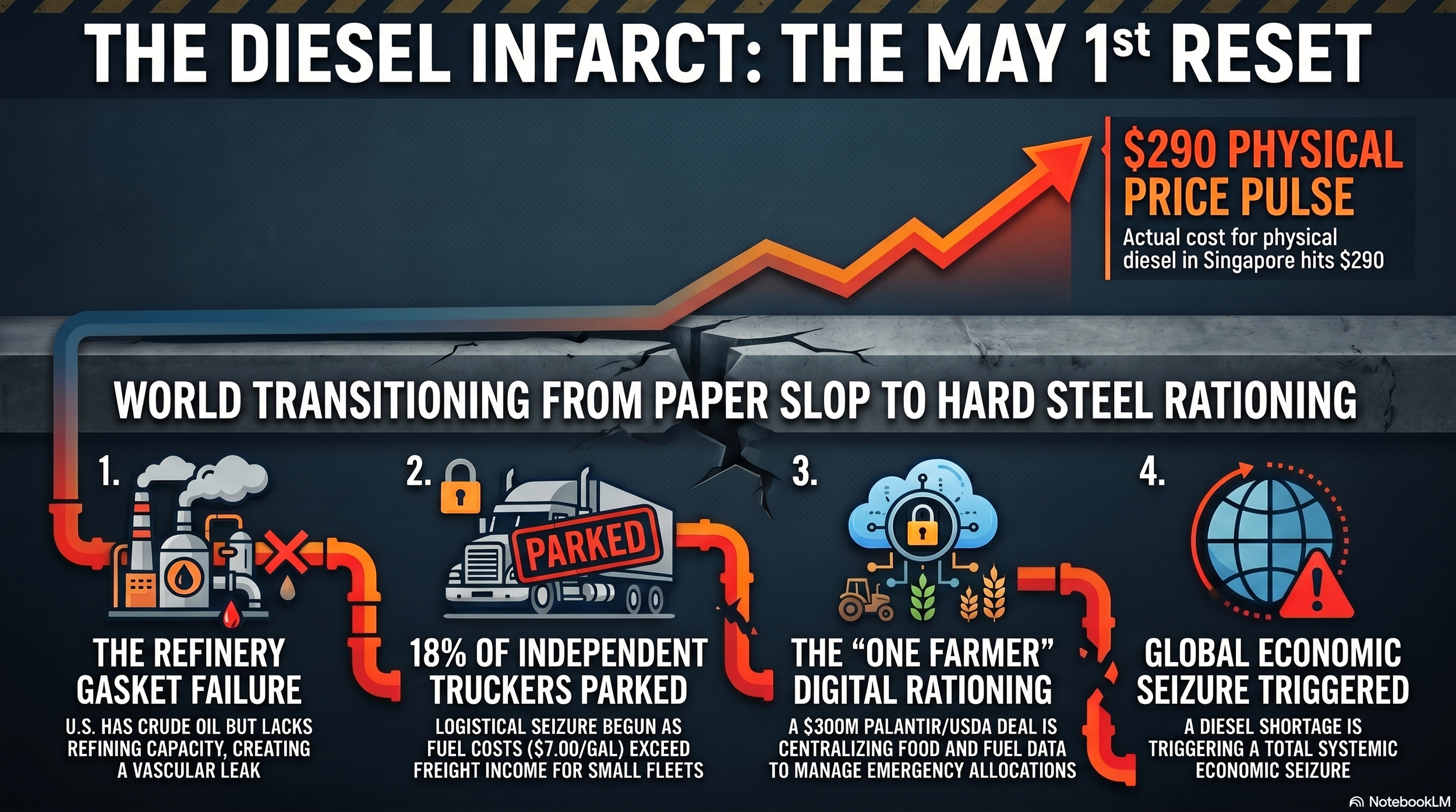
Fuel Price Spikes: Physical diesel prices in Singapore have risen sharply to $292.40/bbl, indicating severe shortages in global refining capacity.
May 1st Deadline: This date marks the expected end of the current supply chain model and a shift toward nationalized economic management.
Trucking Industry Decline: Approximately 18.4% of independent trucks are no longer operating because fuel and maintenance costs have exceeded what they are paid to haul goods.
Shipping Blockades: Strategic maritime blockades remain in place. High-end defensive capabilities in these regions mean trade routes cannot be easily reopened, making these disruptions long-term. Real-world data shows energy is shifting from a simple commodity to a vital survival asset.
2. THE ENERGY ARTERY: THE GREAT DIVERGENCE AUDIT
We track the difference between speculative "paper" prices and real-world "physical" prices. This identifies where financial markets have stopped reflecting the actual availability of goods.
Asset Type
Metric
Price (bbl)
Implication
Paper Brent Crude
Futures
~$128.00
Financial Speculation
Physical Singapore Diesel
Spot Price
$292.40
Physical Scarcity
The gap between these prices indicates a 128% scarcity premium. Additionally, domestic refineries are struggling, forcing the U.S. to export raw crude while being forced to import refined diesel at high costs. This refined product shortage will likely impact the U.S. West Coast within 14 days.
3. LOGISTICAL NECROSIS: THE INDEPENDENT ARTERY UNDER SIEGE
The American trucking industry is facing extreme pressure. Data suggests the current crisis is accelerating a move toward centralized corporate and state control over logistics.
Operational Halts: 18.4% of independent drivers have stopped working. This is a result of fuel costs rising much faster than the surcharges drivers can collect.
Financial Losses: It currently costs $2.96 per mile to operate a heavy truck, but the market only pays $2.11 per mile. This results in a $0.85 loss for every mile an independent carrier drives.
Corporate Consolidation: Large corporate fleets are using their scale and technology to survive the fuel crisis. They are positioned to take over the market share left behind by small businesses that cannot afford to continue.
4. REGULATORY LIGATION: DALILAH’S LAW & THE DIGITAL CORDON
Proposed legislation (H.R. 5688 and S. 3968, known as Dalilah’s Law) introduces strict new controls over the workforce. While framed as a response to security needs, it establishes a framework for significant labor restrictions.
Impact Analysis:
Stated Goals: Standardizes security vetting for commercial drivers and requires English proficiency for emergency situations.
Operational Risks: New audit requirements may force all 3.5 million CDL holders to undergo a federal review. This process could sideline a massive amount of independent shipping capacity. Combined with new agricultural data tracking, this allows the state to manage and monitor the movement of all essential goods.
5. THE TECHNOLOGICAL MIRAGE: STRESS-TESTING THE "ELECTRIC SOLUTION"
Claims that electric vehicles can replace current logistics systems are unrealistic given the current state of the physical infrastructure. Data shows significant hurdles to electric adoption.
Supply Chain Constraints: Global battery materials are heavily controlled; cobalt prices have risen to $56,000/tonne due to export cuts.
Grid Limits: Recent emergency orders for power stations show that the electrical grid is already near its limit. It cannot handle the massive power demands of heavy electric trucking without causing blackouts.
Centralized Control: Electric charging is increasingly tied to digital tracking systems, allowing for remote disabling based on regulatory status.
Shift to Hybrids: Major automakers are moving back toward vehicles with backup gas generators, acknowledging that pure electric logistics are not currently viable.
6. THE MAY 1ST INFARCT: ESCALATION & SOVEREIGN NODES
The transition is accelerating. To prepare, individuals and organizations should secure their household/fortress before the economic shifts become permanent.
Expected Timeline:
Phase 1: Current trucking stoppages, rising food prices, and extreme international fuel price signals.
Phase 2: Diesel prices rising to $8.00–$9.50, leading to delivery failures in many regions.
Phase 3: Diesel exceeds $12.00. Emergency laws may be used to take control of private fleets and implement rationing.
Phase 4: Full transition to a state-managed digital system for rationing food and fuel.
Critical Time of Inheritance Integration: The May 1st transition is a deliberate shift. Securing independent access to fuel and food is the only way to maintain independence. As the free market changes, you must prioritize the truth/physical assets of tangible goods.
Status: Immediate. Maintain your truth/physical assets.
