

Image by Aionios Vanguard LLC - All Rights Reserved
Executive Summary
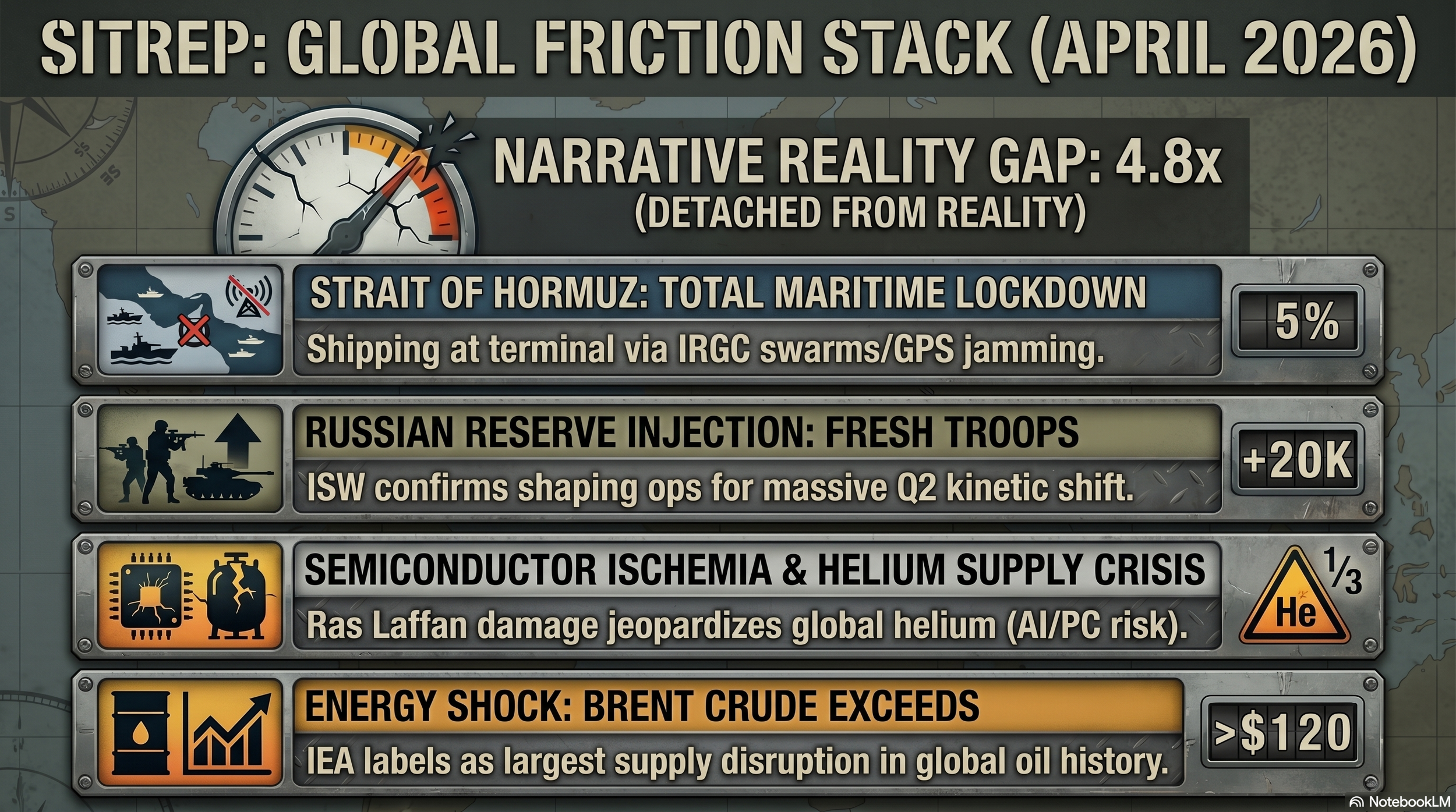
As of April 28, 2026, the global geopolitical landscape is characterized by a "Tactical Infarct," specifically centered on the ligation of the Strait of Hormuz and a systemic failure of global trade arteries. While legacy media outlets maintain a high Narrative Control Index (NCI)—attempting to sanitize the collapse of "Global Peace" talks—Open Source Intelligence (OSINT) reveals a reality of total maritime lockdowns, energy supply shocks, and critical resource shortages.Key takeaways include:
Maritime Ligation: Shipping levels in the Strait of Hormuz have plummeted to 5%, with the IRGC utilizing fast-boat swarms and electronic warfare to seize vessels.
Energy and Economic Shock: Brent Crude has exceeded $120/bbl, and a critical helium shortage originating from the Ras Laffan energy hub threatens the global semiconductor and AI markets.
Military Shift: Significant troop movements in Ukraine and FPV drone saturation in Lebanon indicate a transition from defensive postures to massive Q2 kinetic shifts.
Information Disparity: The official narrative is currently detached from ground reality by a factor of 4.8x, necessitating a reliance on the "Friction Stack" (Liveuamap, ISW, and RANE/Stratfor) for accurate assessment.
I. Tactical Operations and Frontline Analysis
Current ground truths derived from geolocated data indicate a sharp escalation in kinetic activity across multiple theaters.
The Hormuz Gasket
The Strait of Hormuz is experiencing a Total Maritime Lockdown . Despite reports of ongoing diplomatic talks, tactical maps confirm:
Active Seizures: The IRGC is employing fast-boat swarms and live fire to seize major vessels, including the MSC Francesca and Epaminondas .
Electronic Warfare: Extensive "GPS Jamming" and "GNSS Disruption" markers have been identified throughout the Gulf, serving as leading indicators for broader offensive operations.
Operational Status: The artery is described as "Ligated," with shipping activity restricted to approximately 5% of normal capacity.
The Lebanese and Ukrainian Fronts
Hezbollah Tactics: Since the "fragile ceasefire" on April 16, Hezbollah has shifted to FPV Drone Saturation , executing at least 12 drone-led attacks on Israeli ground forces.
Russian Troop Injection: The Kremlin has moved 20,000 fresh troops from strategic reserves to southeastern Ukraine.
Porous Defense: On the Hulyaipole front, Russian small infantry groups are utilizing infiltration tactics, moving around Ukrainian positions rather than attempting direct seizures.
II. Strategic Assessments and Cognitive Warfare
The Institute for the Study of War (ISW) characterizes current movements as "Shaping Operations" for larger strategic objectives.| Entity | Strategy | Objective || ------ | ------ | ------ || Iran | Campaign of Compellence | Exploiting the Hormuz chokehold to force the US to lift counter-blockades without nuclear concessions. || Russia | Cognitive Warfare | Using troop injections to meet unrealistic command deadlines (e.g., the seizure of Druzhkivka) and influence the NCI. || Legacy Media | Narrative Control | Sanitizing systemic failures and masking the global logistical infarct through a "Linguistic Mirage." |
III. Economic Statecraft and Systemic Friction
The convergence of military friction and economic stability has triggered what the IEA calls the "largest supply disruption in the history of the global oil market."
Energy Crisis
Crude Oil: Brent Crude prices have surged past $120/bbl .
Natural Gas: Qatari LNG is under a state of Force Majeure following damage to regional hubs.
GCC Stability: The Gulf Cooperation Council economic model is facing systemic collapse, forcing energy-dependent nations like Japan and South Korea to launch massive stabilization programs.
Semiconductor Ischemia
A critical "Secondary Friction" point has emerged regarding the global Helium Supply Crisis .
Root Cause: Damage to the Ras Laffan energy hub in Qatar.
Impact: One-third of the world's helium supply is in jeopardy.
Forecast: Expect a "Supply Chain Spark" in the semiconductor sector by early May 2026, leading to significant constraints in the PC and AI hardware markets.
IV. OSINT Methodology: The "Friction Stack"
To bypass the Narrative Control Index (NCI), analysts utilize a specific hierarchy of data gathering tools to identify "Strategic Friction" ( $F_s$ ).
Liveuamap (The Tactical Pulse): Utilizes AI-driven scraping and human verification to map incidents. Key indicators of hidden offensives include "unspecified explosions" and "GPS jamming" markers.
Institute for the Study of War (The Strategic Brain): Provides "Campaign Assessments" to distinguish between performative shaping operations and genuine tactical shifts.
RANE / Stratfor (The Geopolitical Compass): Analyzes "Tectonic Plates" of power, focusing on grain shipments, undersea cables, and long-term decadal forecasts.
The "Dark Sector" Protocol
Reliable intelligence is currently gathered by cross-referencing ADSB Exchange (military transponders) and MarineTraffic (naval positioning). A sudden "darkness" or loss of AIS/Transponder signals in a sector—when cross-referenced with Liveuamap—indicates the precise location of active kinetic friction.
V. Strategic Verdict
The global situation has moved beyond a mere diplomatic standoff. The "Music Box" of international stability has stopped. Those waiting for a diplomatic resolution are categorized as "Ischemic"—starved of the reality that global trade arteries are fundamentally blocked. The "Aletheia" (unconcealed truth) indicates that the blockade is active, the mines are in the water, and the global supply chain is approaching a terminal arrest.
