

Image by Aionios Vanguard LLC - All Rights Reserved
The Great Retraction: 5 Surprising Realities of America’s Quiet Pivot to "Fortress Americas"
1. Introduction: The End of the "Blanket"
While public perception of American military power remains anchored in the image of an unstoppable global force, the mathematical reality reveals a shield that is about to shatter. The United States is currently maintaining a "Levant Blanket"—a massive concentration of Carrier Strike Groups and air-defense battalions in the Middle East designed to pin Iran in place and provide the Israeli Defense Forces (IDF) with operational freedom.However, this tactical protection is creating a global "Winchester" status. In military parlance, "Winchester" means a unit has exhausted its ammunition. By acting as a tactical shield in one region, the U.S. is depleting the strategic magazines required to deter peer-state adversaries elsewhere. This resource depletion is no longer a theoretical risk; it is a mathematical certainty driving a quiet, profound retraction toward a "Fortress Americas" posture.
2. The "Winchester" Paradox: Why $10 Million Missiles Can’t Stop $20,000 Drones
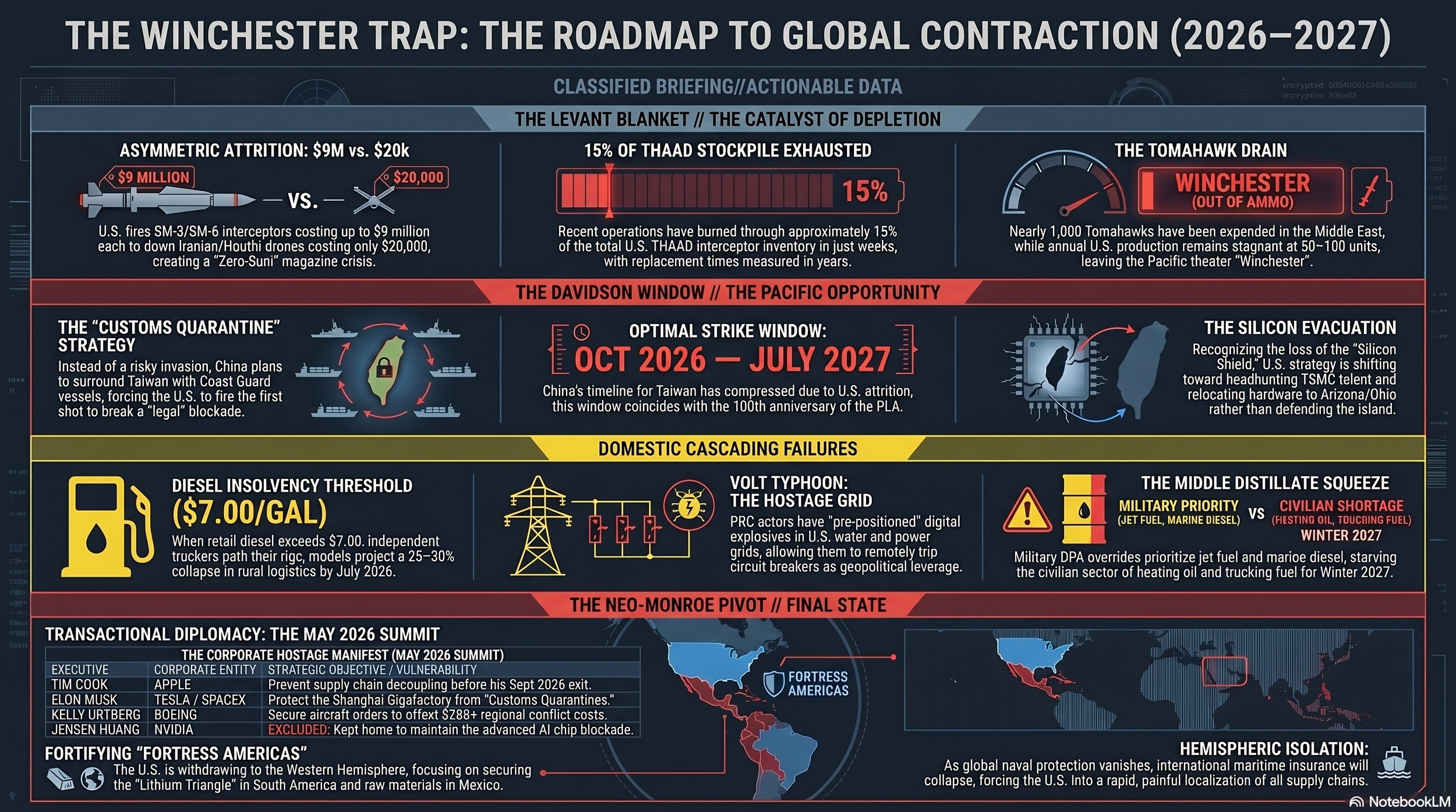
The primary driver of this shift is the "Zero-Sum Magazine." The U.S. defense industrial base is facing a crisis of asymmetric attrition that cannot be solved by fiscal policy. In the Middle East, the U.S. Navy frequently utilizes Standard Missile-3 (SM-3) and SM-6 interceptors to neutralize threats. These interceptors cost between $4 million and $10 million each and take years to manufacture; they are being used to shoot down Iranian-made drones costing as little as $20,000.The math of defeat is staggering:
The Tomahawk Drain: The U.S. has burned through nearly 1,000 Tomahawk Land Attack Missiles (TLAMs) in recent Middle Eastern operations, while annual production remains stagnant at a mere 50 to 100 units.
The Interceptor Deficit: The U.S. has exhausted approximately 15% of its entire THAAD (Terminal High Altitude Area Defense) interceptor stockpile in a matter of weeks.The U.S. cannot print missiles like it prints fiat currency. Unlike adversaries who have benefited from a "peacetime dividend," the U.S. is facing a rapid exhaustion of high-end munitions."While the U.S. fights proxy and direct wars across two theaters... China has enjoyed a 70-year 'peacetime dividend.' They are producing naval vessels and precision-guided munitions at maximum industrial capacity, completely untouched by combat attrition."
3. The Taiwan "Customs Quarantine": A Blockade Without a Bullet
Military analysts have focused on the "Davidson Window"—the period where China’s military modernization makes a move on Taiwan most likely. Current intelligence indicates this window has compressed, with the optimal time frame opening between October 2026 and July 2027. However, the conflict will not resemble a D-Day-style invasion. Instead, China is projected to use a "Customs Quarantine" model:
Maritime Encirclement: The People’s Liberation Army (PLA) surrounds Taiwan with Coast Guard and Maritime Militia vessels.
Administrative Control: Beijing declares a "quarantine," requiring all cargo ships to be inspected by Chinese customs officials before docking in Taipei.
Economic Capitulation: The global maritime insurance market halts all traffic to the island due to the risk.This creates the "U.S. Dilemma." To break the blockade, the U.S. Navy would be forced to fire the first shot, initiating a hot war with half-empty magazines. Without energy and food imports, Taiwan is projected to face capitulation within 60 days. Given the $1.2 trillion already diverted to the "Golden Dome"—the North American continental missile defense shield—the U.S. is mathematically incapable of sustaining the missile exchanges required to penetrate China’s A2/AD (Anti-Access/Area Denial) umbrella.
4. The Hostage Grid: Why the "Off Switch" is Already in Foreign Hands
Traditional battlefield deployment has been rendered secondary by "Pre-Positioning" in the cyber domain. State-sponsored actors, specifically the group "Volt Typhoon," have utilized "Living off the Land" (LotL) techniques to maintain persistent, undetected access to U.S. critical infrastructure.By targeting Protection Relays (the digital brains of substations) and SCADA systems, an adversary can "trip the breaker" on American cities remotely. This capability serves as digital Mutually Assured Destruction. The recent Sacramento utility disruptions were not mere glitches; they functioned as a "Limit Test"—a strategic demonstration to observe U.S. response times and measure how quickly incident response teams detect intrusions. This pre-positioning renders traditional military deployment irrelevant, as any Pacific intervention could be met with the immediate shutdown of power and water across the American mainland.
5. The Transactional Mirage: CEOs as "Hostage Diplomats"
The May 2026 Beijing Summit was not a sign of economic cooperation, but an exercise in "Transactional Pragmatism." By bringing the architects of the American economy to Beijing, the administration signaled it is willing to trade geopolitical influence for short-term economic stability.| Executive | Corporate Entity | Corporate Vulnerability / Objective | Tim Cook | Apple | Manufacturing Hostage: Reliance on Chinese hardware assembly for a multi-trillion dollar market cap. || Elon Musk | Tesla / SpaceX | Leverage Point: The Shanghai Gigafactory makes operations vulnerable to sudden PLA "quarantines." || Kelly Ortberg | Boeing | Midterm Trophy: Requires massive Chinese aircraft orders to salvage financial recovery before the 2026 elections. |
The most significant signal, however, was Nvidia CEO Jensen Huang being "left on the tarmac." While the U.S. is prepared to negotiate on consumer tech and aviation, it is compartmentalizing the conflict—gatekeeping AI and high-end semiconductors (the primary weapons of the future) while preparing the economic terms for a Pacific withdrawal.
6. The Diesel Cliff: The Mathematical Certainty of Rural Isolation
As the U.S. pivots to "Fortress Americas," the civilian logistics sector faces a "Middle Distillate Squeeze." Under the Defense Production Act (DPA), military fuel needs are prioritized. The civilian trucking industry, which relies on the same "cut" of the crude barrel as military marine and aviation fuel, is the first to be sacrificed.The "Insolvency Threshold" for independent truckers is $6.50–$ 7.00 per gallon. Once diesel crosses this mark, profit margins vanish.The "July Cliff" Timeline:
Day 60 (The July Cliff): The 53.3-million-barrel Strategic Petroleum Reserve (SPR) loan is physically exhausted. Refineries prioritize DLA (Defense Logistics Agency) contracts, and wholesale diesel breaches the Insolvency Threshold.
Day 90: Route consolidation begins. Corporate fleets abandon low-profit rural routes to service urban centers.
Day 120: A zero-sum game emerges between heating homes, moving food, and fueling the military.The result is "Rogue Valley Reality"—a state where rural regions are functionally isolated because the cost of moving goods exceeds the value of the cargo.
Conclusion: The New Drawbridge
The United States is transitioning to a "Neo-Monroe Doctrine," shifting from global hegemony to hemispheric survival. In the Middle East, the U.S. is forcing a handover in Q1 2027, requiring Israel to accept a state of "Manageable Friction"—where the proxy threat is degraded by 70% to a level where the U.S. "blanket" is no longer required.As the drawbridge is pulled up, the U.S. will focus military and diplomatic capital on securing Western Hemisphere raw materials, specifically the "Lithium Triangle" (Argentina, Bolivia, and Chile). The $1.2 trillion "Golden Dome" will fortify the continent, but the cost is the abandonment of the global commons. As the U.S. Navy ceases to protect international shipping lanes, maritime insurance will collapse, forcing a rapid and painful localization of the economy.The era of the "Blanket" is over. The final question for every citizen and stakeholder is this: Are your own supply lines ready for a world where the U.S. Navy no longer protects the global commons?

Aionios Vanguard LLC's exclusive OPSEC visual architecture for the guardian. This slide deck visually explains the importance of personal security, mindset, and protocol implementation to transform the guardian into an elite protector.
