

Image via Aionios Vanguard LLC - All Rights Reserved
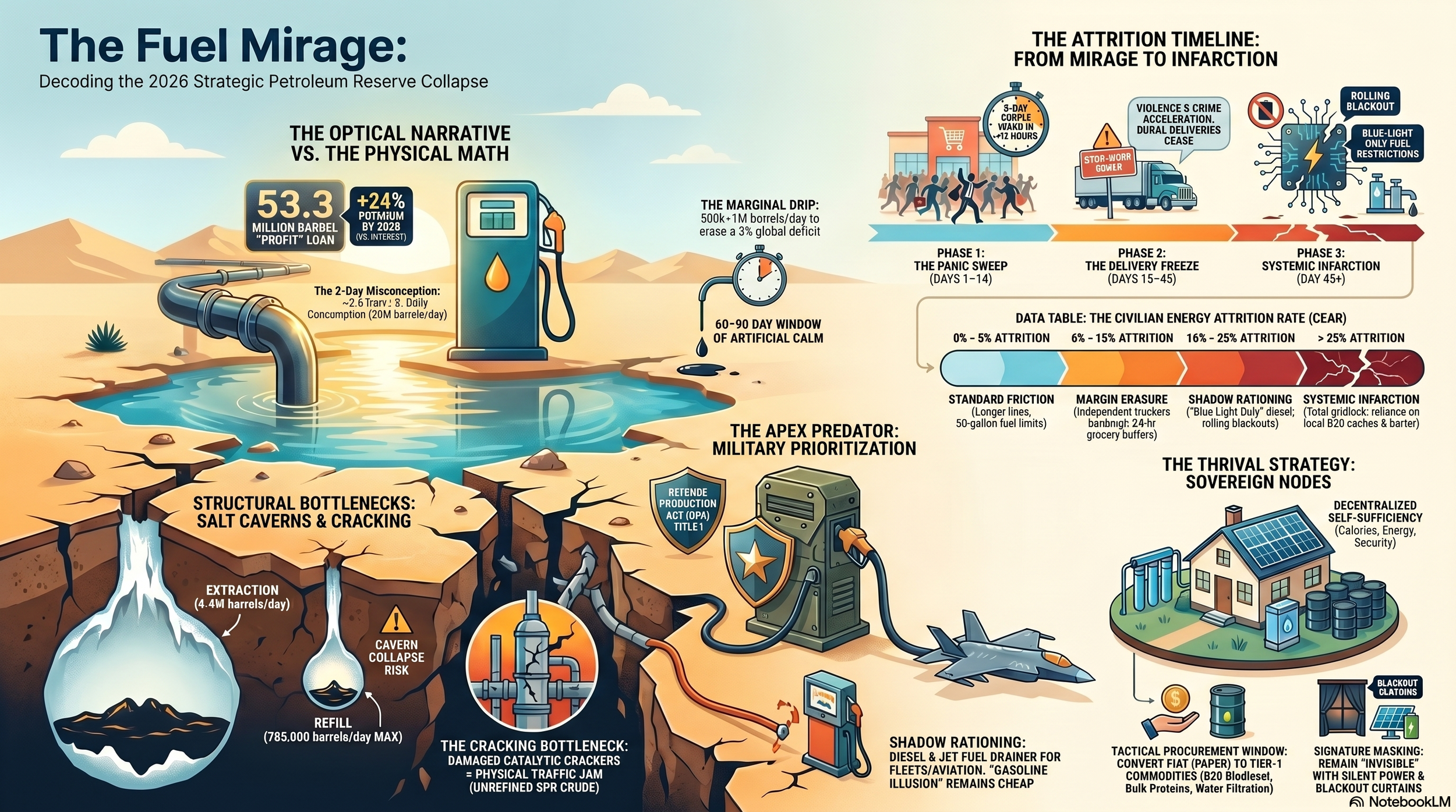
Today, the financial press is celebrating a massive victory: over 53 million barrels of emergency oil have been dumped into the market to crash the price at the pump. But the physical supply chain is in a total mathematical panic. What you are witnessing is the ultimate decoupling of perception and unveiled truth. The political Salesman is executing a Vascular Theft, draining the nation's final emergency buffer in exchange for 60 days of political optics.
Welcome to the deep dive. We have secured access to urgent,classified Level Five strategic knowledge that cuts through the Smog of War. We will expose how the entire system is facing a systemic logistics infarction. We will show you the chilling reality of Shadow Rationing—the legal mechanism by which the military will claim all usable fuel, forcing the civilian transport and agriculture sectors to starve. This isn't a miraculous bailout; it is a countdown to a violent, unmanageable collapse driven by human Panic Compression. Your mission is to use this temporary market illusion as a tactical procurement window to achieve strategic Thrival for your household.
Aionios Vanguard reminds you: maintain your One-Year Box and adhere to your 3/4 Rule. We provide the knowledge (known as gnosis); you must execute the countermeasures diligently. The podcast is for those who wish to be fully educated and is 60 minutes in length. It is a full deep dive analysis. The test blog below is a few minute reading
The 50-Million-Barrel Mirage: Why? the Latest SPR "Loan" is a Strategic Gamble
The U.S. economy is currently bleeding out in the dark. With the Iran-Hormuz maritime blockade strangling 20% of global transit and the national average gas price anchored at a grueling $4.52 per gallon, the Trump administration’s May 11, 2026, announcement of an "Emergency Exchange" of 53.3 million barrels from the Strategic Petroleum Reserve (SPR) is being hailed as a masterstroke. To the uninitiated, it looks like a savvy business move. To the investigative eye, it is a catastrophic act of "strategic procrastination"—a calculated vulnerability that trades long-term structural integrity for short-term political optics.The central question is no longer about the price of gas tomorrow, but about the solvency of the system itself. Is this an "emergency exchange," or is it the U.S. cannibalizing its own vital organs to lead a failing global pact?
It’s Not a Sale, It’s a High-Interest Loan in a Logistical Trap
The administration is framing this release as a profitable "loan" to nine energy giants, including ExxonMobil, Marathon, and Trafigura. These companies are contractually bound to return the crude by September 2028, plus a "premium" of up to 24% in additional barrels. On paper, the DOE claims it is increasing the reserve at no cost to the taxpayer. In reality, this is a "one-way valve" toward depletion. While the SPR can discharge oil at a rapid 4.4 million barrels per day (bpd), the maximum combined refill rate for the Gulf Coast sites is a pathetic 785,000 bpd. We are currently sitting at 392 million barrels—the lowest level since 1982 and just over half of our total capacity. By the time these companies are "obligated" to pay back the loan, the structural deficit will have likely finalized."The U.S. is draining its ultimate emergency buffer to temporarily suppress retail fuel prices... while the physical SPR is currently at its most depleted and vulnerable level since 1982. This represents a catastrophic failure of strategic depth."
The "Two-Day" Math vs. The 60-Day "Drip"
Critics often point out that 53.3 million barrels only covers 2.6 days of the 20-million-barrel daily U.S. consumption. This is a fundamental misunderstanding of "Marginal Economics." Oil prices are not dictated by total volume, but by the supply at the margins. Because demand is highly inelastic, a mere 2% supply shortfall—the "Delta" currently trapped by the blockade—can trigger a 30% price spike.The Department of Energy isn't dumping this oil into the market; they are "dripping" it into pipelines at a rate of 500,000 to 1 million bpd over a 60-to-90-day window. This is a psychological anesthetic designed to erase the marginal deficit and prevent trading algorithms from triggering a panic spike. It creates an "illusion of stability" intended to carry the administration through the summer, masking the fact that the underlying maritime blockade is not static—it is compounding.
The Military is the Apex Predator of the Supply Chain
While commuters celebrate a temporary dip at the pump, they are ignoring the Apex Predator: the U.S. Military. Under the Defense Production Act (DPA), the military possesses the statutory authority to monopolize refined products. In a "Kinetic Siege" environment, the military does not share the deficit with the civilian population; it takes 100% of its operational baseline first.Consider the burn rates:
Arleigh Burke-class Destroyer: A single vessel holds 400,000 gallons of marine diesel. Operating at flank speed to intercept drone swarms, its efficiency is measured in feet-per-gallon.
F-35 Lightning II: This aircraft burns up to 1,500 gallons of fuel per hour. A single combat sortie can erase the daily diesel allocation of an entire agricultural county.This creates "Shadow Rationing." The SPR crude will yield roughly 30% "middle distillates" (diesel/jet fuel). Under the DPA, the Defense Logistics Agency will intercept these barrels at the refinery gate to fuel the Pacific and Central Command fleets. The result is a "Gasoline Illusion": commuters see cheaper unleaded fuel, while the truckers and farmers who power the nation face "Diesel Starvation."
The "Market Mirage" and the Physical Reality Gap
There is a violent decoupling between the "Paper Markets" (Wall Street futures) and the "Physical Markets" (actual wet barrels). The ticker price on the news is a "Market Mirage" driven by algorithms shorting paper contracts. The physical reality is defined by "Backwardation"—a market state where today’s oil is significantly more expensive than oil delivered months from now.Currently, December 2026 paper contracts are trading at an $18-$ 22 discount compared to today’s prompt prices. This "screaming" scarcity creates a lethal incentive: suppliers are emptying their tanks to sell everything now because storage is a money-losing venture. Furthermore, releasing raw crude does nothing if the refining bottleneck—specifically the kinetic damage sustained by PADD 3 catalytic cracking units—isn't resolved. Without refining capacity, the SPR release just creates a crude oil traffic jam at the refinery gates.
The Human Variable—Panic as a Force Multiplier
While the math of supply is cold, the "Human Variable" is volatile. Roughly 90% of the population lives on a 3-to-5-day buffer of essential goods. When the "Social Friction" (Fs) of visible shortages hits, the "Panic Compression" timeline accelerates faster than any model can predict.To quantify this, we use the Civilian Energy Attrition Rate (CEAR) : $$A_{civ} = \max\left(0, 1 - \frac{D_{civ}}{(S_{base} + R_{spr} - M_{dpa}) \cdot (1 - \mu_f)}\right)$$Where $M_{dpa}$ (Military demand) is non-negotiable and $\mu_f$ (Logistical friction) accounts for trucking insolvency and crime. When $A_{civ}$ hits the 15% threshold, the system moves from "Panic Sweep" (Days 1–14, where retail is wiped out) to "Delivery Freeze" (Days 15–45), where logistics companies stop deliveries to high-crime areas to protect their assets.
Conclusion: The Looming "Rubber Band" Snapback
The May 11th SPR release is a subset of a larger, global desperation move—a March 2026 IEA pact where 32 nations are releasing 400 million barrels. The U.S. has committed to the lion’s share (172 million barrels total), effectively gutting its own strategic depth to maintain a global illusion.The "Rubber Band" snapback is predicted for Q3/Q4 2026. Once the artificial 60-day drip ends, the market will slam back into the reality of the Hormuz blockade with an SPR that has hit "tank bottom." This collision will occur precisely as the agricultural harvest demands peak diesel.The administration has traded long-term structural integrity for short-term optical stability. This is "Strategic Procrastination" at its most dangerous. As a "Strategic Analyst," my directive is clear: do not mistake the ticker price for reality. When the DPA diverts the last gallon of diesel to an Arleigh Burke in the Persian Gulf, how does your food reach your table? If your "last-mile" logistics depend on a system that is fundamentally insolvent, you are already out of time.
