

Image by Aionios Vanguard LLC - All Rights Reserved
Executive Summary
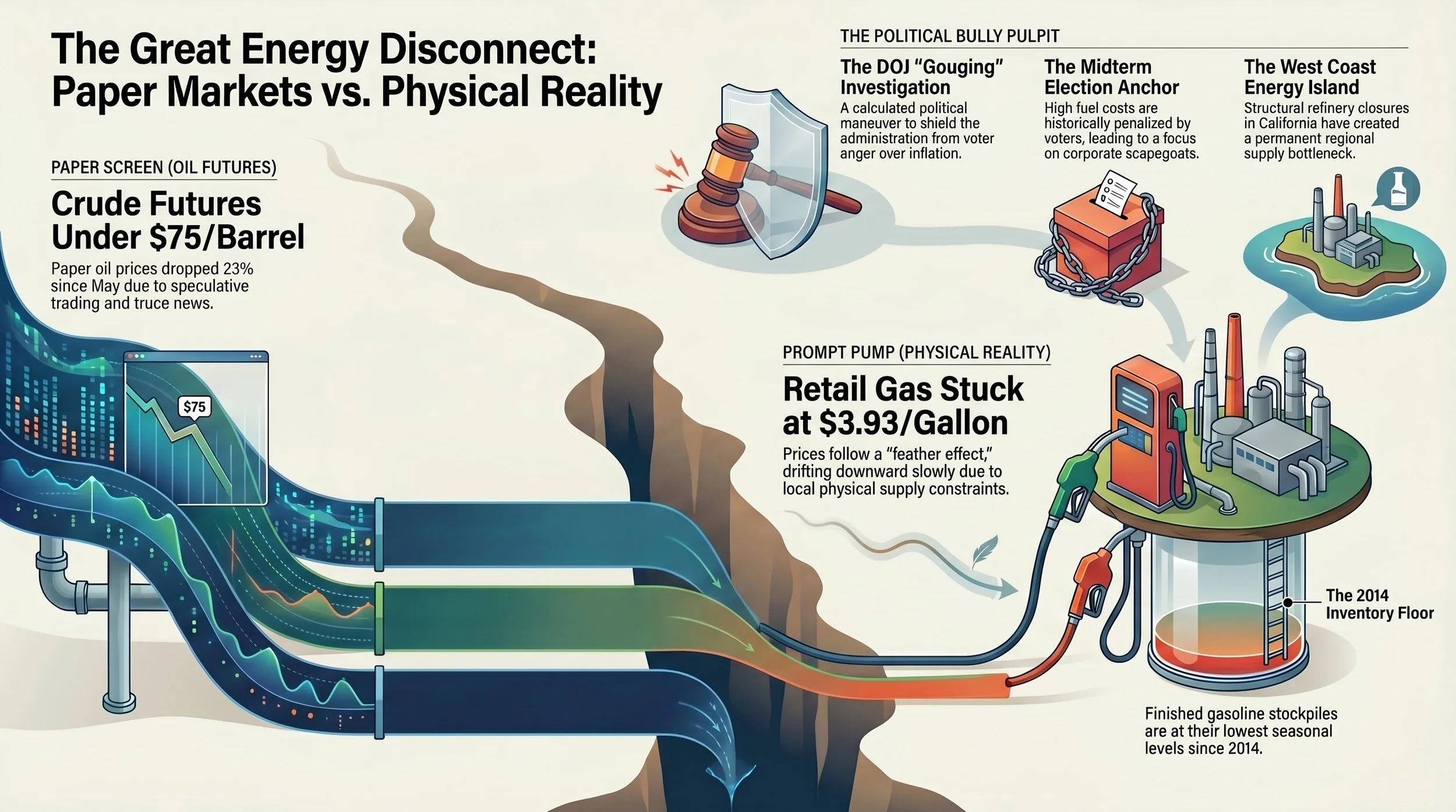
As of June 24, 2026, a significant divergence has emerged between financial energy markets and the physical reality of retail fuel distribution. While global crude benchmarks have plummeted below $75 per barrel—a 23% decline from May peaks driven by news of a 60-day Swiss-brokered truce—retail gasoline prices remain stubbornly high, averaging approximately $3.92 to $3.93 per gallon.
This "rockets and feathers" pricing phenomenon is being driven by a structural inventory deficit, with domestic gasoline stockpiles at their lowest seasonal levels since 2014. In response, the executive branch has deployed a midnight directive ordering a Department of Justice (DOJ) investigation into corporate "gouging." This briefing concludes that while the DOJ probe serves as a potent political tool to deflect voter frustration regarding 4.2% domestic inflation ahead of the 2026 midterm elections, it does not address the underlying material bottlenecks, including depleted storage buffers and West Coast refining closures.
I. The Market Bifurcation: Financial Speculation vs. Physical Reality
The current energy landscape is defined by two distinct and increasingly decoupled layers. Understanding the disconnect requires separating the financial "screen" from the physical "pump."
The Paper Screen (Financial Layer): This market consists of front-month WTI and Brent futures contracts. It is highly liquid and dominated by speculative trading. Prices on the "screen" drop instantly in response to geopolitical headlines, such as the current 60-day ceasefire, because these contracts are cash-settled and do not require the immediate delivery of physical barrels.
The Prompt Pump (Physical Layer): This represents the actual cost of refined, delivered fuel. Prices here are "sticky" due to the physical requirements of refining and transport. Unlike digital contracts, physical fuel is governed by local refining capacity and immediate supply availability. Retail prices drift downward slowly (the "feather effect") as distributors work through expensive, pre-existing inventory.
Comparative Market Metrics (June 24, 2026)
Market Indicator
Status/Metric
Driving Force
Upstream Crude (Paper)
Below 75/barrel (WTI ~72.28)
Speculative reactions to Swiss truce headlines.
Downstream Gas (Pump)
$3.92 – $3.93/gallon average
Local physical supply and distributor risk-hedging.
Inventory Levels
12-year seasonal floor
Structural shortage; lowest levels since 2014.
Core Inflation
4.2% (Domestic)
High energy costs and sticky consumer prices.
II. Structural Drivers of the Inventory Crisis
The inability of retail prices to track the collapse of crude oil is rooted in a material shortage of finished product rather than simple corporate malfeasance.
The 2014 Inventory Floor
Commercial gasoline stockpiles are currently scraping their lowest seasonal levels in over a decade. This deficit is the result of several months of intense regional conflict, which forced refiners to:
Delay Maintenance: Routine facility upkeep was bypassed to maintain maximum output during the height of the crisis.
Draw Down Buffers: Local storage reserves were depleted to critical margins to meet immediate demand, leaving the system with "zero safety cushions."
Regional Vulnerabilities: The West Coast Island
The West Coast faces a compounded crisis due to the permanent closure or conversion of multiple conventional refining plants in California. This has transformed the region into an "isolated energy island," characterized by a 13% middle distillate deficit. These structural losses mean that even when raw crude is cheap, the infrastructure to turn it into gasoline is at maximum capacity or non-existent.
III. Political Strategy and the Bully Pulpit
The administration’s midnight executive decree is identified as a calculated use of the "bully pulpit" to manage the narrative surrounding the 2026 midterm elections.
"The big Oil Companies are not dropping their price at the pump commensurate with the sharply lower prices they are paying for Oil... I have instructed the DOJ to immediately start looking into this." — Presidential Directive, June 2026
Strategic Objectives of the DOJ Probe
The investigation serves three primary political functions:
Deflecting Blame: By branding the price lag as "gouging," the administration shifts responsibility for the 4.2% inflation rate from policy outcomes to corporate actors.
Voter Anchoring: Historically, incumbent parties are penalized for high fuel costs. The DOJ probe allows the administration to position itself as a populist champion for consumers ahead of the November elections.
Margin Compression: The threat of regulatory warfare is intended to pressure integrated oil firms into voluntarily squeezing their "crack spreads" (refining margins) to provide a short-term, artificial price drop at the pump.
IV. Strategic Implications
The disconnect between political rhetoric and physical scarcity creates a window of artificial market behavior.
Artificial Price Windows: It is anticipated that major oil corporations may lower retail prices by a few cents in the coming days to avoid federal antitrust scrutiny. However, this is a response to political pressure, not a sign of structural recovery.
Systemic Fragility: A legal probe cannot "manifest refined gasoline out of thin air." The underlying vulnerability of the 12-year inventory low remains.
Infrastructure Realities: Federal investigations do not build new refineries or refill storage tanks. The physical transport network continues to operate on dangerously thin margins, particularly in isolated regions like southwest Oregon and the broader West Coast.
The current situation remains an "energy trap" where the public narrative of economic victory (the peace deal) clashes with the mechanical reality of a depleted physical grid.
