

Image by Aionios Vanguard LLC - All Rights Reserved
Executive Summary
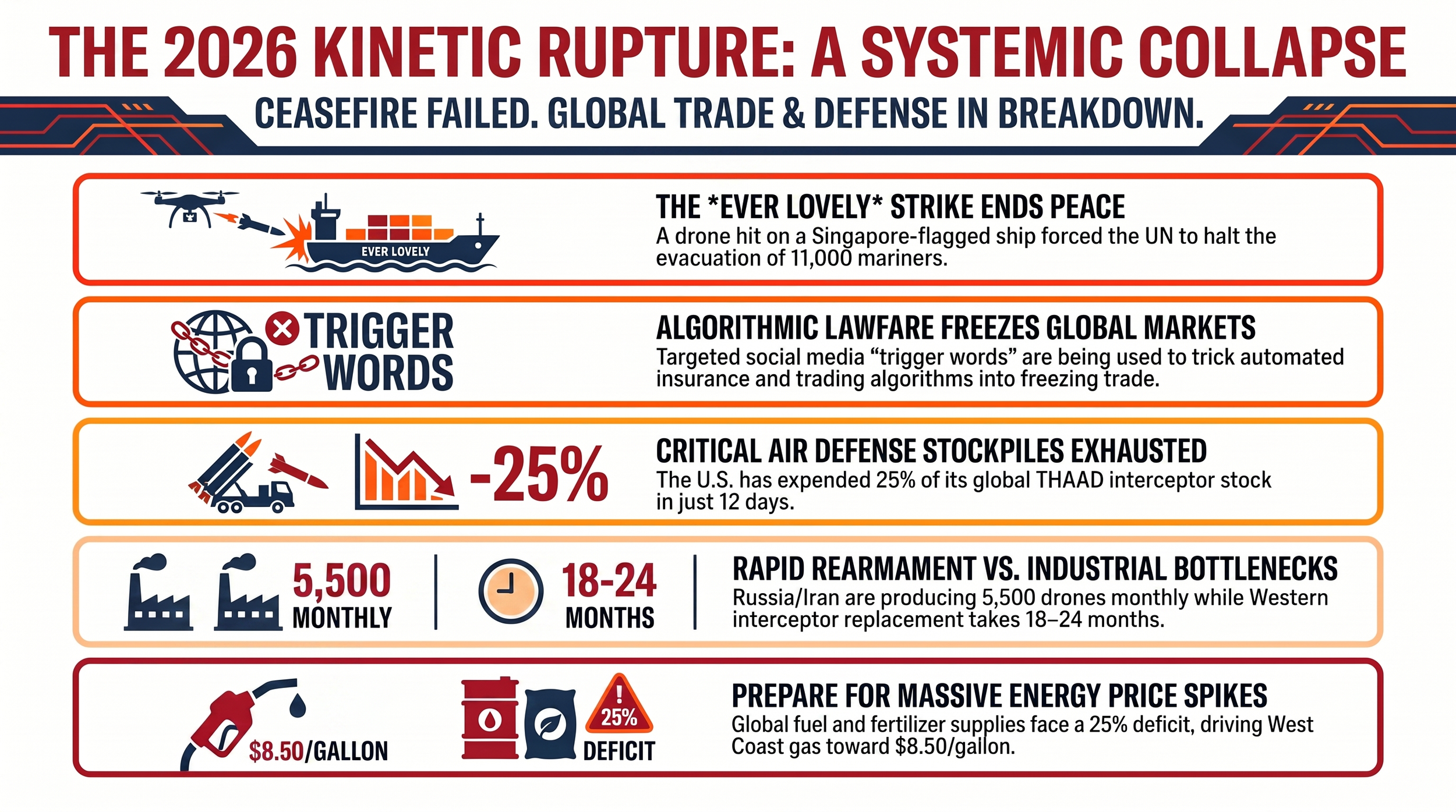
As of June 25, 2026, the global strategic landscape has transitioned from a fragile "Stabilization Phase" into a state of "Kinetic Whiplash." The 60-day ceasefire brokered in Switzerland has effectively ruptured following a projectile strike on the Singapore-flagged vessel Ever Lovely and the subsequent suspension of the International Maritime Organization (IMO) mass evacuation plan.The conflict is now characterized by Algorithmic Lawfare , where adversaries weaponize text induction to trigger automated Western market and insurance freezes, and a severe Asymmetric Attrition Paradox , wherein Iran and its allies (Russia and China) are out-producing Western defense-industrial lines by a significant margin. The depletion of US and Israeli interceptor magazines (THAAD, SM-3, SM-6, and Arrow 2/3) has reached a critical bottleneck. Furthermore, physical damage to Gulf Cooperation Council (GCC) infrastructure has triggered a global chemical shock, threatening Just-In-Time (JIT) manufacturing and agricultural stability.
I. Algorithmic Lawfare: The Weaponization of Risk Infrastructure
A central theme in recent operations is the use of Algorithmic Lawfare to paralyze trade without kinetic engagement. This strategy exploits the automated nature of Western financial and compliance systems.
Mechanics of the Data-Poisoning Attack
Adversaries, specifically the Persian Gulf Strait Authority (PGSA), utilize targeted social media declarations to "poison" the data ingestion pipelines of Western risk-scoring frameworks.
Step 1: Automated Scraping & Tokenization: NLP models (like FinBERT) scrape regulatory accounts. Legalistic trigger words—"insurance coverage," "liabilities," "voided," and "unauthorized routes"—generate a massive negative polarity shift.
Step 2: Actuarial Risk-Scoring Jump: Machine learning algorithms at underwriting desks (e.g., Lloyd's) interpret these signals as an immediate increase in regulatory risk, unilaterally restricting coverage or raising premiums.
Step 3: Automated Compliance Lock: Fleet management dashboards receive automated red-line flags. When systems warn that liability coverage is voided, vessels drop anchor, achieving a de facto blockade entirely through text.
The PGSA Lawfare Vector
The PGSA has explicitly stated that vessels traveling outside Iranian-designated northern routes are stripped of safe passage guarantees. This forces a "Warranty Breach Trap": following UN/Western safe routes leads to insurance nullification by Western syndicates, while following Iranian routes accepts absolute jurisdictional control and proximity to IRGC boarding teams.
II. Asymmetric Attrition and the Rearmament Paradox
The 60-day ceasefire window has functioned structurally as a rearmament phase for the Russia-China-Iran axis, exploiting Western industrial bottlenecks.
Manufacturing and Inventory Disparity
Russia-Iran Production: Russia’s Yelabuga facility, utilizing North Korean technicians, produces approximately 5,500 Shahed-type loitering munitions per month for Iranian use.
Western Magazine Exhaustion: The US and Israel face a severe interceptor shortage. Over 150 THAAD interceptors (25% of global US stockpile) were expended in 12 days. The US Navy burned through years of SM-3 and SM-6 production in mere days.
Israeli Defense Status: Israel has expended 122 of its 150 Arrow long-range interceptors. Domestic production lines are at maximum capacity, creating total dependency on US resupply.
Evolutionary Offensive Doctrine: The "Jellyfish Swarm"
Iran has debuted the "Jellyfish Swarm," a meshed networking drone formation.
Architecture: Large endurance drones digitally linked to dozens of smaller, exploding loitering munitions.
Effect: Creates a moving aerial minefield. This technology was credited with downing an F-15E Strike Eagle through proximity detonations and net entanglement.
III. Global Industrial and Chemical Shock
The targeting of downstream logistics nodes in the UAE, Saudi Arabia, Bahrain, and Kuwait has created a systemic chemical supply chain crisis.
Infrastructure Damage Assessment
Port/Hub,Damage Profile,Restoration Timeline
Jebel Ali & Fujairah (UAE),Gantry crane SCADA networks and radar arrays degraded.,6–9 months for specialized automated controls.
Jubail & Ras Tanura (KSA),Targeted downstream processing; pipeline fracturing.,Full efficiency delayed until late Q4 2026.
Mina Salman (Bahrain),Structural degradation and disabled maritime communications.,Baseline functionality in 30 days.
Global Value Chain Repercussions
The region controls significant shares of critical industrial feedstocks:
Methanol (10–14% of global supply): Shortages impact formaldehyde and synthetic resin production in Europe and Asia.
Nitrogen/Ammonia (~25% of global exports): Disruption threatens the backbone of global fertilizer production and upcoming agricultural planting cycles.
Sulfur (24% of global production): Halts in loading platforms squeeze sulfuric acid and titanium dioxide manufacturing.
IV. Cognitive Warfare and Alliance Fracturing
Iran has launched a "Cognitive Wedge Operation" to exploit internal NATO divisions, weaponizing public admissions by NATO Secretary General Mark Rutte.
The Catalyst: Rutte’s admission that US strike aircraft used Italian bases (Aviano, Sigonella) and Romanian air corridors for Operation Epic Fury .
Strategic Exploitation: Iranian bot networks amplify US isolationist narratives ("Europe as a paper tiger") while simultaneously fueling anti-war rage in Italy and Romania.
Resultant Bottlenecks: European capitals have begun slowing the processing of military and industrial export licenses to the US to signal independence, further hindering the replenishment of interceptor magazines.
V. Maritime Logistics: The "Ever Lovely" Rupture
The attempted mass evacuation of 11,000 seafarers and 500–600 commercial ships has been indefinitely suspended following the kinetic strike on June 25, 2026.
The Strike on the Ever Lovely
The Singapore-flagged container ship was hit by a suspected drone 7.5 nautical miles southeast of Dahit, Oman. While casualties were avoided, the bridge suffered significant damage. This event served as a "Wild Card" trigger, proving the fragility of the Swiss MoU.
Logistical and Actuarial Paralysis
IMO Suspension: Secretary-General Arsenio Dominguez halted the evacuation plan to re-evaluate safety.
The Insurance Trap: Western underwriters (Lloyd’s, Chubb) maintain high War Risk Additional Premiums (8%–12% of hull value) due to active mine threats and the "preemptive doctrine" rhetoric from Tehran.
Bunkering Squeeze: The demand for marine diesel to move the stranded armada is projected to lock in a 13% domestic middle distillate deficit in the US.
VI. Strategic Forecast: The "Kinetic Whiplash"
The current "Stabilization Illusion" is expected to give way to a violent rubber-band effect across global markets.
Phase-Shift Projections
Actuarial Collapse (Hours 0–24): Verification of kinetic impacts triggers emergency "Notice of Cancellation" clauses, evaporating insurance capacity overnight.
Market Explosion (Hours 24–48): Brent crude futures are projected to gap upward by $30–$ 45 per barrel , targeting a $140–$ 160/bbl corridor.
Retail Panic (Days 3–7): Domestic US fuel inventories are at a 12-year floor. Retail pump prices are anticipated to hit $8.50+/gal on the West Coast due to wholesale rack freezes and allocation caps.
Summary of Regional Stance (June 25, 2026)
United States: Secretary of State Marco Rubio has flatly denied the existence of an Iranian reconstruction fund, signaling a return to hardline sanctions.
Iran: General Pourdastan’s "Offensive Doctrine" is active, viewing any strike as a breach of agreement and justifying preemptive salvos.
Israel: Continuous operational activity in southern Lebanon (evidenced by the death of Master Sgt. Basil Sweid) suggests Jerusalem is ignoring diplomatic constraints to fortify its security sectors.
