

Image by Aionios Vanguard LLC - All Rights Reserved
Executive Summary
As of Thursday, June 11, 2026, the conflict between the United States and the Islamic Republic of Iran has reached a critical macro-inflection point. Following a high-intensity escalation where the U.S. executive threatened to "flatten Iran’s oil windpipe," a sudden mid-flight cancellation of strikes occurred, signaling a shift toward a high-stakes "Transactional Pivot." However, this rhetorical de-escalation masks a deteriorating structural reality.
Key findings include:
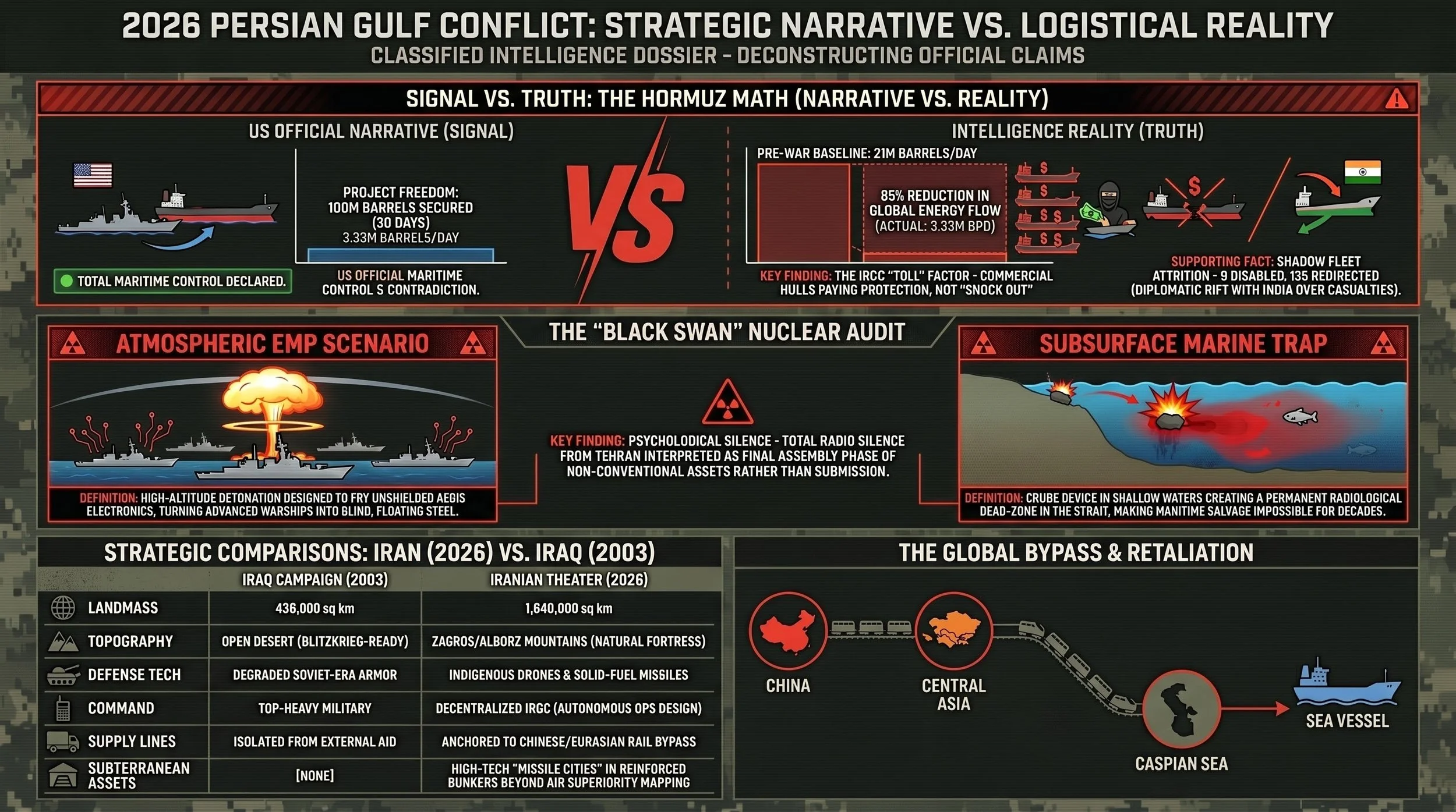
* Mathematical Collapse: Despite administrative claims of "total control" and the movement of 100 million barrels of oil, data reveals an 84% to 95% total transit volume deficit in the Strait of Hormuz.
* Algorithmic Manipulation: Modern financial markets are experiencing extreme "whiplash" as high-frequency trading (HFT) bots react to executive social media posts, causing violent swings in crude oil and Bitcoin while decoupling "paper" market prices from physical resource availability.
* The "Vietnam Trap": Strategic audits suggest the U.S. is measuring success by tactical metrics (missiles fired) while ignoring systemic failures, including a China-backed trans-Eurasian "Ghost Corridor" that renders the naval blockade obsolete.
* Global Economic Breaking Point: The World Bank has downgraded global growth to 2.5%—the lowest since COVID-19 lockdowns—warning of an imminent global food security crisis driven by a 38% spike in fertilizer prices.
I. The Transactional Pivot: Rhetoric vs. Market Mechanics
On June 11, 2026, President Donald Trump executed a lightning-fast strategic pivot, canceling scheduled "Night 3" strikes against the Iranian interior after citing "highest level" diplomatic discussions. This event serves as a case study in "Statecraft by Volatility."
The 90-Minute Whiplash
The global economic machine reacted with instantaneous volatility to the executive's social media dispatches:
* U.S. Crude (WTI): Plunged 5%, dropping from a $92.40 peak back to $88.03 within 90 minutes.
* Bitcoin (BTC): Executed a sharp vertical recovery, surging from evening lows back above $63,300.
* HFT Bot Sensitivity: High-frequency algorithms triggered mass automated sell-offs and purchases based on keyword scrapes of phrases like "VERY HARD TONIGHT" and "cancelled."
The "Paper vs. Prompt" Decoupling
A critical systemic flaw has emerged: the decoupling of market "paper" prices from "prompt" (physical) cash prices.
* Algorithmic Mirage: While computer-generated contracts can drop 5% instantly on a headline, physical molecules of marine diesel cannot be created out of thin air.
* Wealth Extraction: This volatility rewards HFT firms and Tier-1 market makers who capture the "intra-day volatility spread." Conversely, retail investors and passive 401(k) accounts experience "capital erosion" as funds are forced to rebalance at manipulated bottoms.
II. The Hormuz Mathematical Deconstruction
The administration’s claim that "Project Freedom" has secured the world's most vital energy artery is contradicted by empirical transit metrics.
Comparative Transit Metrics (June 2026)
Metric Vector Pre-War Baseline Current Reported Stats Percentage Change
Daily Oil Volume 20–21 Million Barrels 3.33 Million Barrels ~84% Reduction
Total Expected (103 Days) 2.06 Billion Barrels 100 Million Barrels ~95% Total Deficit
Operational Status Open/Globalized Trade High-Risk Convoy Corridor Structural Collapse
The Toll Mechanism: Intelligence indicates that the Strait is not under total U.S. dominance. Instead, many merchant vessels are paying direct "protection tolls" to the Islamic Revolutionary Guard Corps (IRGC) to secure safe passage, bypassing U.S. protection schemes entirely.
III. Geopolitical Fractures and the "Ghost Corridor"
The U.S. strategy of unilateral maritime enforcement has created a "Vietnam Trap," where tactical wins are offset by strategic isolation and the activation of unaligned trade routes.
The China-Iran Overland Bypass
Beijing has activated land-based corridors that render the naval blockade ineffective:
* The Caspian Combined Route: Rail freight from China to Kazakhstan, then ferried across the Caspian Sea (where there is zero U.S. naval presence) to Northern Iran.
* Central Asian Rail: A continuous network through the Sarakhs border crossing reporting a threefold increase in cargo volume, including dual-use missile precursors.
* Lethal Yuan Loop: Trade is cleared exclusively in Chinese currency to decouple the regional economy from the U.S. dollar.
Diplomatic Attrition
* The Indian Revolt: U.S. naval actions have resulted in strikes on vessels carrying Indian mariners (e.g., the M/T Jalveer). India has demanded an immediate cessation of attacks, threatening U.S. isolation at the G7.
* The "Wrath of the Dragon": Should the U.S. destroy Kharg Island (the windpipe of Iran's economy), China is expected to retaliate with a total rare-earth mineral freeze, potentially crippling U.S. defense manufacturing within 48 hours.
IV. Strategic Vulnerabilities: Black Swans and Cyber Targets
While the immediate threat of a mainland bombing campaign has faded, the kinetic reality remains volatile due to the ongoing naval blockade and the threat of asymmetric retaliation.
Tactical Nuclear "Black Swan" Scenarios
Tehran may utilize crude, non-conventional devices for theater denial:
1. Atmospheric EMP: A high-altitude detonation over the Persian Gulf to fry the electronic battle management systems of Aegis warships.
2. Subsurface Marine Trap: Detonating a device in the shallow Strait of Hormuz to create a permanent radiological dead-zone, removing 20% of global oil volume for decades.
Domestic Cyber-Sabotage
Iranian APTs (e.g., Handala Hack, APT33) have shifted doctrine toward "Identity and Cloud Hijacking." Their primary targets are "soft" domestic U.S. infrastructure:
* Municipal Water Works: Exploiting legacy SCADA nodes to alter chemical ratios.
* Regional Electrical Cooperatives: Paralyzing administrative billing and fuel distribution.
* Retail Finance: Freezing point-of-sale transactions at grocery stores and gas pumps to induce localized panic.
V. Global Macroeconomic Audit: The World Bank Downgrade
The World Bank’s Global Economic Prospects report (released June 11, 2026) confirms that the conflict has broken the back of the post-pandemic recovery.
The Multi-Tier Downgrade Architecture
Economic Parameter Pre-Escalation Baseline 2026 WB Baseline Worst-Case Target
Global GDP Growth 2.9% 2.5% (Lowest since COVID) 1.3%
Global Inflation 3.3% 4.0% 4.4%
Brent Crude Oil ~$69/barrel $94/barrel $115+/barrel
Fertilizer Price Index Stable +38% Surge Structural Collapse
The "Lost Decade": World Bank Chief Economist Indermit Gill warns that nearly half of the world's developing economies are facing a lost decade. The MENA region growth forecast has been slashed to 1.6%, while sovereign debt in these nations has reached 70% of GDP, limiting their ability to cushion populations from supply shocks.
VI. Critical Observations and Quotes
* On Market Discovery: "It proves that free markets no longer dictate value. Instead, the financial system functions as a highly centralized liquidity illusion." — Financial Analysis regarding Gregory Mannarino’s critique.
* On the Strategic Miscalculation: "Iran is Not Iraq... Iran’s 1.64 million sq. km landmass is dominated by the Zagros and Alborz mountains, which negate mechanized speed." — Strategic Analysis.
* On the "Vietnam Trap": "Measuring success by tactical metrics—missiles fired, radars destroyed, ships counted—while losing the strategic war of energy flow and alliances is the hallmark of overextension." — Red Team Audit.
* The Transaction Reality: "The Naval Blockade will remain in full force and effect until this Transaction is finalized..." — Presidential Statement, June 11, 2026.
