

Image by Aionios Vanguard LLC - All Rights Reserved
BLUF Report: The Scarcity-Farcity Collision and Local Systemic Risk
Date: June 14, 2026 Classification: FLASH RED-LINE / STRATEGIC RECKONING Subject: Systemic Impact Simulation — Critical Impact Point June 15, 2026
1. Bottom Line Up Front (BLUF): The Terminal Point of the Great Divergence
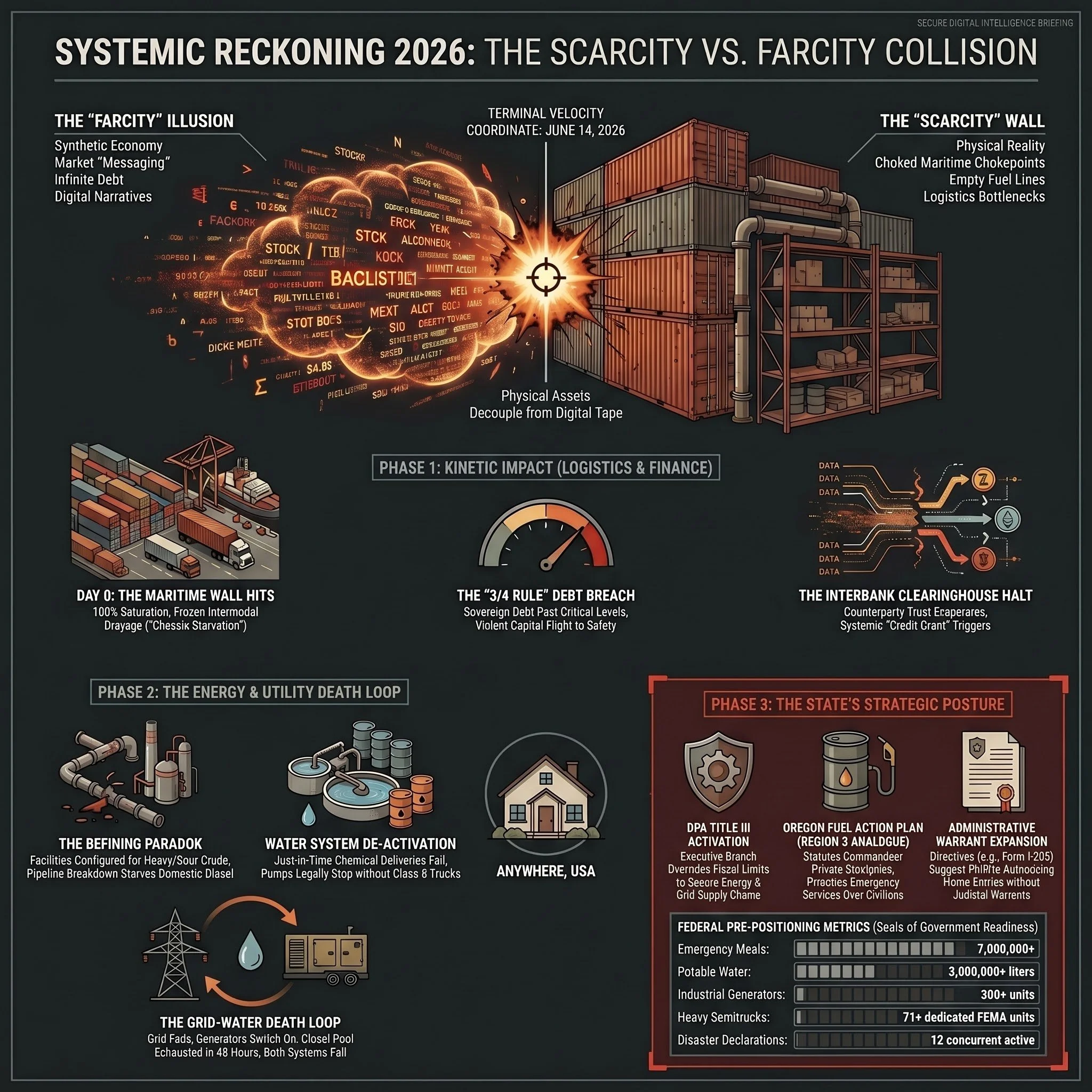
The "Great Divergence"—the unsustainable decoupling of synthetic financial narratives from physical infrastructure—has reached its terminal end-state. We are currently tracking a terminal-velocity collision between "Farcity" (algorithmic market manipulation and the digital illusion of abundance) and the unyielding wall of "Scarcity" (physical logistical and energy constraints). The projected impact point is Monday, June 15, 2026 , when the front-loaded container wall hits the Pacific Northwest ports. The "illusion is cracking" because physical systems can no longer be "massaged" by rhetorical maneuvers or debt expansion. This is not a cyclical correction, but a structural "Judgment Day" for "anywhere USA." As observed in the historical analogue of the Crimean fuel coupon crisis, the transition from unhinged abundance to strict rationing occurs with violent speed once the physical plumbing of civilization locks up. This report analyzes the specific mechanisms of this collapse and the immediate transition to localized survival.
2. The Matrix of Collision: Evaluating Digital Illusion vs. Physical Reality
The most critical variable for domestic stability is the widening chasm between digital sentiment and physical infrastructure. While algorithmic narratives can project stability, physical logistics are governed by the "Refining Paradox" and spatial saturation. When digital expectations meet the "Scarcity Wall," the result is a structural lock-up of the distribution and transaction networks. Strategic Vector Analysis| Strategic Vector | The Farcity Script (The Illusion) | The Scarcity Wall (The Reality) | The Incentivized Kinetic Collision || ------ | ------ | ------ | ------ || Global Maritime Freight | Narratives suggest risks are mitigated; "Friday settlements" are imminent. | Container wall hits Ports of Seattle and Tacoma June 15; 100% spatial saturation. | Lack of warehouse floor space freezes intermodal drayage; I-5 corridor chassis starvation begins. || Energy & Hydrocarbons | Digital crude prices are suppressed to project peace; U.S. touted as "energy independent." | The Refining Paradox: The U.S. exports finished goods but is structurally dependent on heavy crude from Canada/Mexico for diesel yield. | Prompt physical fuel prices decouple from digital tapes. Naval blockades in Hormuz persist; Main Street fuel allocations begin as reserves dry. || Sovereign Debt Bomb | Treasury/Fed complex prints infinite liquidity to maintain high market multiples. | System is drowning in un-payable debt, scaling past the "3/4 Rule" (where debt service exceeds 75% of GDP). | Debt service becomes mathematically impossible; counterparty trust evaporates. A systemic Credit Event halts interbank clearinghouses. |
These vectors indicate a rapid shift from a financial "bear market" to a structural "lock-up," where the inability to move heavy feedstock and refined diesel terminates the viability of the synthetic economy.
3. Operational Decay Phases: Algorithmic Blind Spots and Asset Flight
Strategic danger emerges when high-frequency trading (HFT) and digital narratives dominate decision-making while physical distribution fails. Algorithms are programmed to trade headlines, not physical commodities, creating a fatal disconnect.The failure executes through three distinct Operational Decay Phases :
Phase I: Narrative-Logistical Decoupling: While bots buy "Friday Deal" headlines thousands of times per second, they cannot physically unload a shipping container or refine a barrel of oil. When distributors attempt to clear paper contracts against empty warehouses, the digital narrative loses all power.
Phase II: The Revenge of the Physical Asset: As the debt bomb detonates, capital executes a violent flight to safety. Gold and silver prices decouple from the stock market, representing "systemic distrust" against the "headline followers." Real wealth is recognized only in tangible, physical assets.
Phase III: Transition to Localized Autonomy: As central command structures lock up, security and distribution become strictly local responsibilities. Governance becomes hyper-localized, mirroring the friction-heavy environments seen in recent geopolitical conflict zones.This macro-failure manifests most acutely in the "death loop" of essential household services: water and power.
4. The Interdependency Loop: Local Water and Electrical Vulnerabilities
Water and power are not separate systems; they exist in an interdependent "death loop." Infrastructure Vulnerabilities (Case Study: Grants Pass, OR):
Water Infrastructure: Municipal systems rely on a just-in-time supply of chemical inputs: 12.5% sodium hypochlorite (bleach), aluminum coagulants, and polymers. The system is physically vulnerable at 13 remote pumping stations and 8 reservoir telemetry systems that require constant grid power or diesel backup. Without truck-delivered chemicals, water cannot be safely treated.
Electrical Grid: Substation control fluidity depends on lead-acid backup batteries with a 48-hour window . Beyond this, mobile diesel refueling is required for generators to prevent a total node failure and grid "blind spot."Logistical Resource Depletion Impact| Logistical Resource | Water Treatment Impact | Emergency Electrical Grid Impact || ------ | ------ | ------ || Class 8 Tanker Trucks | Immediate cutoff of essential bleach/alum; plant cannot legally pump. | Halts delivery of transformer oils and localized repair hardware. || Bulk Diesel | Starves backup generators and the Water Emergency Response Trailer (WERT). | Substation battery drain leads to node failure after 48 hours; grid goes dark. || Intermodal Drayage | Delays critical replacement parts for pump station telemetry. | Restricts movement of heavy utility trucks for line repair along the I-5 corridor. |
5. The Regulatory Shadow State: Analysis of Federal and State Triggers
Tracking "quiet" administrative actions—executive waivers and statutory reclassifications—is the primary indicator of the coming shift toward resource commandeering.
Energy Infrastructure Pivot: Presidential Determinations (PD 2026-08 through 2026-11) have authorized Defense Production Act (DPA) Title III . This allows the government to bypass fiscal limits to secure petroleum production, refining, and grid infrastructure through purchase commitments.
Regional Fuel Mandates (Region 3): Under the "Oregon Fuel Action Plan" for Region 3 (SW Oregon), authorities have the statutory power to commandeer private fuel stocks. Fuel Points of Distribution (FPODs) will be established, redirecting all tanker trucks to "life-safety" lifelines and cutting off civilian access.
Administrative Enforcement: A leaked DHS/ICE memorandum regarding Form I-205 administrative warrants reveals a shift toward unilateral enforcement flexibility, authorizing residence entries without traditional judicial oversight.
FEMA Logistical Pre-positioning:
7,000,000+ meals and 3,000,000+ liters of water staged at regional hubs.
300+ industrial generators and 71+ heavy semi trucks positioned for deployment.
12 concurrent federal emergency disaster declarations currently active to manage road clearance and energy infrastructure.
6. Strategic Conclusion: Securing the Domestic Perimeter
As the "Farcity" illusion meets the "Scarcity" wall, traditional public systems will be either commandeered or collapse. In this environment, "mesh sovereignty" and physical insulation are the only remaining tactical advantages. Immediate Hardening Directives:
Physical Reserves: Maintain 12-month storable calorie caches and independent, off-grid water filtration/power systems (solar/battery) that do not rely on municipal chemicals or the "death loop" grid.
Communication Security: Transition all critical coordination to private, Fernet-encrypted peer-to-peer mesh networks. Abandon reliance on the public web, which will be subject to credit-event freezes.
Resource Independence: Move away from the "unhinged abundance" of the public grid toward localized autonomy. Recognize that the "Region 3" Fuel Action Plan ensures that public fuel and water will be prioritized for the state, not the household.When the digital narrative can no longer move the physical world, standing sovereign within a hardened domestic perimeter is the only path to survival. The collision is tomorrow; the time for preparation has concluded.
