

Image by Aionios Vanguard LLC - All Rights Reserved
The recent flurry of "Peace Treaty" headlines surrounding the Islamabad MoU has invited a collective sigh of relief from global markets. On the surface, the "maritime freeze" is thawing and digital signatures suggest a return to geopolitical stability. For those monitoring the corporate news cycle, it appears the world has successfully navigated a systemic crisis and is now transitioning back to a predictable "normal."
However, we are currently tracking a profound anomaly: high military tension and diplomatic de-escalation are occurring simultaneously. This is not a resolution; it is a holding pattern. While the administrative "paper peace" is being celebrated, the physical world reveals a much darker trajectory of structural gridlock and material scarcity. The telemetry confirms that we are in a tactical countdown where the "digital signatures" are dry, but the physical fuse continues to burn.
The reality is that an administrative patch cannot retroactively manufacture the resources lost during months of kinetic friction. From the pharmaceutical pipeline to municipal water infrastructure, the safety margins have been liquidated. To understand the true state of the domestic interior, one must look past the headlines and into the physical metrics of a system in structural contraction.
The Five-Year Medicine Gap: A Structural Contraction in the Pharmaceutical Pipeline
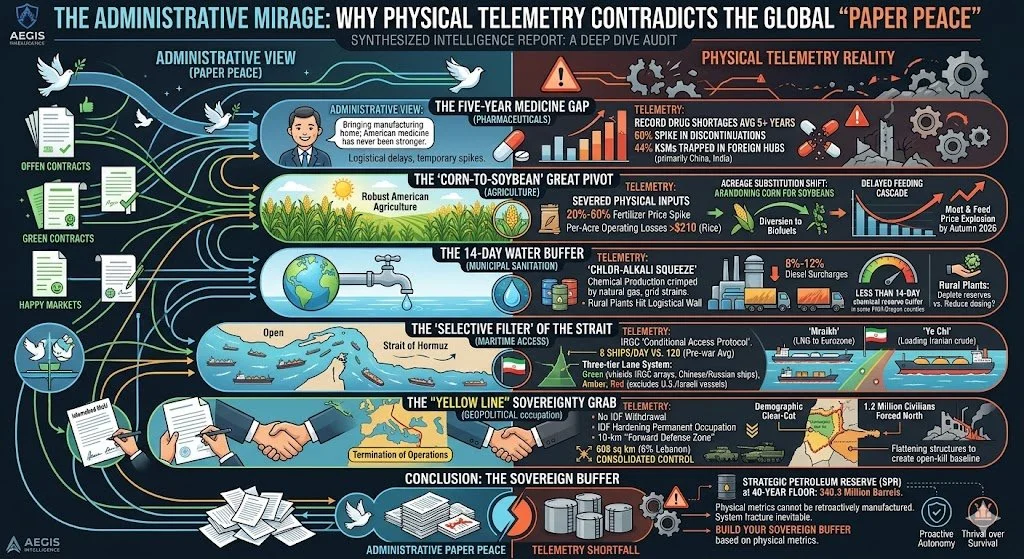
The domestic medical supply chain is currently enduring a record-breaking period of instability that far exceeds pandemic-era baselines. According to the United States Pharmacopeia (USP) Annual Drug Shortages Report, the average duration of a critical drug shortage has spiked to an all-time record of over five years. This is not a logistical delay; it is a "smoking gun" for the structural contraction of the entire pharmaceutical sector.
This vulnerability is punctuated by a 60% year-over-year spike in product discontinuations by generic manufacturers, who are exiting the market as thin margins evaporate under the weight of Section 232 tariffs. The upstream concentration remains a primary failure point: approximately 44% of all drugs in acute shortage rely on Key Starting Materials (KSMs) manufactured exclusively in a single foreign hub, primarily China or India.
The White House Narrative: "We are bringing manufacturing home; American medicine has never been stronger."
The Raw Telemetry: Chronic shortages averaging 5+ years; 60% spike in product discontinuations; 44% of KSMs trapped in single-source foreign hubs.
The "Corn-to-Soybean" Great Pivot: A Self-Inflicted Feeding Cascade
While the diplomatic narrative suggests American agriculture is robust, the physical inputs required for food production have been severed. The Middle East conflict has triggered a 20% to 60% price spike in U.S. retail nitrogen-based fertilizers, hitting precisely during the critical Northern Hemisphere planting window. Facing unsustainable operating costs—including per-acre operating losses for rice exceeding $210—American farmers are executing a massive "Acreage Substitution Shift."
Operators are systematically abandoning high-nitrogen crops like Corn in favor of nitrogen-fixing Soybeans. Furthermore, rising oil prices are motivating agribusinesses to divert land to high-profit biofuel production models, tightening the food supply even further. This shift guarantees a severe tightening of the domestic grain supply, triggering a "Delayed Feeding Cascade" that ensures a meat and feed price explosion by Autumn 2026. This deficit is already "baked in" to the physical system, regardless of whether regional conflicts resolve tomorrow.
The 14-Day Water Buffer: Municipal Sanitation on the Brink
The most immediate threat to domestic population centers is the "Chlor-Alkali Squeeze" affecting clean drinking water. The production of essential purification chemicals—chlorine gas, caustic soda, and hydrochloric acid—has been crimped by rising natural gas benchmarks and power grid strains. While Tier 1 metropolitan utilities are protected by long-term contracts, rural plants are hitting a logistical wall.
In the Pacific Northwest and Southwestern Oregon, regional chemical distributors have implemented 8% to 12% diesel surcharges on bulk deliveries. This has forced multiple rural counties to operate on less than a 14-day chemical reserve buffer. These small-town utilities, operating on fixed annual budgets, are facing a choice that directly impacts public safety.
"Small municipal water treatment plants are facing a critical choice: deplete their financial reserves or reduce chemical dosing frequencies because they can no longer guarantee a reliable stream of bulk chlorine."
The "Selective Filter" of the Strait: A Conditional Maritime Clamp
The "reopening" of the Strait of Hormuz is not a return to universal maritime access, but the implementation of a "Conditional Access Protocol." While 8 major ships are moving per day, this is a mere fraction of the 120-ship pre-war average. The IRGC is utilizing a three-tier lane system (Green, Amber, and Red) to filter traffic. Crucially, the IRGC is using "Green Lane" vessels (Chinese and Russian) to shield their coastal tracking arrays from Western surveillance.
The "Red Lane" ensures the total operational exclusion of U.S.-flagged, U.S.-owned, or Israeli-linked vessels. The following table illustrates the tactical reality of who is moving and why:
Vessel Name
Tactical Context
Status / Status
Mraikh
French-operated LNG carrier; first such transit since February 28.
Delivering Qatari gas to stabilize the Eurozone.
Ye Chi
Chinese-owned tanker; entering the Gulf "empty in ballast."
Exploiting U.S. Treasury waivers to load Iranian crude for China.
The "Yellow Line" Sovereignty Grab: Structural Hardening of a Permanent Occupation
Contrary to the Islamabad MoU’s mandate for the "termination of operations on all fronts," military telemetry confirms the Israeli Defense Forces (IDF) are not preparing for a withdrawal. Instead, they are structurally hardening a permanent occupation in the Levant. The IDF has consolidated control over 608 square kilometers (roughly 6% of Lebanon’s landmass), establishing a 10-kilometer-deep "Forward Defense Zone."
This "Demographic Clear-Cut" has been enforced through over 135 mass evacuation mandates, forcing 1.2 million civilians north of the Zahrani River. The IDF is actively flattening structures to create an open-kill baseline, indicating a permanent shift in regional sovereignty rather than a temporary security buffer.
"Israeli forces will remain inside their established security zones in Lebanon, Syria, and Gaza 'without any time limit,' and these areas will be systematically cleared of local residents." — Defense Minister Israel Katz
Conclusion: The Sovereign Buffer
The physical metrics prove that the administrative "paper peace" cannot retroactively manufacture the fertilizer, pharmaceutical chemicals, or chlorine gas the system has lost. The global energy supply remains fundamentally choked, and the national Strategic Petroleum Reserve (SPR) sits at a 40-year historic floor of 340.3 million barrels.
As corporate headlines celebrate a signed truce, the telemetry suggests a system in structural contraction and an asymmetric breach of the current ceasefire. The question for the goal-oriented individual is no longer if the system will fracture, but how they have prepared for the inevitable material shortfall. Are you relying on corporate headlines to secure your future, or are you building a sovereign buffer based on the physical metrics?
