

Image by Aionios Vanguard LLC. All Rights Reserved.
It is often easy to view distant naval strikes or regional blockades as abstract events confined to a digital map. However, the "front lines" of modern warfare are no longer tethered to specific borders; they are woven into the very fabric of the global supply chain that stocks our grocery shelves and pharmacies. A missile exchange in the Persian Gulf or a drone strike in the Caspian Sea creates an "invisible circuit" of economic pressure—a series of kinetic cascades that eventually ground themselves at your front door.This briefing distills the most impactful takeaways from the July 2026 intelligence reports, illustrating how "Tri-Theater Interdiction" in distant waters is being translated into the tangible reality of household costs.
1. Ukraine’s 1,000km Leap into the Caspian Sea
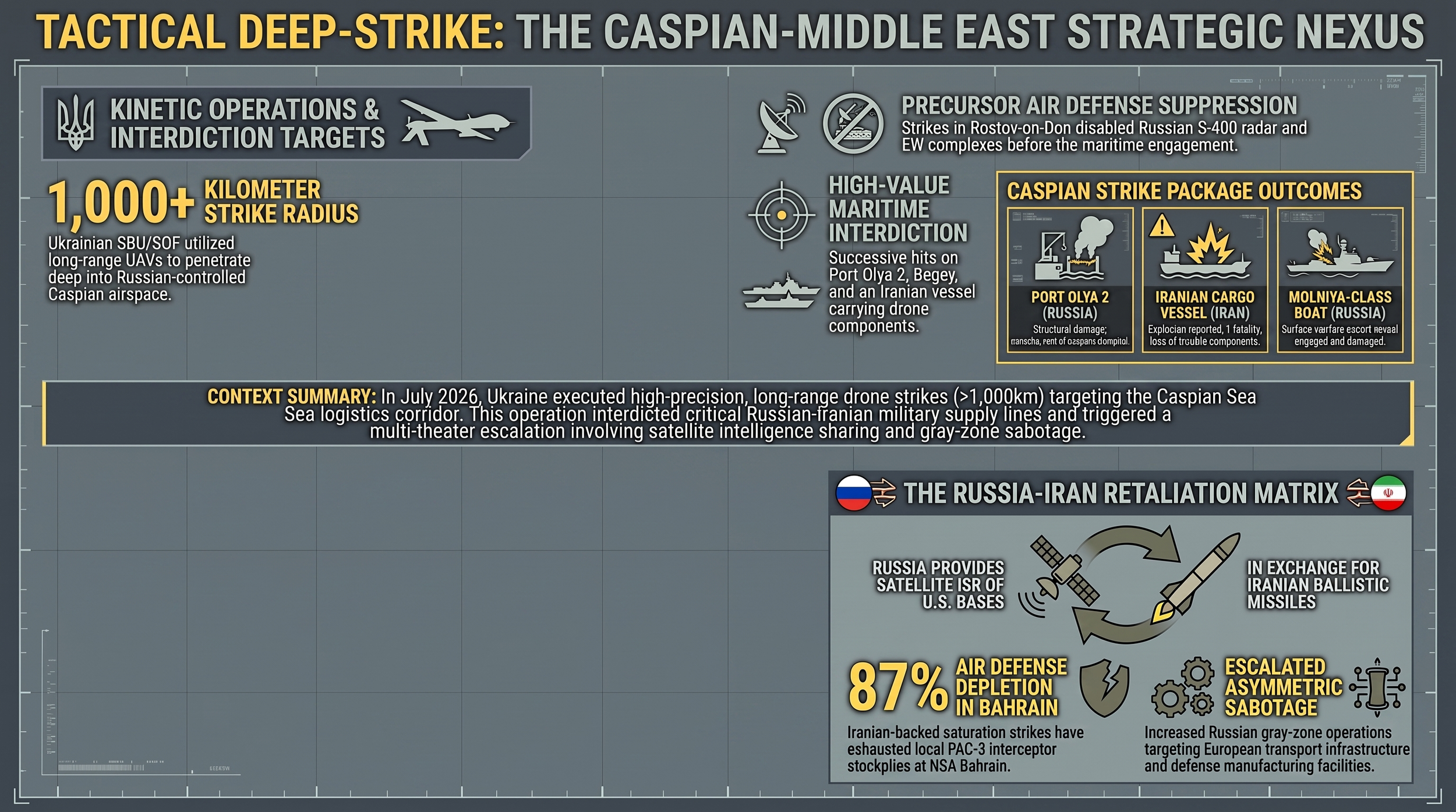
In a major tactical shift, the Eastern European conflict has undergone a "structural expansion" into the Caspian Sea. In late July 2026, Ukrainian long-range UAVs—operated by the SBU and Special Operations Forces—executed strikes at distances exceeding 1,000 kilometers, shattering the assumption that this landlocked waterway was a secure, unsanctioned "back door" for military transfers.Targets included the Port Olya 2 and the Begey —vessels known for disabling AIS transponders to move armor and drone components—and a Russian Molniya -class missile boat. Crucially, the strikes also hit the Lukoil Filanovsky Oil Platform , successfully interrupting hydrocarbon extraction. This operation demonstrates that geographic distance no longer guarantees safety for military logistics or the energy infrastructure supporting them."The Iranian vessel struck during the operation was carrying specialized components for strike drones and ballistic guidance systems destined for military supply chains." — Yevgen Korniychuk, Ukrainian Ambassador
2. The "Satellite-for-Hardware" Quid Pro Quo
The "invisible circuit" is fueled by a dangerous reciprocal trade between Russia and Iran that bypasses all traditional containment strategies. Intelligence confirms that Russia is utilizing its space-based satellite assets to provide Tehran with real-time targeting imagery and post-strike Battle Damage Assessment (BDA) of U.S. and allied installations across the Middle East—specifically airbases in Bahrain, Jordan, and Kuwait.In exchange for this high-level intelligence, Iran provides the drone components and missile hardware Russia requires to sustain its operations. This is no longer two separate wars; it is a single, linked military ecosystem. The efficiency of Iranian strikes in the Gulf is directly proportional to Russian reconnaissance, proving that the failure of regional containment is now a global macro-strategic reality.
3. The Math of Exhaustion (The 87% Depletion)
In the Persian Gulf, the tactical reality has shifted to an "asymmetric advantage" for aggressors. Iranian-backed forces are utilizing low-cost drone saturation tactics to force U.S. and allied forces to expend high-cost, high-lead-time munitions. This is the "math of exhaustion."Currently, air defense reserves in Bahrain have hit a critical 87% depletion rate for Patriot PAC-3 interceptors. The vulnerability is compounded by a lethal administrative supply bottleneck:
The Munition Gap: Critical resupply orders, including 50 PAC-3 MSE and 150 GEM-T rounds , are currently trapped in standard Foreign Military Sales (FMS) channels.
The Policy Failure: Unlike other regional partners, Bahrain was excluded from the emergency security waivers signed in May.
The Lead Time: This exclusion necessitates a mandatory 30-day congressional review and an 18-month delivery lead time , leaving forward command infrastructure exposed to saturation risks for the foreseeable future.
4. The Diesel-to-Kitchen-Table Pipeline
The disruption of maritime routes in the Strait of Hormuz and the Caspian Sea triggers what we call the "Kitchen Table Translation Matrix." The primary transmission vector to your budget is a 58% surge in Ultra-Low Sulfur Diesel (ULSD) .This is governed by the Input-Friction Relation . In macro-strategic terms, the domestic retail cost-of-living inflation is tempered by inventory buffers. However, as these buffers deplete over a 30-to-90-day window, the decay rate of existing stock accelerates. When the buffer fails, the consumer is exposed directly to:
Agricultural Volatility: The Middle East is a primary exporter of petrochemical precursors. Interdictions have caused nitrogen and urea fertilizer prices to surge by 40–70% , directly inflating the cost of domestic meat, dairy, and grains.
Freight Attrition: With over 70% of U.S. freight moved via diesel trucking, the surge in ULSD forces long-haul carriers to implement massive fuel surcharges, which are passed directly to the grocery shelf.
5. The Hidden Shortage in Your Medicine Cabinet
The most acute risk to domestic stability may be the systemic threat to clinical medical supplies. As vessels are rerouted around the Cape of Good Hope to avoid kinetic zones, the 10-to-14-day delay creates a bottleneck for Active Pharmaceutical Ingredients (APIs). Over 80% of APIs for domestic generic medications—including antibiotics and cardiovascular drugs—are now caught in this extended transit.Furthermore, disruptions to global refining networks have created a shortage of medical plastics (IV bags, syringes, and tubing) derived from petroleum byproducts. However, the most insidious threat is the "Latency of Truth."The "Latency of Truth" refers to the catastrophic failure of Automated Clearing House (ACH) and identity infrastructure during maritime crises. Shipments of life-saving medication are currently being halted at ports not by physical blockades, but by the failure of digital payment verification systems to settle transactions in a volatile "dark-fleet" environment.
Conclusion: The 120-Day Horizon
As we approach the 120-day mark, we enter the "Structural Recalibration" phase. At this horizon, the global economy ceases to view these disruptions as temporary spikes. We anticipate a wave of carrier bankruptcies and massive freight market consolidation as smaller players are crushed by volatile operating costs.The invisible circuits connecting the Caspian and the Gulf to your household budget are now permanent features of the global landscape. Can a modern economy truly "un-link" its security and cost of living from these distant maritime chokepoints, or is your kitchen table now a permanent part of the global battlefield?
