

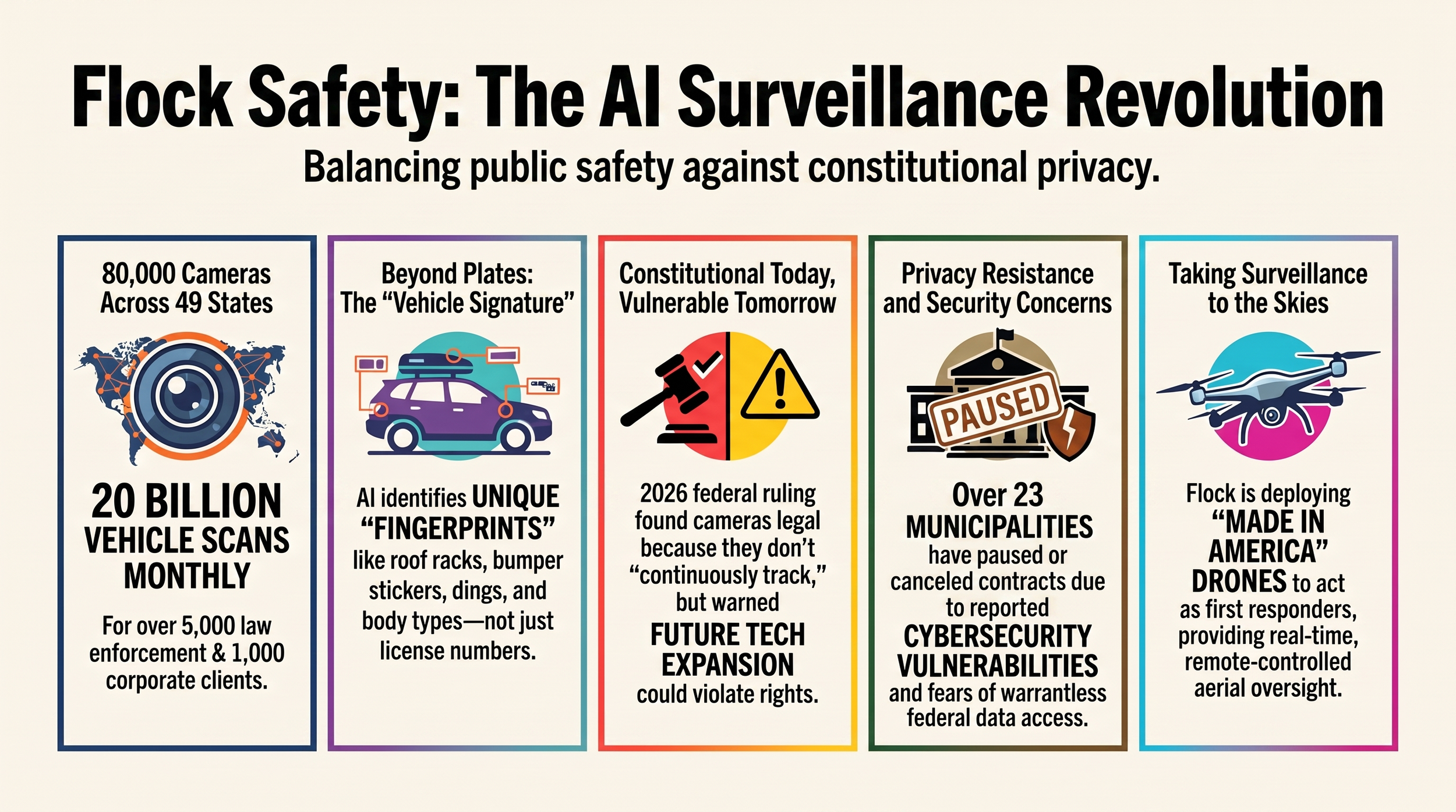
The cadence of the modern town hall meeting is shifting. Where neighbors once gathered to argue over park maintenance or the height of a fence, they now debate the merits of "smart security" subscriptions. In suburban cul-de-sacs and gentrifying urban blocks, the hum of a quiet neighborhood is increasingly punctuated by the silent click of a cloud-synced shutter. To the average resident, these systems are sold as a digital neighborhood watch—a simple tool to catch the person who stole a catalytic converter.However, beneath this veneer of civic safety lies a rapid, silent transformation of our public spaces. Recent investigations and corporate records reveal that what began as a network of automated license plate readers (ALPRs) has evolved into a sophisticated, AI-powered surveillance dragnet. This is no longer a reactive tool for tracking suspects; it is the infrastructure for querying an entire population in real time.
It’s a “Google Search” for the Physical World
The marketing for companies like Flock Safety often centers on the "Automated License Plate Reader." But the reality of the technology has moved far beyond reading metal tags. A feature called "FreeForm" allows users to perform natural-language AI searches across the camera network, effectively turning your neighborhood into a searchable database.Instead of needing a specific plate number to begin an investigation, an officer can search for descriptors as if they were using a search engine. A query can be as specific as "blue SUV with a racing stripe" or "white F-150 with a ladder in the back." The system extends this capability to people, allowing officers to reconstruct someone’s movements back in time based on their clothing or accessories.“Just type what you're looking for, like 'man in blue shirt and cowboy hat,' and get visual matches instantly.” — Flock Safety FreeForm product pageThis capability fundamentally shifts the nature of surveillance. We have moved from "tracking a known suspect" to "querying a population." It enables the warrantless tracking of anyone who fits a general description, mapping their movements across an interconnected grid of thousands of cameras.
The Patent Office Paper Trail: What the CEO Won't Admit to City Council
There is a startling discrepancy between the marketing materials handed to city councils and the legal IP filings held by the company. Publicly, Flock maintains a firm stance against biased technology. Their marketing explicitly states that their products "do not use facial recognition" and "do not identify race, gender, or ethnicity."However, the corporate legal filings—where the stakes are higher than a PR cycle—tell a different story. U.S. Patent US11416545B1 , which lists Flock CEO Garrett Langley as an inventor, specifically describes neural networks designed to classify people by “race” and “face recognition data points.” While Langley has publicly dismissed privacy activists as "terroristic," his own patents protect the very demographic-classification features his marketing disavows.The technical "meat" behind these AI models is even more unsettling. In December 2025, it was revealed that Flock utilizes overseas gig workers in the Philippines , hired via Upwork, to manually annotate and classify vehicle and people imagery captured from U.S. streets. This data handling practice creates a significant trust gap: your neighborhood imagery is being reviewed by unvetted global contractors to train the machine-learning models that track you.Furthermore, "contract upgrade rights" often allow vendors to push software updates at their "sole discretion." This means a council can vote for a "dumb" camera today, only to have the vendor activate facial recognition or demographic classification tomorrow without a second public vote.
The “Human Distress” Narrative and the Power of Resistance
The surveillance net is now moving from the visual to the auditory. In late 2025, Flock announced plans to expand its gunshot detection microphones to listen for "human distress," specifically targeting the sound of "screaming." This represented a textbook case of mission creep, turning emergency response devices into "always-listening" monitors of human voices on public streets.However, this narrative serves as a rare example of public accountability. Following intense exposure by the Electronic Frontier Foundation (EFF) and a wave of community organizing, Flock officially terminated the rollout of its audio ‘distress detection’ of human voices in July 2026. While the company attempted to sanitize its marketing materials by using vaguer language like "distress detection," the public reversal proved that coordinated resistance can halt the expansion of the digital dragnet.
Security Irony: The Open Livestream Exposure
In late December 2025 and into early 2026, the irony of the "security" industry was laid bare. Researchers discovered that "Condor" people-tracking cameras were left exposed on the open internet with no username, no password, and no encryption. Using commercial search engines like Shodan, investigators identified approximately 67 live feeds covering playgrounds, street corners, and bike paths.This wasn't just a viewing leak. The exposed administrative and debug panels allowed anyone to not only watch the feeds but to delete footage and change system settings. A private company had effectively created a public webcam network out of private-citizen data, leaving it vulnerable to anyone with a browser.“On my phone, I am watching myself in real time as the camera records and livestreams me—without any password or login—to the open internet.” — Jason Koebler, 404 Media
High Stakes and the Veneer of Accountability
The human cost of technical inaccuracies is profound. A 2026 LAPD Inspector General report revealed that 1 in 3 stolen-car alerts were wrong. These errors frequently stem from "stale" data or "Wrong State" triggers, where the AI misreads a license plate’s origin. The result is often a "high-risk stop," where innocent drivers find themselves at the end of a police barrel because of a software glitch.Vendors point to "immutable audit trails" as a safeguard, but investigative reporting suggests these are often a veneer of accountability. In practice, these logs are rarely, if ever, reviewed by supervisors. Officers frequently bypass internal safeguards by using vague reason codes like "criminal justice" or "investigation" for their searches—vague terms that provide zero actual oversight until a scandal breaks.
Weaponized Surveillance: Beyond Criminal Justice
The most alarming shift is the use of these networks to enforce social and political policies. In 2025, records showed that agencies used Flock data to track political protesters during the "No Kings" demonstrations in February, June, and October.The technology has also been weaponized against reproductive healthcare. In an October 2025 case in Texas, a single official used the network to investigate a woman’s abortion. Using a "missing person" search as a pretext, the official ran a query that probed more than 8,000 networks and accessed over 83,000 cameras nationwide.The official’s search note was chillingly direct:“had an abortion, search for female.”
Conclusion: The “Subscription” of Public Space
These systems are not one-time infrastructure purchases; they are a subscription surveillance service. Under these contracts, the public never truly owns the hardware; they merely rent access to a proprietary database of their own movements.Even when communities fight back, the ecosystem proves inescapable. In cities like Denver and Syracuse, residents successfully pressured officials to "ditch" Flock over privacy concerns, only to see the city hire Axon to do the exact same job weeks later. This "Axon Swap" illustrates the true nature of the surveillance industry: a multi-corporate dragnet where the brand may change, but the scanning never stops.We have moved from a society that tracks suspects to one that queries entire communities. As we outsource the management of our streets to private vendors with a history of misleading the public, we must ask: If our every movement is a searchable, proprietary record, who truly owns the right to move freely through our streets?
