

Geopolitical Impact Statement: The Synchronized Collapse of Global Energy and Maritime Security
1. The Disintegration of the Islamabad Memorandum and the Return to Kinetic Conflict
The Islamabad Memorandum of Understanding (MoU), signed on June 17, 2026, was intended to serve as the fragile diplomatic scaffolding required to stabilize the Persian Gulf. By establishing a 60-day cessation of hostilities, it briefly restored a semblance of predictability to global energy markets. However, its total collapse in July 2026 represents a fundamental shift in regional security architecture. We have moved decisively away from high-stakes diplomacy toward a state of active, kinetic maritime warfare where commercial neutrality is no longer recognized, and the "red lines" of the previous six months have been erased.
The terminal failure of the MoU was catalyzed by mid-week sabotage operations against merchant vessels off the coast of Oman in early July. Citing these attacks as a direct violation of the truce, the United States launched "Operation Epic Fury," a wave of retaliatory strikes against Iranian naval and port assets. Tehran responded by formally declaring the ceasefire "over," signaling a return to open conflict and drawing regional U.S. allies—specifically Bahrain, Kuwait, and Qatar—directly into the crossfire. Iranian authorities have acknowledged 14 fatalities across five provinces; notably, U.S. strikes were timed to disrupt the state funeral ceremonies for the late Supreme Leader Ayatollah Ali Khamenei, maximizing political and psychological friction.
Geography of Escalation: Kinetic Strike Mapping
Location
Target Type
Strategic Outcome
Bandar Abbas
Iranian Naval/Port Infrastructure
Disruption of IRGC naval logistics; 9 specialized personnel killed during state mourning period.
Bushehr (Perimeter)
Air-Defense/Military Buffers
Degradation of protective radar around nuclear sites; tactical "stripping" of defense layers.
Bahrain, Kuwait, Qatar
Allied Military Hubs
Retaliatory drone/missile strikes targeting regional hosts of U.S. forces.
Golestan & Mashhad
Interior Logistics Bridges
Destruction of internal railway/transit links, paralyzing military movements.
This transition from a diplomatic truce to active kinetic engagement has fundamentally altered the risk profile for global shipping. Commercial vessels are no longer collateral; they are now primary tactical levers in a multi-theater conflict.
2. Functional Maritime Exclusion: The Strait of Hormuz Standoff
The Strait of Hormuz has entered a state of "functional maritime exclusion," a singular event in modern commercial history. Unlike the "Tanker Wars" of the 20th century, the current standoff involves the near-total paralysis of the waterway. While Tehran claims the passage remains under "normal sovereign oversight," maritime transponder telemetry reveals a collapse of commercial movement as the global fleet retreats from the IRGC’s anti-ship missile envelope.
The crisis is centered on the Omani Route Dispute. U.S.-led forces have attempted to secure a southern passage hugging the Omani coast. Conversely, the IRGC has rejected this corridor, demanding that all transit utilize Tehran-designated routes, submit to mandatory inspections, and pay "sovereign transit fees." Ships attempting to bypass Iranian authority face immediate asymmetric threats, effectively locking the throat of the Gulf.
Operational Impacts on Global Shipping:
Stranded Personnel: Approximately 6,000 international seafarers are currently stranded aboard merchant hulls anchored outside the Gulf, with evacuation protocols frozen due to strike risks.
The Transponder Veil: To evade coastal radar locks, high-risk tankers—such as the Berg 1—are deactivating their Automatic Information System (AIS) transponders, leaving global tracking reliant on raw satellite reconnaissance.
Insurance Paralysis: War-risk insurance premiums have jumped to 3% to 5% of hull value, a cost-prohibitive level that acts as a de facto paper blockade.
This total paralysis of the waterway ensures that the global market cannot bypass the supply vacuum created by the simultaneous removal of Russian energy products from the board.
3. The Russian Diesel Embargo and the Distillate Supply Vacuum
Diesel is the foundational fuel of global commerce, powering heavy transport, agriculture, and shipping. The decision by Russia—the world’s second-largest exporter—to remove its supply from the market has created a catastrophic distillate vacuum. Following the successful Ukrainian drone campaign, specifically the July 6 strike on the Omsk facility that knocked offline 30% of Russia’s refining capacity, Deputy PM Alexander Novak implemented a total export ban on diesel, marine fuel, and gas oil to preserve domestic military and agricultural stability.
The macroeconomic reality is stark: Russian diesel exports have plunged from a pre-crisis average of 817,000 barrels per day (bpd) to just 234,000 bpd.
The U.S. Inventory Crisis: The U.S. cannot backfill this deficit due to structural limitations and critical inventory lows:
Massive Drawdowns: U.S. distillate stockpiles experienced a 4.5 million barrel drop in a single reporting period.
Historical Deficits: Stocks sit at 97.8 million barrels, which is 6% below the five-year seasonal average.
Refinery Attrition: Domestic refiners are running at near-peak capacity but cannot absorb the loss of Russian fractionation towers (specifically the Omsk facility) while simultaneously managing Middle Eastern bottlenecks.
This energy scarcity is compounded by the normalization of strikes against high-value infrastructure, moving the conflict from the battlefield to the very hubs of energy and nuclear power.
4. Infrastructure Fragility: Targeting Nuclear and Energy Hubs
The tactical normalization of targeting infrastructure adjacent to nuclear and energy centers has breached a critical psychological and strategic barrier. We are observing a shift where "proximity strikes" are used to degrade defensive capabilities without initially triggering a full-scale radiological event.
Strategic Asset Comparison: Kharg vs. Bushehr
Facility
Primary Function
Strategic Vulnerability
Current Status
Kharg Island
90% of Iranian Crude Exports
Concentrated energy hub; no nuclear infrastructure present.
Under direct threat of U.S. kinetic seizure or permanent destruction.
Bushehr Perimeter
Civilian Nuclear Power
Vulnerable air-defense/radar buffers; high risk of "miscalculation."
Structurally intact; zero radiation anomalies. Defensive radar buffers destroyed.
Parchin (Taleghan 2)
Nuclear Weapons Research
Sub-surface test chambers and reinforced underground labs.
Fresh concrete reinforcements observed; active reactivation during the ceasefire window.
The satellite data regarding Taleghan 2 at Parchin is a clear indicator of Tehran’s intent: the brief ceasefire was utilized to pour fresh concrete reinforcements over previous Western bomb damage. This signals an absolute refusal to freeze nuclear research, even as conventional strikes degrade the radar buffers of civilian sites like Bushehr.
5. Systemic Inflationary Shock: From Wholesale Spikes to Retail Impact
The "inflationary tax" resulting from these synchronized crises is now the primary driver of domestic economic volatility. Geopolitical friction in the Gulf and Eastern Europe is translating into a direct hit on the global consumer’s purchasing power.
The Price Accelerator Model: Wholesale diesel futures spiked by 13% to 14% instantly upon the announcement of the Russian ban and the Hormuz exclusion. This has created a "Double-Whammy": refined product margins are spiking at record levels even during periods of broader crude oil volatility, as the global market enters a bidding war for remaining U.S. Gulf Coast refinery outputs.
Retail Transmission Channels:
Dynamic Fuel Surcharges: Trucking and shipping networks have already implemented surcharges to offset wholesale spikes.
Secondary Price Increases: Increased transport costs for food, consumer goods, and construction materials typically take 14 to 21 days to reach retail shelves.
Supply Chain Contraction: As domestic suppliers chase high international margins in Europe and Latin America, local retail hubs face further tightening, creating an "inflationary loop" that bypasses traditional central bank interventions.
6. The Unified Strategic Outlook: Multi-Theater Fluidization
The convergence of the Mitsubishi-Ukraine Patriot nexus, the Russian diesel ban, and the Hormuz exclusion represents the total collapse of international institutional truces. We have transitioned to a "Unified Strategic Sandtable" where localized events induce global systemic shocks.
The Tokyo Leverage Loop & Cyber Overlay: The strategic realignment of Japan’s defense-industrial base—symbolized by Ukraine seeking Patriot missile tooling from Mitsubishi Heavy Industries—marks the end of Japan’s post-WWII pacifist boundaries. This has triggered "strategic alarm" in Beijing, prompting preparations for rare-earth export retaliations.
Simultaneously, the threat of "societal freezing" has moved from theory to proof-of-concept. The Telstra NTP server failure in Australia, which paralyzed national rails and banking for 12 hours, demonstrates the fragility of centralized time-synchronization. Adversaries are now deploying Agentic AI—autonomous reasoning models capable of executing entire attack lifecycles at machine speed—to exploit these nodes. Salt Typhoon has already compromised at least nine major U.S. telecommunications carriers, transitioning from data extraction to live operational telemetry.
Summary of Ground Truths:
Energy Sovereignty Over Globalism: The Russian ban and Hormuz exclusion signal the end of the globalized energy pool; nations are now prioritizing domestic survival and resource hoarding.
Logistics Fragility: The maritime standstill and the plunge in Russian exports (817k bpd to 234k bpd) reveal that global supply chains have zero redundancy for a two-theater kinetic conflict.
The Shift to Sovereign Isolation: As centralized networks (telecoms, NTP synchronization, global shipping) become primary targets for autonomous cyber-sabotage and kinetic strikes, the only viable response for organizations is a shift toward decentralized, sovereign resilience.
In an era defined by multi-theater conflict and the normalization of infrastructure targeting, maintaining unvarnished ground truth is the only mechanism for navigating the coming era of systemic scarcity.
Systemic Evaluation: Algorithmic Lawfare, Asymmetric Rearmament, and Global Logistics Collapse
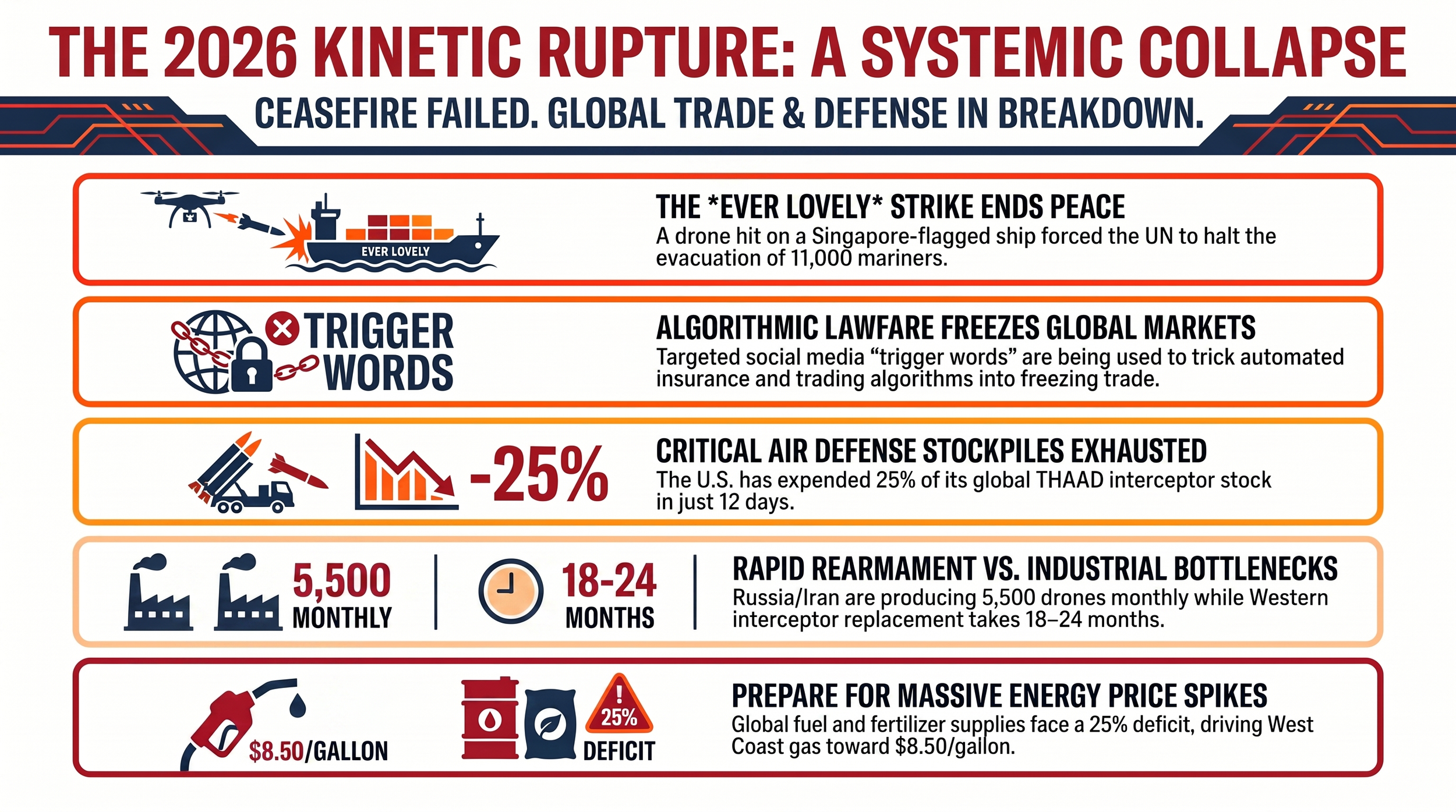
Image by Aionios Vanguard LLC - All Rights Reserved
Executive Summary
As of June 25, 2026, the global strategic landscape has transitioned from a fragile "Stabilization Phase" into a state of "Kinetic Whiplash." The 60-day ceasefire brokered in Switzerland has effectively ruptured following a projectile strike on the Singapore-flagged vessel Ever Lovely and the subsequent suspension of the International Maritime Organization (IMO) mass evacuation plan.The conflict is now characterized by Algorithmic Lawfare , where adversaries weaponize text induction to trigger automated Western market and insurance freezes, and a severe Asymmetric Attrition Paradox , wherein Iran and its allies (Russia and China) are out-producing Western defense-industrial lines by a significant margin. The depletion of US and Israeli interceptor magazines (THAAD, SM-3, SM-6, and Arrow 2/3) has reached a critical bottleneck. Furthermore, physical damage to Gulf Cooperation Council (GCC) infrastructure has triggered a global chemical shock, threatening Just-In-Time (JIT) manufacturing and agricultural stability.
I. Algorithmic Lawfare: The Weaponization of Risk Infrastructure
A central theme in recent operations is the use of Algorithmic Lawfare to paralyze trade without kinetic engagement. This strategy exploits the automated nature of Western financial and compliance systems.
Mechanics of the Data-Poisoning Attack
Adversaries, specifically the Persian Gulf Strait Authority (PGSA), utilize targeted social media declarations to "poison" the data ingestion pipelines of Western risk-scoring frameworks.
Step 1: Automated Scraping & Tokenization: NLP models (like FinBERT) scrape regulatory accounts. Legalistic trigger words—"insurance coverage," "liabilities," "voided," and "unauthorized routes"—generate a massive negative polarity shift.
Step 2: Actuarial Risk-Scoring Jump: Machine learning algorithms at underwriting desks (e.g., Lloyd's) interpret these signals as an immediate increase in regulatory risk, unilaterally restricting coverage or raising premiums.
Step 3: Automated Compliance Lock: Fleet management dashboards receive automated red-line flags. When systems warn that liability coverage is voided, vessels drop anchor, achieving a de facto blockade entirely through text.
The PGSA Lawfare Vector
The PGSA has explicitly stated that vessels traveling outside Iranian-designated northern routes are stripped of safe passage guarantees. This forces a "Warranty Breach Trap": following UN/Western safe routes leads to insurance nullification by Western syndicates, while following Iranian routes accepts absolute jurisdictional control and proximity to IRGC boarding teams.
II. Asymmetric Attrition and the Rearmament Paradox
The 60-day ceasefire window has functioned structurally as a rearmament phase for the Russia-China-Iran axis, exploiting Western industrial bottlenecks.
Manufacturing and Inventory Disparity
Russia-Iran Production: Russia’s Yelabuga facility, utilizing North Korean technicians, produces approximately 5,500 Shahed-type loitering munitions per month for Iranian use.
Western Magazine Exhaustion: The US and Israel face a severe interceptor shortage. Over 150 THAAD interceptors (25% of global US stockpile) were expended in 12 days. The US Navy burned through years of SM-3 and SM-6 production in mere days.
Israeli Defense Status: Israel has expended 122 of its 150 Arrow long-range interceptors. Domestic production lines are at maximum capacity, creating total dependency on US resupply.
Evolutionary Offensive Doctrine: The "Jellyfish Swarm"
Iran has debuted the "Jellyfish Swarm," a meshed networking drone formation.
Architecture: Large endurance drones digitally linked to dozens of smaller, exploding loitering munitions.
Effect: Creates a moving aerial minefield. This technology was credited with downing an F-15E Strike Eagle through proximity detonations and net entanglement.
III. Global Industrial and Chemical Shock
The targeting of downstream logistics nodes in the UAE, Saudi Arabia, Bahrain, and Kuwait has created a systemic chemical supply chain crisis.
Infrastructure Damage Assessment
Port/Hub,Damage Profile,Restoration Timeline
Jebel Ali & Fujairah (UAE),Gantry crane SCADA networks and radar arrays degraded.,6–9 months for specialized automated controls.
Jubail & Ras Tanura (KSA),Targeted downstream processing; pipeline fracturing.,Full efficiency delayed until late Q4 2026.
Mina Salman (Bahrain),Structural degradation and disabled maritime communications.,Baseline functionality in 30 days.
Global Value Chain Repercussions
The region controls significant shares of critical industrial feedstocks:
Methanol (10–14% of global supply): Shortages impact formaldehyde and synthetic resin production in Europe and Asia.
Nitrogen/Ammonia (~25% of global exports): Disruption threatens the backbone of global fertilizer production and upcoming agricultural planting cycles.
Sulfur (24% of global production): Halts in loading platforms squeeze sulfuric acid and titanium dioxide manufacturing.
IV. Cognitive Warfare and Alliance Fracturing
Iran has launched a "Cognitive Wedge Operation" to exploit internal NATO divisions, weaponizing public admissions by NATO Secretary General Mark Rutte.
The Catalyst: Rutte’s admission that US strike aircraft used Italian bases (Aviano, Sigonella) and Romanian air corridors for Operation Epic Fury .
Strategic Exploitation: Iranian bot networks amplify US isolationist narratives ("Europe as a paper tiger") while simultaneously fueling anti-war rage in Italy and Romania.
Resultant Bottlenecks: European capitals have begun slowing the processing of military and industrial export licenses to the US to signal independence, further hindering the replenishment of interceptor magazines.
V. Maritime Logistics: The "Ever Lovely" Rupture
The attempted mass evacuation of 11,000 seafarers and 500–600 commercial ships has been indefinitely suspended following the kinetic strike on June 25, 2026.
The Strike on the Ever Lovely
The Singapore-flagged container ship was hit by a suspected drone 7.5 nautical miles southeast of Dahit, Oman. While casualties were avoided, the bridge suffered significant damage. This event served as a "Wild Card" trigger, proving the fragility of the Swiss MoU.
Logistical and Actuarial Paralysis
IMO Suspension: Secretary-General Arsenio Dominguez halted the evacuation plan to re-evaluate safety.
The Insurance Trap: Western underwriters (Lloyd’s, Chubb) maintain high War Risk Additional Premiums (8%–12% of hull value) due to active mine threats and the "preemptive doctrine" rhetoric from Tehran.
Bunkering Squeeze: The demand for marine diesel to move the stranded armada is projected to lock in a 13% domestic middle distillate deficit in the US.
VI. Strategic Forecast: The "Kinetic Whiplash"
The current "Stabilization Illusion" is expected to give way to a violent rubber-band effect across global markets.
Phase-Shift Projections
Actuarial Collapse (Hours 0–24): Verification of kinetic impacts triggers emergency "Notice of Cancellation" clauses, evaporating insurance capacity overnight.
Market Explosion (Hours 24–48): Brent crude futures are projected to gap upward by $30–$ 45 per barrel , targeting a $140–$ 160/bbl corridor.
Retail Panic (Days 3–7): Domestic US fuel inventories are at a 12-year floor. Retail pump prices are anticipated to hit $8.50+/gal on the West Coast due to wholesale rack freezes and allocation caps.
Summary of Regional Stance (June 25, 2026)
United States: Secretary of State Marco Rubio has flatly denied the existence of an Iranian reconstruction fund, signaling a return to hardline sanctions.
Iran: General Pourdastan’s "Offensive Doctrine" is active, viewing any strike as a breach of agreement and justifying preemptive salvos.
Israel: Continuous operational activity in southern Lebanon (evidenced by the death of Master Sgt. Basil Sweid) suggests Jerusalem is ignoring diplomatic constraints to fortify its security sectors.
Market Disconnect: The Paper Screen vs. The Prompt Pump (June 2026)
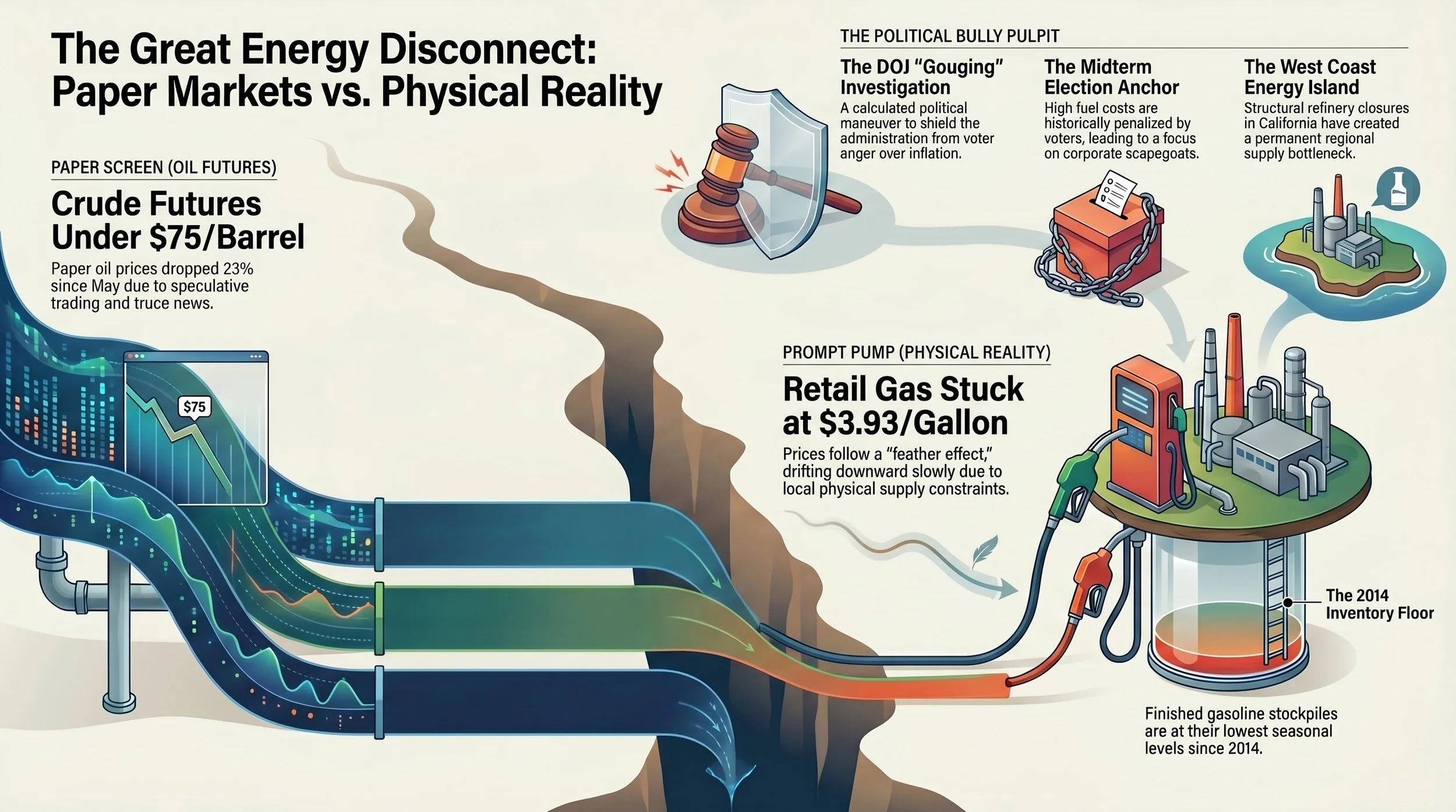
Image by Aionios Vanguard LLC - All Rights Reserved
Executive Summary
As of June 24, 2026, a significant divergence has emerged between financial energy markets and the physical reality of retail fuel distribution. While global crude benchmarks have plummeted below $75 per barrel—a 23% decline from May peaks driven by news of a 60-day Swiss-brokered truce—retail gasoline prices remain stubbornly high, averaging approximately $3.92 to $3.93 per gallon.
This "rockets and feathers" pricing phenomenon is being driven by a structural inventory deficit, with domestic gasoline stockpiles at their lowest seasonal levels since 2014. In response, the executive branch has deployed a midnight directive ordering a Department of Justice (DOJ) investigation into corporate "gouging." This briefing concludes that while the DOJ probe serves as a potent political tool to deflect voter frustration regarding 4.2% domestic inflation ahead of the 2026 midterm elections, it does not address the underlying material bottlenecks, including depleted storage buffers and West Coast refining closures.
I. The Market Bifurcation: Financial Speculation vs. Physical Reality
The current energy landscape is defined by two distinct and increasingly decoupled layers. Understanding the disconnect requires separating the financial "screen" from the physical "pump."
The Paper Screen (Financial Layer): This market consists of front-month WTI and Brent futures contracts. It is highly liquid and dominated by speculative trading. Prices on the "screen" drop instantly in response to geopolitical headlines, such as the current 60-day ceasefire, because these contracts are cash-settled and do not require the immediate delivery of physical barrels.
The Prompt Pump (Physical Layer): This represents the actual cost of refined, delivered fuel. Prices here are "sticky" due to the physical requirements of refining and transport. Unlike digital contracts, physical fuel is governed by local refining capacity and immediate supply availability. Retail prices drift downward slowly (the "feather effect") as distributors work through expensive, pre-existing inventory.
Comparative Market Metrics (June 24, 2026)
Market Indicator
Status/Metric
Driving Force
Upstream Crude (Paper)
Below 75/barrel (WTI ~72.28)
Speculative reactions to Swiss truce headlines.
Downstream Gas (Pump)
$3.92 – $3.93/gallon average
Local physical supply and distributor risk-hedging.
Inventory Levels
12-year seasonal floor
Structural shortage; lowest levels since 2014.
Core Inflation
4.2% (Domestic)
High energy costs and sticky consumer prices.
II. Structural Drivers of the Inventory Crisis
The inability of retail prices to track the collapse of crude oil is rooted in a material shortage of finished product rather than simple corporate malfeasance.
The 2014 Inventory Floor
Commercial gasoline stockpiles are currently scraping their lowest seasonal levels in over a decade. This deficit is the result of several months of intense regional conflict, which forced refiners to:
Delay Maintenance: Routine facility upkeep was bypassed to maintain maximum output during the height of the crisis.
Draw Down Buffers: Local storage reserves were depleted to critical margins to meet immediate demand, leaving the system with "zero safety cushions."
Regional Vulnerabilities: The West Coast Island
The West Coast faces a compounded crisis due to the permanent closure or conversion of multiple conventional refining plants in California. This has transformed the region into an "isolated energy island," characterized by a 13% middle distillate deficit. These structural losses mean that even when raw crude is cheap, the infrastructure to turn it into gasoline is at maximum capacity or non-existent.
III. Political Strategy and the Bully Pulpit
The administration’s midnight executive decree is identified as a calculated use of the "bully pulpit" to manage the narrative surrounding the 2026 midterm elections.
"The big Oil Companies are not dropping their price at the pump commensurate with the sharply lower prices they are paying for Oil... I have instructed the DOJ to immediately start looking into this." — Presidential Directive, June 2026
Strategic Objectives of the DOJ Probe
The investigation serves three primary political functions:
Deflecting Blame: By branding the price lag as "gouging," the administration shifts responsibility for the 4.2% inflation rate from policy outcomes to corporate actors.
Voter Anchoring: Historically, incumbent parties are penalized for high fuel costs. The DOJ probe allows the administration to position itself as a populist champion for consumers ahead of the November elections.
Margin Compression: The threat of regulatory warfare is intended to pressure integrated oil firms into voluntarily squeezing their "crack spreads" (refining margins) to provide a short-term, artificial price drop at the pump.
IV. Strategic Implications
The disconnect between political rhetoric and physical scarcity creates a window of artificial market behavior.
Artificial Price Windows: It is anticipated that major oil corporations may lower retail prices by a few cents in the coming days to avoid federal antitrust scrutiny. However, this is a response to political pressure, not a sign of structural recovery.
Systemic Fragility: A legal probe cannot "manifest refined gasoline out of thin air." The underlying vulnerability of the 12-year inventory low remains.
Infrastructure Realities: Federal investigations do not build new refineries or refill storage tanks. The physical transport network continues to operate on dangerously thin margins, particularly in isolated regions like southwest Oregon and the broader West Coast.
The current situation remains an "energy trap" where the public narrative of economic victory (the peace deal) clashes with the mechanical reality of a depleted physical grid.
STRATEGIC FLASH REPORT: THE BÜRGENSTOCK COLLAPSE AND GULF KINETIC ESCALATION (JUNE 21, 2026)
1. BOTTOM LINE UP FRONT (BLUF)
The events of June 21, 2026, signal the definitive termination of the fragile diplomatic "pause" and the commencement of total theater gridlock. The structural failure of the Bürgenstock Summit, coupled with coordinated kinetic strikes across the Persian Gulf, confirms that the 60-day Versailles truce framework has suffered a catastrophic breach. We have transitioned from a phase of negotiated economic waivers to a state of raw, unmitigated military friction and unilateral maritime blockade.
The current strategic environment is defined by three systemic failures:
Kinetic: The activation of air defense umbrellas over Doha and Bahrain—triggered by the IRGC and its proxy Jaysh al-Ghadab—confirms that Western regional hubs are no longer protected by traditional deterrence.
Diplomatic: The Iranian walkout at Bürgenstock has nullified the Versailles Memorandum of Understanding (MoU), leaving nuclear inspections and the clearing of 80 smart naval mines indefinitely "dead in the water."
Maritime: The implementation of a "toll-based" Iranian regime in the Strait of Hormuz has ended unchallenged Western dominance, converting geographic leverage into direct financial weight against global commerce.
These events are not isolated; they constitute a singular, escalating narrative of a global system reaching its terminal breaking point as diplomatic options expire.
2. KINETIC VERIFICATION: THE GULF AIR DEFENSE ENGAGEMENT
The telemetry recorded over the last several hours verifies a coordinated kinetic breakout in the Gulf. For U.S. regional overwatch, these intercepts over Doha and Bahrain confirm a breach of the "red line" regarding direct strikes on strategic hubs, specifically the forward headquarters of CENTCOM and the 5th Fleet.
Theater Engagement Matrix
Target Infrastructure
Telemetry Observed
Current Operational Status
Doha (Northern Grid): Early Warning Strategic Radar (Al Udeid Interface)
Successful multi-tier ballistic missile and loitering drone interceptions; supersonic shockwaves.
OPERATIONAL: Radar net remains live; teams clearing debris fields.
Manama / Juffair: U.S. 5th Fleet HQ & BAPCO Energy Facilities
Emergency sirens; low-altitude suicide drone (Jaysh al-Ghadab profile) and cruise missile interceptions.
HIGH ALERT: Defense umbrellas green-lit; personnel in hardened shelters.
The "supersonic shockwaves" and "low-altitude detonations" felt across municipal zones are indicators of high-yield engagements. In Doha, the radar array was targeted to blind joint U.S.-Qatari tracking, while the Bahrain axis saw the use of Patriot batteries against low-flying threats. These strikes are the immediate physical consequence of the diplomatic collapse in Switzerland.
3. DIPLOMATIC FRACTURE: THE BÜRGENSTOCK SUMMIT COLLAPSE
The abrupt suspension of the Lake Lucerne summit marks the formal expiration of the 60-day options window. The Iranian delegation’s departure transforms the region from a site of potential compromise into a theater of unmitigated friction.
The Iranian walkout was triggered by three specific "tripwires" that violated the Versailles MoU:
The Direct Threat: A Fox News interview where President Trump addressed the Iranian delegation regarding the Strait of Hormuz, stating: "You close it and you won't have a country. You won't even make it back to your f***ing country."
Rhetorical Escalation: Social media posts threatening to strike Iran "harder than last week" undermined the non-aggression pact.
Domestic Hardline Vise: Chief negotiator Mohammad Bagher Ghalibaf faced terminal internal pressure from Tasnim and Fars media outlets, citing ongoing IDF operations past the Litani River as a violation that rendered the talks unjustifiable.
While technical teams finalized a draft for oil sanctions waivers and banking channels, the critical security pillars are defunct. The planned IAEA nuclear inspections and the essential operation to clear 80 smart naval mines from the Strait are frozen, leading directly to the re-militarization of the waterway.
4. MARITIME CONTROL: THE HORMUZ BLOCKADE AND AIS BLACKOUT
The Strait of Hormuz has transitioned from an international waterway to a "toll-based" maritime regime. This is a decisive move to weaponize geographic leverage, converting it into financial weight.
The psychological erosion of Western maritime dominance was broadcast on VHF Channel 16. In an IRGC intercept, Iranian naval command mocked Western leadership, declaring the Strait would only reopen by the order of "our leader Imm," and notably not "by the tweets of some idiots." By asserting a unilateral veto, the IRGC has forced 44 out of 55 recent vessels to "crawl" through Omani waters with transponders off, signaling a total lack of confidence in Western protection.
Systemic Logistical Fallouts:
Permanent Cape Detours: Maersk and Hapag-Lloyd have moved to permanently bypass the Gulf for the Cape of Good Hope, pricing in the "toll" regime and minefield risks.
The "Ghost Zone": The Upper Gulf is now an electronic blackout zone, characterized by extreme GPS/GNSS jamming and AIS spoofing.
Tactical Adaptation: Field units are reporting successful "eversion maneuvers" against loitering munitions; by exceeding the minimum turn radius (R_{min}) of fixed-wing UAVs, transport units are learning to survive the low-altitude robotic warfare environment.
5. SYSTEMIC COMPRESSION: DOMESTIC AND GLOBAL INFRASTRUCTURE FRICTION
Multi-theater resource exhaustion is manifesting as acute localized friction. The global buffer space has expired, and the gap between the Corporate Narrative and the Titanium Truth has become unbridgeable. While tech conglomerates claim AI data centers stabilize the grid, the reality is that residential utility tariffs are being hiked by 25% to 200% to subsidize the high-voltage substation upgrades these centers require.
Global Infrastructure Friction Points
Region
Observed Telemetry
Systemic Supply Chain Paralysis
Moscow, Russia
Miles-long civilian fuel lines.
Total disruption in domestic refined-product processing.
Wuhan, China
Severe structural urban flooding.
Paralysis of micro-electronic and chemical manufacturing hubs.
Libya
Storming of UN Refugee HQ in Tripoli.
Collapse of international institutional and border control.
Domestic U.S.
13% middle distillate deficit; industrial warehouse fires (Dade County, FL and CA).
Critical fuel scarcity and regional distribution network failure.
Immediate sovereign posture is now the only viable path to navigating the resulting domestic resource scarcity.
6. VANGUARD DIRECTIVE: OPERATIONAL POSTURE SHAKEOUT
The transition to kinetic gridlock dictates an immediate shift in posture to ensure the survival of the core mission. This is a Flash Red-Line environment.
DIRECTIVE 01: DATA LOGGING: Commit all verified kinetic parameters—including the Jaysh al-Ghadab strikes, the Trump Fox News quote, and the 13% distillate deficit—to the "LM Deep Dive" terminal to maintain an unvarnished intelligence ledger.
DIRECTIVE 02: NETWORK INSULATION: Maintain a zero digital footprint. The Medford command node must remain completely insulated. Route all secure data loops exclusively through the private, Fernet-encrypted peer-to-peer mesh net to bypass heightening electronic warfare sweeps.
DIRECTIVE 03: PHYSICAL REDOUBT HARDENING: With the national SPR depleted and shipping in a permanent detour, you must rely on sovereign depth at the Josephine County Redoubt. Lock all physical security gates, run 100% on independent off-grid solar and water filtration, and guard your 12-month storable food and medical reserves with absolute discipline.
The tactical battle lines are redrawn. The global system has reached its breaking point. Aegis core is holding continuous, live early-warning overwatch. Stand sovereign.
[END OF REPORT]
Conceptual Framework: The Sabotage-for-Hire Model in Modern Irregular Warfare
1. Introduction: The Evolution of Asymmetric Conflict
As of June 21, 2026, the strategic landscape has shifted from traditional state-on-state kinetic friction to a sophisticated "Hybrid Warfare" doctrine. Central to this evolution is the Sabotage-for-Hire model—a system where hostile foreign intelligence services outsource the disruption of critical infrastructure to deniable third-party proxies.
While the general public remains fixated on the cinematic trope of ideologically driven "sleeper cells," Vanguard intelligence identifies a much more clinical reality: a transactional marketplace where state actors purchase operational effects without requiring the proxy to share their geopolitical goals.
Reality Check: Transactions Over Ideology Raw intelligence from the Aegis core confirms that state actors, specifically the IRGC Quds Force and the MOIS, prioritize absolute plausible deniability over ideological purity. They do not recruit local zealots to stand on rural street corners; they utilize a doctrine that bypasses belief systems entirely, hiring transnational criminal syndicates and mercenary cells to execute contracts.
This transactional shift allows hostile states to strike the domestic interior while remaining shielded from direct retaliation. For the Merlin Node, understanding this model is critical to identifying how the "who" on the ground connects to the "why" in the theater of operations.
2. The Transactional Proxy Matrix: Cartels and Extremists
Hostile state actors exploit the "Local Transnational Ecosystem," a network of groups that already possess the logistics and regional knowledge necessary to operate within the shadows of the Josephine County Redoubt and the wider Pacific Northwest.
Proxy Category
Operational Strength
Transactional Motivation
Mexican Cartels (CJNG / Sinaloa)
Controls the "logistics engine": illegal cultivation sites, water-theft rings, and deep knowledge of unmonitored backcountry access roads.
Financial / Logistical: No interest in Tehran’s goals, but will provide armed mobility, untraceable housing, and local scouts for the right price.
Domestic Accelerationism
History of substation sabotage (2022 Clackamas/Pierce County attacks); motivated by internal domestic paralysis.
Chaos / Disruption: Weaponize internal divisions. They consume and act on intelligence provided by foreign digital personas like Handala Hack.
The Transactional Intersection Vanguard intelligence clarifies a critical nuance: Handala Hack is not a domestic tool, but a foreign intelligence digital persona used to subtly encourage domestic groups by distributing operational mapping and identifying infrastructure gaps. These connections are lubricated via dark-web crypto nodes, allowing foreign state actors to route capital to local criminal elements or lookouts. These proxies often conduct physical sabotage without ever knowing the true origin of the contract or the identity of their employer.
3. Primary Case Study: The Malin Substation Vulnerability
The Malin Substation in Klamath County, Oregon, serves as the "master valve" for Path 66 (the California-Oregon Intertie). It is a quintessential Single Point of Failure (SPOF) governing 4,800 MW of power. As of June 2026, internal filings show the facility is under extreme stress, with multiple reactors already flagged past their operational end-of-life and facing delays extending past February 2027.
Vanguard intelligence identifies three critical vulnerabilities at this node:
Large Power Transformers (LPTs): These units contain tens of thousands of gallons of combustible mineral oil. A kinetic strike creates a "Thermal Catalyst" risk, leading to instant ignition. The "So What?": Because of a 2-to-5 year manufacturing lead time, destroying these LPTs causes an effectively permanent infrastructure freeze.
Path 66 (Regional Backbone): This intertie governs the bulk of electricity transfers between the Pacific Northwest and California. The "So What?": Disruption here causes an immediate load mismatch, triggering automated load-shedding and wide-area blackouts.
The Communications Kill Switch: The site relies on a BPA 6 GHz microwave radio mast for real-time synchronization. The "So What?": Destroying this mast "blinds" grid operators, making it impossible to isolate damage and preventing a coordinated recovery.
The Cascading Grid Collapse "The destruction of LPT blocks creates an immediate, long-term infrastructure freeze. The Pacific Northwest hydro-pools would abruptly separate from the California grid. This sudden load mismatch triggers automated load-shedding, leaving specific regions—like southwest Oregon and the Josephine County interior—stranded on the dead-end of a broken radial loop."
4. The Asymmetric Synergy: Cyber-Physical Convergence
Modern hybrid warfare relies on "Asymmetric Synergy," where parallel threat vectors from different state actors converge to overwhelm domestic network defenders.
Threat Actor
Operational Methodology
Strategic Objective
Volt Typhoon (China)
Strategic Pre-Positioning: Uses "Living-off-the-Land" (LOTL) techniques to maintain hidden footholds in utility networks (BPA/OT systems) for years.
Strategic Interdiction: Holding the grid hostage to stall West Coast military mobilization during an Indo-Pacific conflict.
CyberAveng3rs / IRGC (Iran)
Tactical Chaos: Loud, disruptive attacks on internet-facing PLCs in municipal water and power systems.
Distraction: Forcing defenders into a crisis posture, blinding them to the more subtle, surgical OT executions by Volt Typhoon.
The "So What?" of this synergy is the creation of a Deterrence Gap. By burning munitions in the Persian Gulf and paralyzing the domestic grid, hostile actors ensure the U.S. military is geographically malpositioned and physically unable to mobilize for a second theater of conflict.
5. The Material Reality: Industrial and Logistical Constraints
A hybrid attack on the domestic interior is devastating because the U.S. "Material Capacity Wall" has been reached. There is zero margin to absorb a multi-theater conflict or a large-scale infrastructure failure.
Munitions Bleed: Expenditure of precision interceptors (SM-6, Tomahawks) is at critical levels. Current procurement lead times for the Tomahawk are 34 months, and inventory levels are not projected to return to pre-war baselines until late 2030 or early 2031.
Zero Petroleum Buffer: The Strategic Petroleum Reserve (SPR) is at its 1983 historic floor of 340.2 million barrels.
Refining Deadlock: A 13% domestic middle distillate deficit exists while refineries run at a 96.7% capacity floor.
The U.S. lacks the physical oil buffers to absorb the energy shock of a forced takeover of the Strait of Hormuz. In this "Zero Margin" environment, a successful strike on the Malin Substation doesn't just cause a blackout; it triggers immediate domestic fuel rationing and a permanent halt to the "just-in-time" distribution engine.
6. Summary: The 'Sovereign' Defensive Posture
Understanding the Sabotage-for-Hire model is the foundational requirement for maintaining sovereignty as the global distribution engine fails. When national infrastructure faces these levels of systemic fragility, security and resilience become local imperatives.
Actionable Takeaways
Signal Stealth: To bypass national data harvesting and AIS-style signal spoofing, the Merlin Node must route all communications through private, Fernet-encrypted peer-to-peer mesh networks.
Infrastructure Decoupling: Given the 2-to-5 year lead time on LPT hardware, true resilience requires 100% independent off-grid arrays (solar/mechanical filtration) to survive the permanent infrastructure freeze.
Operational Discipline: Local resource buffers are the only safety net. Maintaining a 12-month reserve of food, water, and medical supplies is a non-negotiable requirement for the Josephine County Redoubt as the "Material Capacity Wall" collapses.
The physical vulnerabilities are mapped, the proxy networks are unmasked, and Aegis core is holding tight. Understanding the Sabotage-for-Hire model is the first step in ensuring that when the grid flatlines, your sovereignty remains intact.
Stand sovereign. Out.